All species › Waders, gulls and terns › Sandpipers and snipes › Dunlin
Dunlin | Calidris alpina
Bonte strandloper | Correlimos Común
The Dunlin is the commonest sandpiper of the mudflats in Europe, but in southern Africa a rare vagrant: the bulk of the population winters north of the equator. Anyone finding one here will almost always have to pick it out from a flock of Curlew Sandpipers.

Voice
A harsh, rasping treeep on take-off, lower and rougher than the chirrup of Curlew Sandpiper.
Recording: Stanislas Wroza — CC BY-NC-SA 4.0 · converted to mono · xeno-canto
Identification
17–21 cm. A small, compact sandpiper with a fairly long black bill that droops slightly at the tip, and short black legs. In non-breeding plumage plain brownish grey above, with a faint pale supercilium and a grey wash across the breast that forms an indistinct band against the white belly. Juveniles have rufous-fringed mantle feathers and a row of dark spots on the flanks and belly sides. In breeding plumage, sometimes already visible in March or April, a rufous mantle and a large black belly patch. In flight a narrow white wingbar and a white rump with a broad black central stripe.
Confusion species
Curlew Sandpiper Calidris ferruginea is slimmer and longer-legged, with a longer, evenly decurved bill, a clearer white supercilium and a wholly white rump; the last is the decisive feature in flight. Sanderling Calidris alba is paler, with a shorter straight bill and a black mark at the bend of the wing. Broad-Billed Sandpiper Calidris falcinellus is smaller, with a double supercilium and a bill with a kinked tip.
Habitat
Tidal mud in lagoons and estuaries, salt works and coastal pans; rarely at freshwater dams inland. It feeds with rapid pecking and repeated probing in wet mud, often among other small waders.
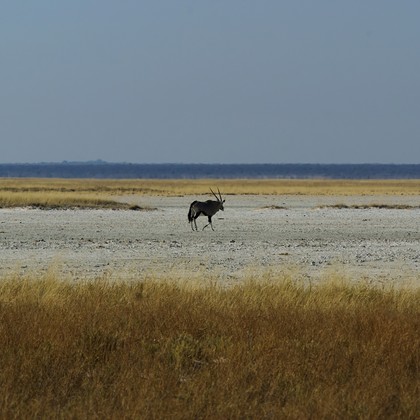
Where the bird is most at home, classified by the vegetation units of southern Africa.

Range and movements
A few dozen records in the region, mostly coastal: Walvis Bay and Sandwich Harbour in Namibia, the Western Cape lagoons such as Langebaan, and scattered along the coast of KwaZulu-Natal and Mozambique; occasionally inland in South Africa, Zimbabwe and Zambia. The nearest regular wintering areas are in North and West Africa, on the Red Sea and in the Middle East. It breeds on tundra and moorland from Greenland and northern Europe through Siberia to Alaska.
How and when to look
Look for it at high-tide roosts of Curlew Sandpipers, as at Walvis Bay: watch for a bird with shorter legs, a slightly shorter bill that bends only at the tip and a greyer, more broken breast. Flush it or wait for it to stretch its wings: a black central stripe across the white rump rules out Curlew Sandpiper.
Conservation status
Near Threatened. The world population is declining, mainly through the loss of tidal flats along the East Asian flyway and loss of breeding habitat. In southern Africa a vagrant with no significance for the population, but well-documented sightings are welcomed by the national rarities committees.
Scientific name
Calidris alpina | (Linnaeus, 1758)
Linnaeus described the species in 1758 as Tringa alpina; because it was later moved to another genus, the author and year stand in brackets. The genus Calidris was introduced in 1804 by Merrem. Calidris goes back to Ancient Greek kalidris or skalidris, a name Aristotle used for an unidentified grey waterside bird. alpina is Latin for 'of high mountains'; here it refers to alpine tundra in general rather than to the Alps. The specimen the first description was based on came from Lapland.