All species › Pigeons and doves › Pigeons and doves › Eastern Bronze-Naped Pigeon
Eastern Bronze-Naped Pigeon | Columba delegorguei
Delegorgues duif | Paloma de Delegorgue
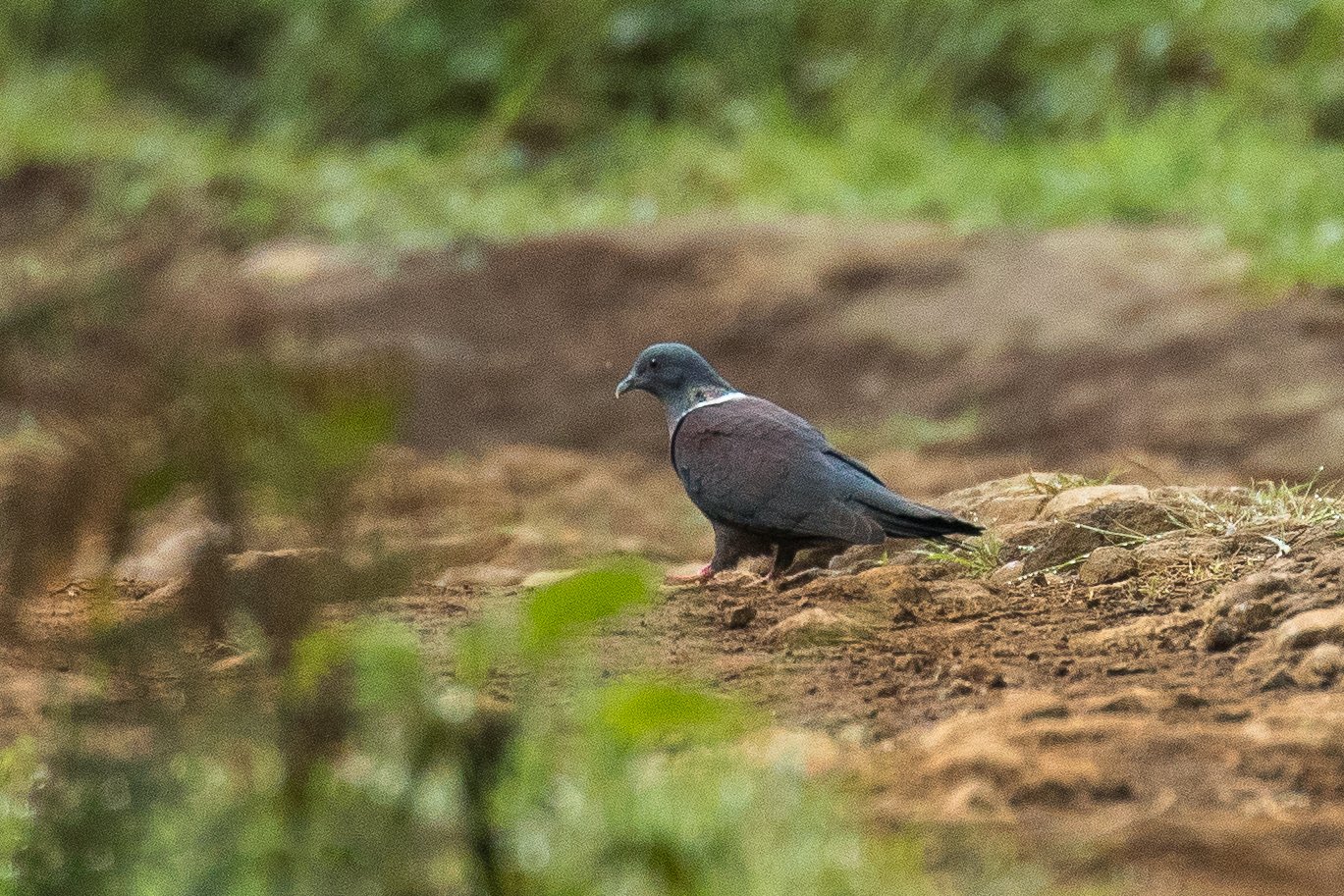
The Eastern Bronze-Naped Pigeon is a small, dark canopy pigeon of eastern forests that spends most of its time in the treetops and is easily overlooked. The male has a pale nape band above a glossy bronze and purple hindneck.
Voice
A series of six to ten hollow cooing notes that start loud and slow, then accelerate and fade away, hoo-hoo-hoo-hoo-hoohoohoo, from high in the canopy. The call often betrays the bird long before it is seen.
Recording: Oliver Fowler — CC BY-NC-SA 4.0 · converted to mono · xeno-canto
Identification
About 29 cm, compact and dark. The male is slate grey, dark grey on head and breast, with a glossy bronze, green and purple patch on the hindneck topped by a narrow pale grey to whitish nape band. Mantle and wings are dark with a purple gloss, the tail blackish. The female has a rufous to chestnut crown, nape and face, lacks the pale nape band and shows less extensive iridescence. Both sexes have a dark bill with a paler tip, a reddish eye and reddish-purple legs. Juveniles are browner, with rufous feather fringes.
Confusion species
African Olive Pigeon (Columba arquatrix) is clearly larger, wine red with white spots, with a yellow bill, yellow legs and a yellow eye ring. Red-Eyed Dove (Streptopelia semitorquata) is paler, with a pink head, a black collar and a pale grey tail band, and more often sits at forest edges. African Green Pigeon (Treron calvus) is green. The male's pale nape band and the female's rufous head are distinctive in eastern forest.
Habitat
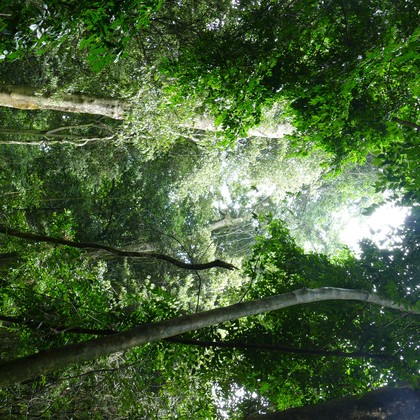
Tall, moist indigenous forest: montane and mistbelt forest, lowland and coastal forest, and riverine forest in adjoining areas. It feeds in the canopy on small fruits and berries, especially figs, and follows the fruit supply, sometimes in small groups. It rarely comes to the ground.
Where the bird is most at home, classified by the vegetation units of southern Africa.

Range and movements
Within the region confined to the eastern forests: Pondoland in the Eastern Cape and KwaZulu-Natal (particularly Zululand), locally Mpumalanga, the eastern highlands of Zimbabwe, the montane and lowland forests of Mozambique and the Malawi highlands. Outside the breeding season it wanders along the coast and between forest blocks. Beyond the region it occurs in Tanzania, Kenya, Uganda, South Sudan and eastern DR Congo.
- Resident
- Summer visitor (c. Oct–Mar)
- Winter visitor (c. Apr–Sep)
- Passage (Mar–Apr, Oct–Nov)
- dark = core range, pale = thinly spread
How and when to look
Dlinza and Ngoye in Zululand, the Vumba and Haroni-Rusitu forests in Zimbabwe and the Mulanje massif in Malawi. Listen for the accelerating series of coos and then patiently scan the canopy, preferably from a canopy walkway or near a fruiting fig. All year, with movements depending on fruit supply.
Conservation status
Not globally threatened. In South Africa the species is scarce because of its small, fragmented habitat and is included on the regional Red List. Logging and fragmentation of indigenous forest are the main threats.
Scientific name
Columba delegorguei | Delegorgue, 1847
Delegorgue described the species in 1847 and placed it straight away in the genus where it still stands. The genus Columba was introduced in 1758 by Linnaeus. Columba is the Latin word for 'dove, pigeon'. delegorguei honours the French explorer and hunter Adulphe Delegorgue (1814–1850), who collected in Natal. The specimen the first description was based on came from Durban, South Africa.