All species › Sandgrouse › Sandgrouse › Burchell's Sandgrouse
Burchell's Sandgrouse | Pterocles burchelli
Bont zandhoen | Ganga Goteada
Burchell's Sandgrouse is the sandgrouse of the red Kalahari sands: warm cinnamon and covered in white droplet spots. Flocks come to water in mid-morning with soft, chuckling calls.

Voice
A soft, chuckling chup-chup or chok-chok, often repeated in flight and then somewhat higher and faster. It carries less far than the call of the Namaqua Sandgrouse.
Recording: Lynette Rudman — CC BY-NC-SA 4.0 · converted to mono · xeno-canto
Identification
About 24 to 26 cm long and around 180 grams in weight; compact, with a short, rounded tail. The whole plumage is warm cinnamon to rufous-brown, sprinkled with large white, black-edged spots, coarser on the upperparts and wings than on the breast. The male has a blue-grey face and grey throat; the female has a buff face and throat and is slightly duller and more finely spotted. The belly is barred cinnamon and white. In flight the spotted underparts and rounded tail are easy to see.
Confusion species
Double-Banded Sandgrouse (Pterocles bicinctus) also has a rounded tail, but the male has a black-and-white forehead pattern and a black-and-white barred belly, and it drinks at dusk. Namaqua Sandgrouse (Pterocles namaqua) has a long pin tail and lacks the white droplet spots on breast and belly. Yellow-Throated Sandgrouse (Pterocles gutturalis) is much larger, with a yellow throat and black collar.
Habitat
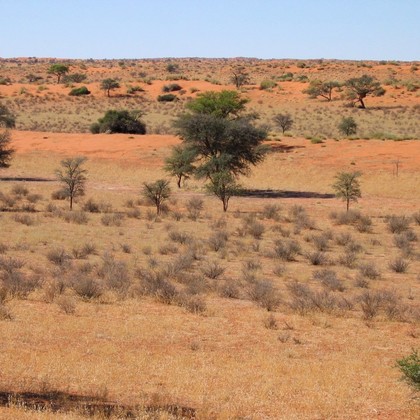
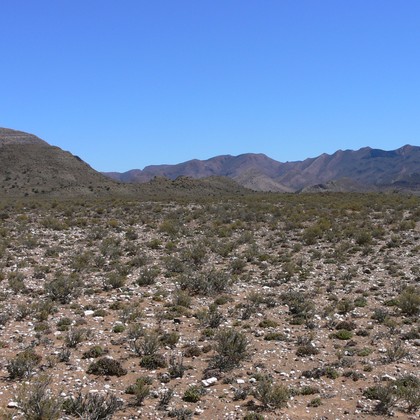
Kalahari thornveld and open savanna on red sand, with scattered grasses, shrubs and trees, and the edges of pans; locally also in dry, open parts of the Nama Karoo. It feeds on small seeds of herbs and legumes and nests in a scrape on bare ground.
Where the bird is most at home, classified by the vegetation units of southern Africa.
Range and movements
An endemic of the arid interior of southern Africa: most of Botswana except the north, eastern and central Namibia, the Kalahari in the Northern Cape and western North West Province in South Africa, with extensions to the far west of Zimbabwe and southern Angola. Its stronghold is the Kalahari.
- Resident
- Winter visitor (c. Apr–Sep)
- Passage (Mar–Apr, Oct–Nov)
- dark = core range, pale = thinly spread
How and when to look
The Kgalagadi Transfrontier Park is the best place: sit at a waterhole in the Auob or Nossob riverbeds two to four hours after sunrise, where Burchell's often drinks alongside Namaqua Sandgrouse. Look for the smaller, warmly coloured, round-tailed birds among the pin tails. In good light the white droplets on the cinnamon plumage are unmistakable.
Conservation status
Not threatened. The species has a restricted but large and little-disturbed range and is locally common. Artificial waterholes have benefited it. Overgrazing and prolonged drought can cause local fluctuations but are not a major threat.
Scientific name
Pterocles burchelli | Sclater, 1922
Sclater described the species in 1922 and placed it straight away in the genus where it still stands. The genus Pterocles was introduced in 1815 by Temminck. Pterocles comes from the Greek pteron, 'wing', and -kles, 'fame' — 'famed for its wings', for the fast, sustained flight with which sandgrouse travel kilometres to waterholes every day. burchelli honours the English naturalist William John Burchell (1781–1863), who travelled in the interior of southern Africa from 1810 to 1815. The specimen the first description was based on came from Unknown (not given in the sources).