All species › Sandgrouse › Sandgrouse › Double-Banded Sandgrouse
Double-Banded Sandgrouse | Pterocles bicinctus
Dubbelbandzandhoen | Ganga Bicinta
The Double-Banded Sandgrouse is the sandgrouse of the bushveld, sitting unseen among the leaf litter by day and only coming to water in small groups after sunset. The male sports a striking black-and-white forehead pattern.

Voice
A soft, whistled chwee-chee-chee and in flight a series of chirping notes, something like wee-chee-choo-chip-chip. At the waterhole soft cooing and cackling can also be heard.
Recording: Yoann Blanchon — CC BY-NC-SA 4.0 · converted to mono · xeno-canto
Identification
About 24 to 26 cm long and around 240 grams in weight; compact, with a short, rounded tail. The male has a white forehead with a black band behind it and a black-and-white pattern above the eye, a plain buff breast bordered below by a narrow white and a black band, and a finely black-and-white barred belly. The upperparts are sandy brown with fine barring and pale spots. The female lacks the head and breast pattern and is densely barred black and buff all over. Juveniles resemble the female.
Confusion species
Namaqua Sandgrouse (Pterocles namaqua) has a long pin tail, a dark belly and a white and chestnut breast band, and drinks in the morning. Burchell's Sandgrouse (Pterocles burchelli) also has a rounded tail but is cinnamon with large white spots and also drinks in the morning. Yellow-Throated Sandgrouse (Pterocles gutturalis) is much larger, with a yellow throat and black collar. The male's forehead pattern and drinking at dusk are diagnostic.
Habitat
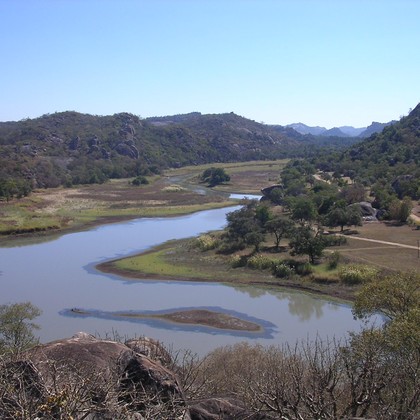
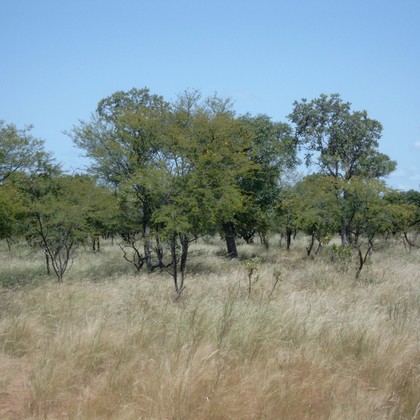
Mopane, mixed broadleaf woodland and acacia savanna with open undergrowth and bare patches, often on stony or sandy ground; it avoids both dense woodland and open plains. It feeds on seeds and nests in a scrape, often in the shade of a shrub or grass tuft.
Where the bird is most at home, classified by the vegetation units of southern Africa.

Range and movements
Largely confined to southern Africa: northern and central Namibia, most of Botswana, Zimbabwe, southern Zambia, southern Mozambique and north-eastern South Africa (Limpopo, the Mpumalanga lowveld including Kruger, and North West). Beyond the region it reaches only south-western Angola. It is virtually a regional endemic.
- Resident
- Summer visitor (c. Oct–Mar)
- Winter visitor (c. Apr–Sep)
- Passage (Mar–Apr, Oct–Nov)
- dark = core range, pale = thinly spread
How and when to look
Sit at a waterhole at dusk, for example in Kruger, Hwange or Etosha: the small groups arrive just after sunset, often with soft whistling calls. A spotlight or torch is sometimes needed to see them well. By day you usually only come across them when they flush right in front of the vehicle on a bushveld track.
Conservation status
Not threatened. The species is common and widespread in woodland, and locally benefits from artificial waterholes. Outside protected areas it is hunted, and conversion of woodland to farmland removes habitat, but no clear decline has been detected.
Scientific name
Pterocles bicinctus | Temminck, 1815
Temminck described the species in 1815 and placed it straight away in the genus where it still stands. He introduced the genus Pterocles in that same work. Pterocles comes from the Greek pteron, 'wing', and -kles, 'fame' — 'famed for its wings', for the fast, sustained flight with which sandgrouse travel kilometres to waterholes every day. bicinctus is Latin for 'two-banded' — for the male's black and white breast bands. The specimen the first description was based on came from Fish River, Great Namaqualand, Namibia.