All species › Sandgrouse › Sandgrouse › Yellow-Throated Sandgrouse
Yellow-Throated Sandgrouse | Pterocles gutturalis
Geelkeelzandhoen | Ganga Gorgigualda
The Yellow-Throated Sandgrouse is the largest and heaviest sandgrouse in southern Africa, a bird of bare, short-grass plains near floodplains. Flocks fly to water in mid-morning with deep, guttural calls.
Voice
A deep, hoarse, guttural aw-aw or ipi-ipi, mainly in flight; it sounds lower and harsher than the calls of the other sandgrouse. Flocks coming to water are often heard from afar.
Recording: Bernard BOUSQUET — CC BY-NC-SA 4.0 · converted to mono · xeno-canto
Identification
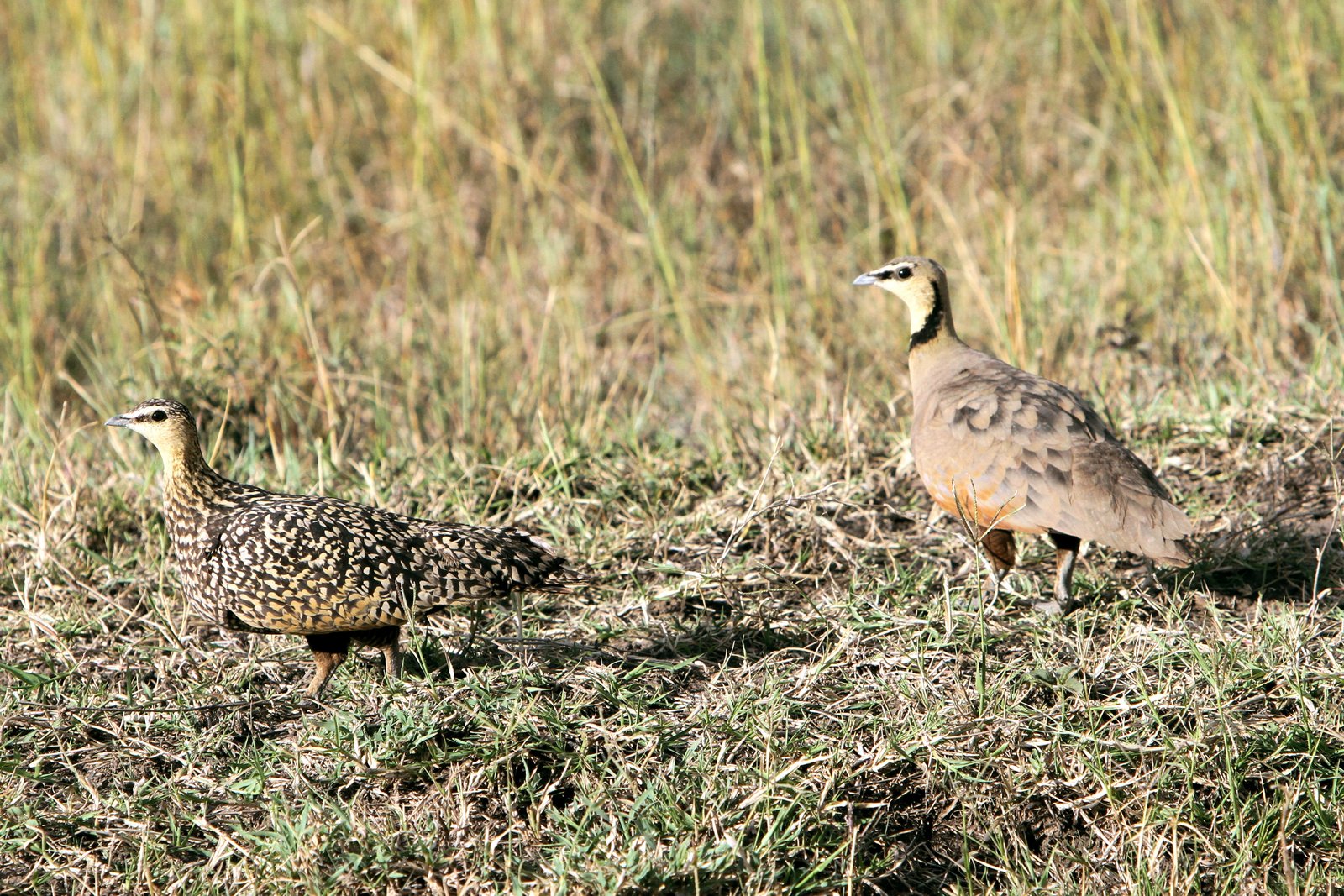
About 29 to 32 cm long and some 340 grams in weight; stocky, with a short, slightly pointed tail. The male has a plain pale yellow throat and face, sharply set off by a broad black collar; breast greyish sandy, the belly deep chestnut-black. The upperparts are grey-brown with large yellow and brown spots on the wing coverts. The female also has a yellow throat but no collar; the rest of the plumage is densely spotted and streaked sandy brown, the belly barred dark. In flight the dark underwings and dark belly stand out against the pale breast.
Confusion species
Namaqua Sandgrouse (Pterocles namaqua) is clearly smaller, has a long pin tail and in the male a white and chestnut breast band instead of a black collar. Double-Banded Sandgrouse (Pterocles bicinctus) and Burchell's Sandgrouse (Pterocles burchelli) are smaller, have rounded tails and lack the yellow throat with black collar. Size, heavy build and dark belly make Yellow-throated easy to recognise in flight too.
Habitat
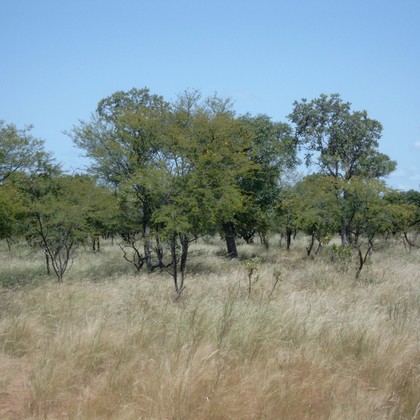
Short, open grassy plains on moist clay soils, especially along seasonal rivers, vleis and floodplains, and around salt pans; also on fallow and cultivated land. It feeds on grass and herb seeds and nests in a shallow scrape on bare ground, mainly in the dry winter months.
Where the bird is most at home, classified by the vegetation units of southern Africa.

Range and movements
Mainly in northern Botswana (Okavango, Makgadikgadi, Nxai Pan and Chobe), north-eastern Namibia, western Zimbabwe and southern Zambia, where the Kafue Flats and the plains of western Zambia form a dry-season breeding area. A small, declining population lives in south-western Limpopo and north-eastern North West in South Africa. Beyond the region a separate subspecies occurs in East Africa, from Ethiopia to Tanzania.
- Resident
- dark = core range, pale = thinly spread
How and when to look
Search the Makgadikgadi pans, Nxai Pan or the Kafue Flats and settle at a waterhole in mid-morning, roughly two to three hours after sunrise. Listen for the low calls, which announce the flocks from far away. On the ground the bird is hard to find despite its size because of its cryptic plumage; drive slowly across the plains and watch for moving silhouettes.
Conservation status
Not threatened. The species is spread over a large area and locally numerous. In South Africa, however, the small peripheral population is vulnerable and regionally listed as of concern, owing to conversion of grassland to farmland and disturbance. Management of floodplains, such as water regulation on the Kafue Flats, affects the breeding areas.
Scientific name
Pterocles gutturalis | Smith, 1836
Smith described the species in 1836 and placed it straight away in the genus where it still stands. The genus Pterocles was introduced in 1815 by Temminck. Pterocles comes from the Greek pteron, 'wing', and -kles, 'fame' — 'famed for its wings', for the fast, sustained flight with which sandgrouse travel kilometres to waterholes every day. gutturalis comes from the Latin guttur, 'throat' — for the yellow throat with its black collar. The specimen the first description was based on came from Near Kurrichane (Zeerust area), North West, South Africa.