All species › Sandgrouse › Sandgrouse › Namaqua Sandgrouse
Namaqua Sandgrouse | Pterocles namaqua
Namakwazandhoen | Ganga de Namaqua
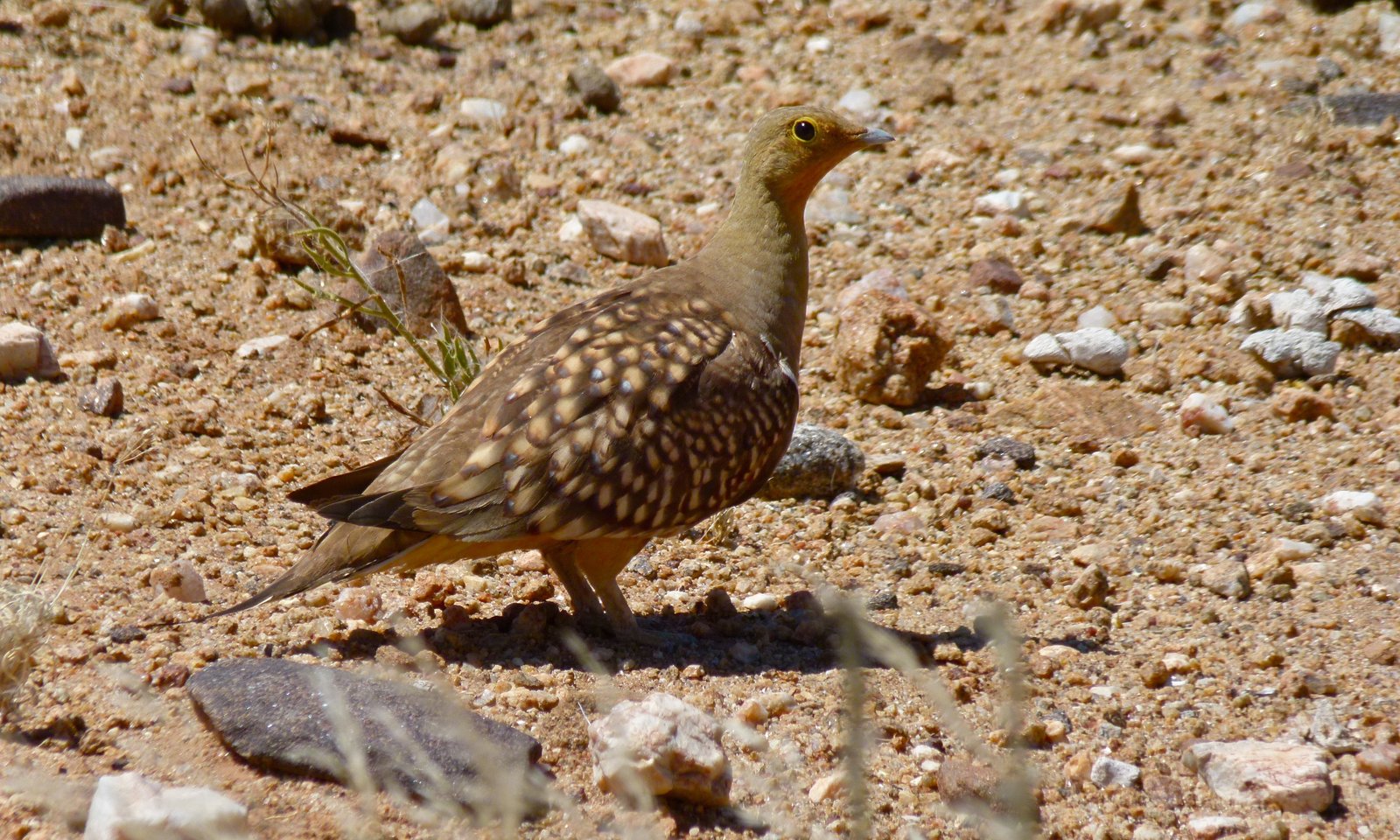
The Namaqua Sandgrouse is the pigeon-like desert bird with a pointed, pin-tipped tail that flies in flocks for tens of kilometres to water each morning. There the male soaks his belly feathers and carries the water back to the chicks.
Voice
A nasal, far-carrying kelkiewyn or chanta-goo, repeated in flight as flocks approach water. The birds are usually heard well before they come into view. On the ground they are silent.
Recording: Ehren Eksteen — CC BY-NC-SA 4.0 · converted to mono · xeno-canto
Identification
About 24 to 28 cm long including the elongated central tail feathers, and 150 to 200 grams in weight. The plumage is sandy brown and cryptic, the back marked with large cream spots. The male has a buff-yellow head and throat and below it a sharp white and chestnut double band across the lower breast, with a dark brown belly beneath. Female and juveniles are closely streaked and barred sandy all over, without a breast band. Flight is fast and direct on pointed wings, with short rapid beats.
Confusion species
Double-Banded Sandgrouse (Pterocles bicinctus) has a rounded tail, a black-and-white forehead pattern in the male and a barred belly, and it drinks at dusk rather than in the morning. Burchell's Sandgrouse (Pterocles burchelli) also has a rounded tail, is spotted white all over and cinnamon below. The pin tail, the male's plain dark belly and the morning drinking flights mark out the Namaqua.
Habitat
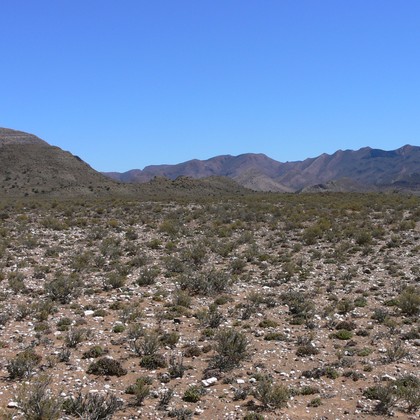
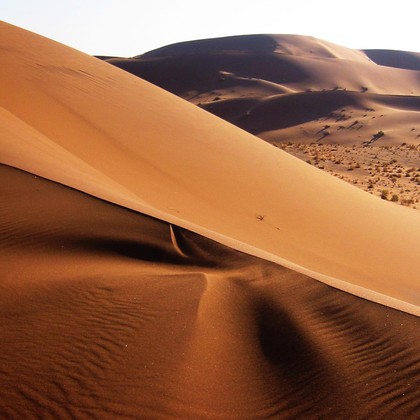
Arid Karoo, Kalahari sandveld, the gravel plains of the Namib, semi-desert scrub and sparse grassland. The diet consists almost entirely of small hard seeds picked from the ground; it nests in a bare scrape on open ground.
Where the bird is most at home, classified by the vegetation units of southern Africa.
Range and movements
The drier western half of southern Africa: Namibia, the Kalahari in Botswana, the Northern Cape and western Free State, the western fringes of Zimbabwe and the far north-west of the Western Cape. Beyond the region it reaches only south-western Angola, so it is effectively an arid-zone southern African endemic. Within the region it is nomadic and follows the rain.
- Resident
- Summer visitor (c. Oct–Mar)
- Winter visitor (c. Apr–Sep)
- dark = core range, pale = thinly spread
How and when to look
Settle at a waterhole between about eight and eleven in the morning, when the flocks come in in waves; stay well back in a vehicle or hide, as the birds only land once all is quiet. Listen for the call first, which arrives ahead of the birds. Watch for a male taking off after drinking with soaked belly feathers: that water goes to the chicks over distances of up to thirty kilometres.
Conservation status
Not threatened. The species is numerous and widespread in arid country, and has benefited from stock-watering troughs and boreholes, which let it occupy areas once too far from open water. Prolonged drought causes local departures and failed breeding seasons, and where hunting is permitted substantial numbers are shot.
Scientific name
Pterocles namaqua | (Gmelin, 1789)
Gmelin described the species in 1789 as Tetrao Namaqua; because it was later moved to another genus, the author and year stand in brackets. The genus Pterocles was introduced in 1815 by Temminck. Pterocles comes from the Greek pteron, 'wing', and -kles, 'fame' — 'famed for its wings', for the fast, sustained flight with which sandgrouse travel kilometres to waterholes every day. namaqua refers to Namaqualand, the semi-desert region of western South Africa and Namibia where the species was first collected. The specimen the first description was based on came from Namaqualand.