All species › Cuckoos › Cuckoos › Thick-Billed Cuckoo
Thick-Billed Cuckoo | Pachycoccyx audeberti
Diksnavelkoekoek | Críalo Piquigrueso
The Thick-Billed Cuckoo is a scarce, large cuckoo of tall woodland, with a heavy bill, long wings and a flight recalling a small raptor. It lays its eggs almost exclusively in the nests of Retz's Helmetshrike, a helmetshrike that breeds in groups. Its plain colours and quiet life in the canopy make it one of the hardest cuckoos of the region to find.

Voice
A loud, whistled wee-wee-weet or weeru-wick, weeru-wick, repeated many times, often in flight above the canopy or from a high branch. Also a fast, high wee-wee-wee-wee. The call is the best clue to finding the species.
Recording: Murray Christian — CC BY-NC-SA 4.0 · converted to mono · xeno-canto
Identification
34–36 cm, with long, pointed wings and a long, rounded tail. Adults are plain dark grey-brown above and white below, with a pale grey wash on the breast; the undertail shows broad dark and white bars and white tips. The bill is strikingly thick and heavy, black with a yellow base, and the eye-ring is yellow. The sexes are alike. Juveniles are very different and striking: head and underparts white, with a dark-spotted crown and a dark stripe behind the eye, and the brown upperparts scaled white by pale feather edges. It flies on slow, deep beats of the long wings, sometimes in a slow, dragging display flight above the canopy.
Confusion species
African Cuckoo Cuculus gularis and Common Cuckoo Cuculus canorus are greyer and finely barred below. African Cuckoo-Hawk Aviceda cuculoides has a small crest and a rufous-barred belly. Gabar Goshawk Micronisus gabar is smaller, with barred underparts and red legs. The combination of plain white underparts, heavy bill and long wings is diagnostic; the white juvenile plumage is unmistakable.
Habitat
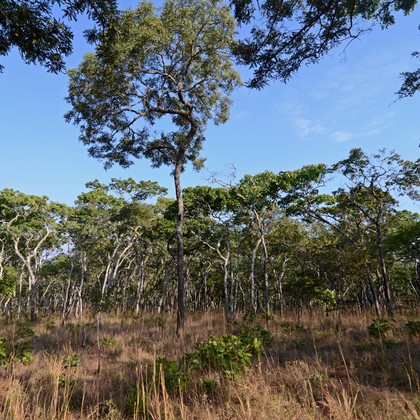
Tall, well-developed woodland: miombo, mopane woodland with large trees, Zambezi teak woodland and riverine forest along large rivers, wherever Retz's Helmetshrike Prionops retzii breeds. It usually keeps to the canopy and eats mainly hairy caterpillars, also grasshoppers and other large insects.
Where the bird is most at home, classified by the vegetation units of southern Africa.


Range and movements
Within the region mainly in Mozambique, northern and eastern Zimbabwe (including the Zambezi Valley), Malawi, Zambia and Angola; scarce to rare in north-eastern South Africa (Kruger National Park and surroundings), the far north of Botswana and the Zambezi Region of Namibia. In the south of its range probably mainly a summer visitor. Beyond the region it is widespread but scarce in wooded sub-Saharan Africa, from Guinea to Kenya, but absent from large parts of the Congo Basin.
- Resident
- Summer visitor (c. Oct–Mar)
- Passage (Mar–Apr, Oct–Nov)
- dark = core range, pale = thinly spread
How and when to look
October to January, when the birds call and display: in miombo or tall mopane, listen for the repeated whistling above the canopy and then look up for a long-winged bird with slow beats. Another approach is to follow a group of Retz's Helmetshrikes, which fiercely chase off any cuckoo that approaches their nest.
Conservation status
Not threatened, but scarce throughout its range. In southern Africa it is regarded as rare; clearing and fragmentation of tall woodland, and with it the loss of its host, are the main threats. Its inconspicuousness means it is probably under-recorded.
Scientific name
Pachycoccyx audeberti | (Schlegel, 1879)
Schlegel described the species in 1879 as Cuculus Audeberti; because it was later moved to another genus, the author and year stand in brackets. The genus Pachycoccyx was introduced in 1882 by Cabanis. Pachycoccyx comes from the Greek pachys, 'thick', and kokkyx, 'cuckoo' — for the notably heavy bill. audeberti honours the German naturalist Joseph Peter Audebert (1848–1933), who collected animals in Madagascar from 1875 for Hermann Schlegel of Leiden; Schlegel described the species in 1879. The specimen the first description was based on came from Ambodikilo near Mananara, Antongil Bay, Madagascar.