All species › Passerines › Sunbirds › Eastern Miombo Sunbird
Eastern Miombo Sunbird | Cinnyris manoensis
Oostelijke miombohoningzuiger | Suimanga del Miombo Oriental
The Eastern Miombo Sunbird is the double-collared sunbird of the miombo of Zimbabwe, Mozambique, Malawi and eastern Zambia. Older guides call it Miombo Double-Collared Sunbird, together with the western species; in Zimbabwe it is a common garden bird, including in Harare.

Click a thumbnail to switch the photo above.
Voice
A hard, metallic tchik or tchit-tchit. The song is louder, slower and less rambling than in the western species, with strident whistled notes among the twittering, tchiwi-tchiwi-tsi-tsi-swee, and carries far.
Recording: Catriona Leven — CC BY-NC-SA 4.0 · converted to mono · xeno-canto
Identification
13 to 14 cm, longer-bodied and heavier-billed than the western species. The male is metallic green with a slight bluish cast, and the uppertail coverts are blue-violet. Below the green throat come a narrow blue line and a broad scarlet breast band; the belly is grey to grey-olive. Yellow pectoral tufts are usually hidden and shown in display. The female is plain grey to grey-brown above and pale grey below, without obvious streaking. Juveniles are greyer with a yellowish throat.
Confusion species
Western Miombo Sunbird (Cinnyris gertrudis) is smaller and shorter-bodied, more uniformly green, with grey uppertail coverts and a narrower red band; its song ends in a descending trill. Greater Double-Collared Sunbird (Cinnyris afer) is larger, with an even broader red band and a longer bill, and hardly meets this species anywhere in the region. Forest Double-Collared Sunbird (Cinnyris fuelleborni) lives in montane forest above the miombo in Malawi and northern Mozambique. Marico Sunbird (Cinnyris mariquensis) and Purple-Banded Sunbird (Cinnyris bifasciatus) have a dark belly and a purple, not red, breast band.
Habitat
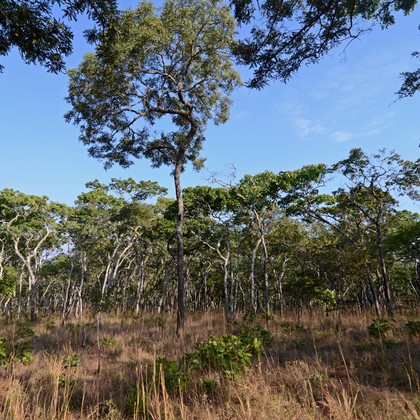
Miombo and other woodland with Brachystegia, preferably on rocky hills, kopjes and escarpments with scrub, and also forest edge, plantations and gardens with aloes and other nectar plants. It visits flowering aloes, mistletoes and coral trees and takes many insects.
Where the bird is most at home, classified by the vegetation units of southern Africa.


Range and movements
In Zimbabwe across the central plateau and the eastern highlands, in central and northern Mozambique, over much of Malawi and in eastern Zambia east of the Muchinga Escarpment. Beyond the region in southern and western Tanzania.
- Resident
- Winter visitor (c. Apr–Sep)
- dark = core range, pale = thinly spread
How and when to look
In Zimbabwe easy in Harare gardens, in the Matobo Hills and in the eastern highlands, especially in the dry winter when the aloes flower. In Malawi in miombo on hills around Dedza and Zomba. Check for the blue-violet uppertail coverts and the broad band to rule out the western species where both are possible.
Conservation status
Not threatened. Common and stable over a large area and well adapted to gardens and degraded woodland, although the miombo itself is declining in many districts through logging and conversion to farmland.
Scientific name
Cinnyris manoensis | Reichenow, 1907
Reichenow described the species in 1907 and placed it straight away in the genus where it still stands. The genus Cinnyris was introduced in 1816 by Cuvier, GLCFD. Cinnyris derives from the Greek kinnuris, the name of a small bird mentioned by the lexicographer Hesychius that cannot be identified further. manoensis refers to Mano, the area west of Lake Malawi where the first specimen was collected. The specimen the first description was based on came from Missale, Mano area, west of Lake Malawi.