All species › Passerines › Sunbirds › Western Miombo Sunbird
Western Miombo Sunbird | Cinnyris gertrudis
Westelijke miombohoningzuiger | Suimanga del Miombo Occidental
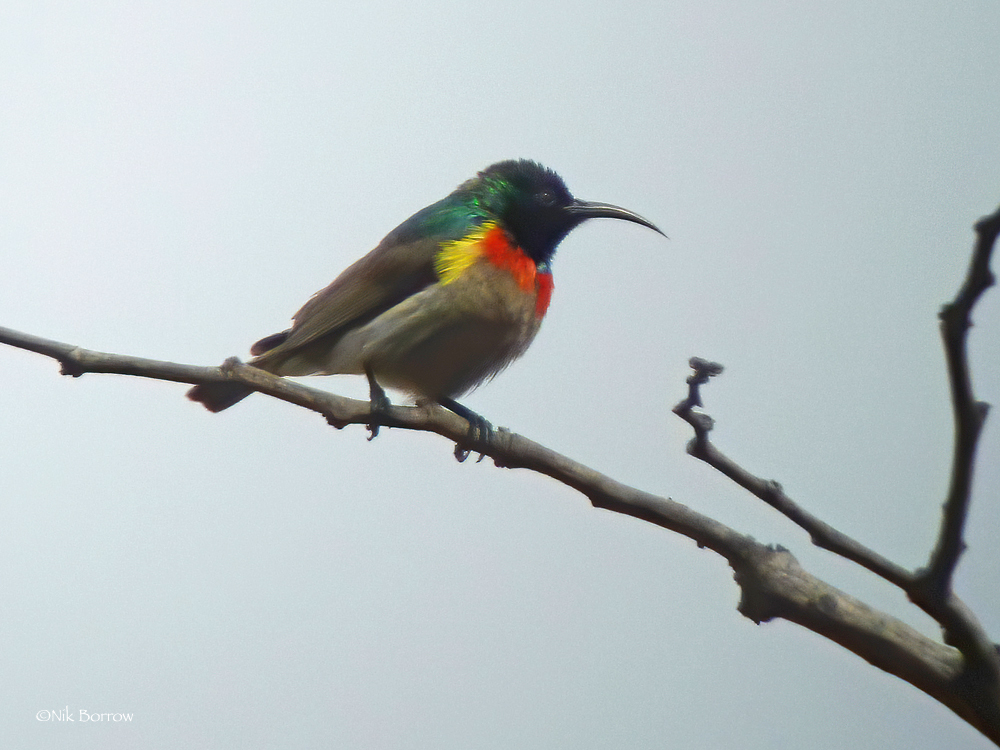
The Western Miombo Sunbird is the double-collared sunbird of the miombo woodland of Angola and western Zambia. It was long lumped with Eastern Miombo Sunbird as Miombo Double-Collared Sunbird, but it differs in size, plumage, song and nest building, and meets that species along the Muchinga Escarpment in Zambia.
Voice
A hard tchik or tchit contact note. The song is a fast, twittering series of high notes that characteristically ends in a long, descending trill, tsi-tswi-tsitsi-tsrrrrrr; that ending is the best feature for separating it from the eastern species.
Recording: Dries Van de Loock — CC BY-NC-SA 4.0 · converted to mono · xeno-canto
Identification
11 to 13 cm, with a relatively short body and a slender, decurved bill. The male is bright, uniform metallic green on the head, throat and back; the uppertail coverts are grey with green-glossed tips, not blue. Below the green throat lie a narrow blue line and a fairly narrow scarlet breast band; the belly is pale grey. The yellow pectoral tufts extend well beyond the red band. The female is grey-brown, darker than most other female double-collared sunbirds, with conspicuously white underwing coverts in flight. Juveniles resemble the female, with a yellowish wash below.
Confusion species
Eastern Miombo Sunbird (Cinnyris manoensis) is larger and longer-bodied, with a heavier bill, blue-violet uppertail coverts, a slightly bluer green and a broader red band; the two barely overlap. Ludwig's Double-Collared Sunbird (Cinnyris ludovicensis) lives higher up in Angola in montane forest edge and scrub, and is larger. Olive-Bellied Sunbird (Cinnyris chloropygius) has a dark olive belly and lives in humid forest. White-Bellied Sunbird (Cinnyris talatala) also occurs in miombo, but the male has a purple-blue breast band and a white belly.
Habitat
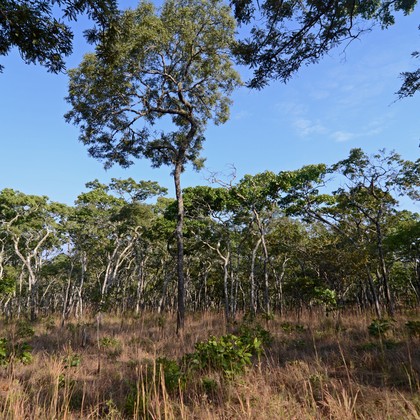
Closed and open miombo woodland with Brachystegia, Julbernardia and Isoberlinia, and the transition to dambo margins and riverine forest. It forages mainly in the canopy at flowering trees, mistletoes and Protea shrubs within the woodland. It builds a hanging, pear-shaped nest of beard lichen (Usnea) on a branch.
Where the bird is most at home, classified by the vegetation units of southern Africa.
Range and movements
Within the region in the miombo of the central and eastern plateau of Angola, and in Zambia west of the Muchinga Escarpment, from North-Western Province and the Copperbelt to the west and the central plateau. How far it reaches into northern Malawi is uncertain. Beyond the region in southern DR Congo and possibly the far south-west of Tanzania.
- Resident
- dark = core range, pale = thinly spread
How and when to look
In Zambia readily found in miombo around Kasanka, Mutinondo and in the Kafue area, and in Angola on the plateau around Huambo and Kuito. The best time is when the miombo trees or mistletoes are in flower. Listen for the descending trill at the end of the song to name the bird where both miombo sunbirds are possible.
Conservation status
Not threatened according to the available assessment. Common where the miombo is intact, but it depends on woodland rich in beard lichen and suffers locally from logging, charcoal production and over-frequent fires.
Scientific name
Cinnyris gertrudis | Grote, 1926
Grote described the species in 1926 and placed it straight away in the genus where it still stands. The genus Cinnyris was introduced in 1816 by Cuvier, GLCFD. Cinnyris derives from the Greek kinnuris, the name of a small bird mentioned by the lexicographer Hesychius that cannot be identified further. gertrudis honours Gertrud Luise Grote, née Vietzen (1890–1981), wife of the German ornithologist Hermann Grote, who described the taxon in 1926. The specimen the first description was based on came from Songea, southern Tanzania.