All species › Passerines › Sunbirds › Olive-Bellied Sunbird
Olive-Bellied Sunbird | Cinnyris chloropygius
Olijfbuikhoningzuiger | Suimanga Ventrioliva
The Olive-Bellied Sunbird is a small, short-billed double-collared sunbird of humid forest edges in West and Central Africa. The male combines a metallic green head with a narrow red breast band and a dark olive belly; within the region the species reaches only northern Angola and the far north-west of Zambia.

Click a thumbnail to switch the photo above.
Voice
A dry, repeated tsip or tswik contact note. The song is a fast, high, squeaky twitter lasting a few seconds, tsi-tsi-swee-tsitsitsi, often repeated from an exposed branch at the forest edge.
Recording: Jonathan Onongo — CC BY-NC-SA 4.0 · converted to mono · xeno-canto
Identification
Small and compact, 11 to 12 cm, with a short, slightly decurved bill. The male has the head, throat, mantle and scapulars metallic green, below that a narrow blue-violet line and a scarlet breast band that narrows at the sides; the belly and undertail coverts are dark olive-green, not grey. Bright yellow pectoral tufts are obvious in display. The female is olive-green above and pale yellow below, with a faint supercilium and indistinct streaking on the breast and flanks. Immature males resemble the female with the first green gloss on throat and back.
Confusion species
Western Miombo Sunbird (Cinnyris gertrudis) is larger, grey-bellied and lives in dry miombo rather than humid forest and gardens. The male Orange-Tufted Sunbird (Cinnyris bouvieri) has a purple forehead band, a purple-blue breast without a broad red band, and orange and yellow tufts. Oustalet's Sunbird (Cinnyris oustaleti) has a white belly. Females are difficult: note the small size, the short bill and the yellowish, faintly streaked underparts.
Habitat
Edges of humid lowland and gallery forest, secondary growth, clearings, abandoned cultivation, plantations and gardens with flowering shrubs. It forages at all heights, often low at flowering shrubs and creepers, and also takes many small insects and spiders.
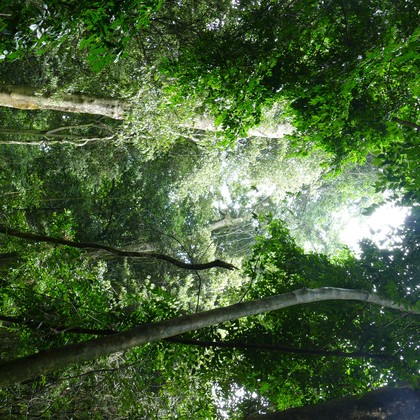
Where the bird is most at home, classified by the vegetation units of southern Africa.


Range and movements
Within the region confined to northern and north-western Angola, including Cabinda, south along the western escarpment to about Cuanza Sul, and to the far north-west of Zambia around Mwinilunga. Beyond the region from Guinea east through West and Central Africa to Uganda, western Kenya and north-western Tanzania.
- Resident
- dark = core range, pale = thinly spread
How and when to look
In Angola easiest in gardens and forest edge in the north, around Uíge and in the Kumbira forests; in Zambia in the gallery forests of Mwinilunga. Check flowering shrubs in the morning. With any red-banded male, look at the belly colour: dark olive points to this species, grey to a miombo sunbird.
Conservation status
Not threatened. Common over a large range and tolerant of degraded forest, secondary growth and gardens, so deforestation affects it less than many other forest birds.
Scientific name
Cinnyris chloropygius | (Jardine, 1842)
Jardine described the species in 1842 as Nectarinia chloropygia; because it was later moved to another genus, the author and year stand in brackets. The genus Cinnyris was introduced in 1816 by Cuvier, GLCFD. Cinnyris derives from the Greek kinnuris, the name of a small bird mentioned by the lexicographer Hesychius that cannot be identified further. chloropygius comes from the Greek khlōros, 'green', and pugē, 'rump' — for the male's green rump. The specimen the first description was based on came from Niger River.