All species › Passerines › Sunbirds › Scarlet-Chested Sunbird
Scarlet-Chested Sunbird | Chalcomitra senegalensis
Roodborsthoningzuiger | Suimanga Pechiescarlata
The Scarlet-Chested Sunbird is the large, dark savanna sunbird whose male sports a brilliant scarlet breast below a green throat. It is one of the most conspicuous and vocal sunbirds of the north-east of the region.

Click a thumbnail to switch the photo above.
Voice
A loud, whistled and often repeated cheep-chup-toop; the male can repeat a fixed phrase of three or four notes for hours from a high branch. The call is a sharp tcheek.
Recording: Jonathan Onongo — CC BY-NC-SA 4.0 · converted to mono · xeno-canto
Identification
A large sunbird of 14 to 15 cm with a long, strongly decurved bill. The male is dark chocolate-brown to black, with a metallic green crown and throat and a brilliant scarlet breast with fine blue barring visible only at close range. The female is dark olive-brown above and buffish-yellow below with heavy dark mottling, especially on the throat and breast, and has a pale moustachial stripe. Immature males resemble the female with scattered red feathers on the breast.
Confusion species
The male Amethyst Sunbird (Chalcomitra amethystina) lacks the red breast and has a purple throat; its female is paler and less heavily mottled below. Purple-Banded Sunbird (Cinnyris bifasciatus) and Marico Sunbird (Cinnyris mariquensis) are smaller, with a green back and a purple and blue breast band. The male Green-Throated Sunbird (Chalcomitra rubescens) of Angolan and Zambian forests has the green throat but no red.
Habitat
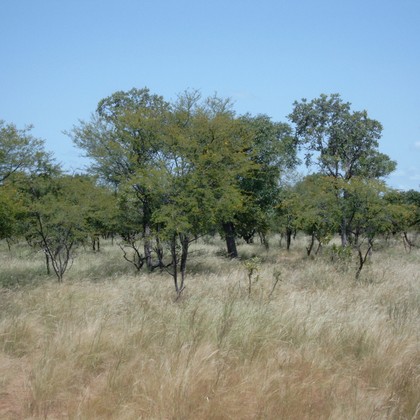
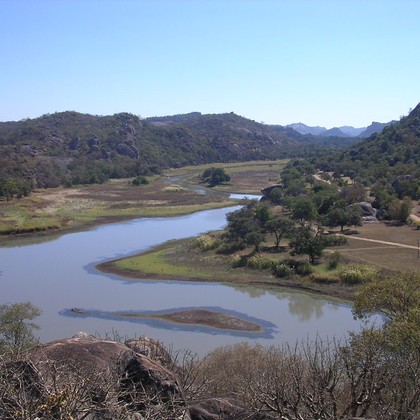
Acacia savanna, mixed woodland, mopane and miombo edges, riverine forest, villages, parks and gardens. It feeds at flowering trees such as coral trees, Schotia and aloes, and catches many insects. It avoids dense forest and the dry Karoo.
Where the bird is most at home, classified by the vegetation units of southern Africa.

Range and movements
In South Africa in the north and east: Limpopo, Mpumalanga, Gauteng, North West and KwaZulu-Natal south to the eastern part of the Eastern Cape; also Eswatini, Zimbabwe, Mozambique, Malawi, Zambia and Angola, and northern and eastern Botswana and northern Namibia. Beyond the region across much of sub-Saharan Africa, from Senegal to Ethiopia and East Africa.
- Resident
- Summer visitor (c. Oct–Mar)
- Winter visitor (c. Apr–Sep)
- Passage (Mar–Apr, Oct–Nov)
- dark = core range, pale = thinly spread
How and when to look
In the Kruger Park and around Pretoria the male often first gives itself away by its repeated whistled phrase from a dead branch. At flowering coral trees in winter several males often gather and chase one another noisily. A female with a dark, heavily mottled throat and breast is often best identified by looking for a male nearby.
Conservation status
Not threatened. The species is common and adapts well to gardens and villages, and is increasing in parts of its range.
Scientific name
Chalcomitra senegalensis | (Linnaeus, 1766)
Linnaeus described the species in 1766 as Certhia senegalensis; because it was later moved to another genus, the author and year stand in brackets. The genus Chalcomitra was introduced in 1854 by Reichenbach. Chalcomitra comes from the Greek khalkos, 'bronze, copper', and mitra, 'headband, diadem' — for the metallic sheen on the males' head and throat. senegalensis means 'from Senegal', where the first specimen came from. The specimen the first description was based on came from Senegal.