All species › Woodpeckers and allies › African barbets › Eastern Yellow-Billed Barbet
Eastern Yellow-Billed Barbet | Trachylaemus purpuratus
Oostelijke geelsnavelbaardvogel | Barbudo Piquigualdo Oriental
The Eastern Yellow-Billed Barbet is a large, long-tailed and shy barbet of the Congo rainforest that occurs in the region only in northern Angola. It lives in the middle storey of dense forest and is heard far more often than seen.

Voice
A series of low, hollow, mellow whistles, hoop-hoop-hoop, slowly rising and falling in pitch, often given alternately by both partners. Also a croaking, frog-like kraa and short quacking notes.
No recording with a suitable Creative Commons licence is available for this species yet.
Identification
About 25 cm, slim for a barbet, with a relatively long tail and a heavy, bright yellow bill. Bare yellow skin surrounds the eye. The plumage is dark purplish-black with a blue gloss on head and back; forehead and throat are washed red, and yellow streaks on the breast and flanks broaden towards the belly. The sexes are alike; juveniles are duller with a less bright bill.
Confusion species
Naked-Faced Barbet (Gymnobucco calvus) is smaller and dark brown, with a bare grey head and a dark bill, and lives in noisy groups around dead trees. Double-Toothed Barbet (Pogonornis bidentatus) has a red belly and a pale bill. The yellow bill with bare yellow eye-ring on a dark body is unmistakable.
Habitat
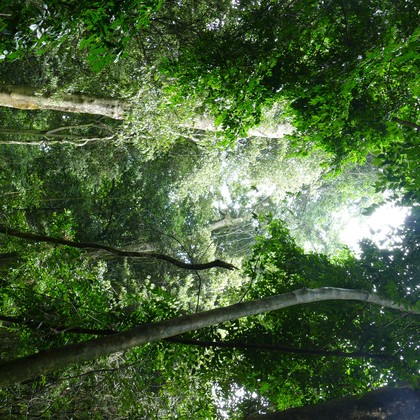
Humid lowland and gallery forest, especially dense undergrowth, lianas and the mid-storey, at times old secondary forest. It feeds mainly on fruit, supplemented with large insects. It nests in a self-excavated cavity in dead wood.
Where the bird is most at home, classified by the vegetation units of southern Africa.

Range and movements
Within the region only in northern Angola, in the forest belt of Cabinda, Uíge and the Lunda provinces. Beyond the region from Cameroon and Gabon through the Congo Basin to Uganda, western Kenya and north-western Tanzania. The Western Yellow-Billed Barbet (Trachylaemus goffinii) of West Africa was formerly treated as the same species.
- Resident
- dark = core range, pale = thinly spread
How and when to look
A bird for those birding the Angolan rainforest: listen early in the morning for the hollow whistled series, then search patiently in the mid-storey, where the bird may sit motionless for long periods. Fruiting trees at a forest edge give the best chance of a good view.
Conservation status
Not assessed separately by the IUCN; it is included in Yellow-Billed Barbet in the broad sense (Trachyphonus purpuratus, Least Concern). In the region it is confined to a small and little-studied belt of forest, where deforestation is the main threat.
Scientific name
Trachylaemus purpuratus | (Verreaux & Verreaux, 1851)
Verreaux & Verreaux described the species in 1851 as Trachyphonus lurpuratus (sic: purpuratus); because it was later moved to another genus, the author and year stand in brackets. The genus Trachylaemus was introduced in 1891 by Reichenow. Trachylaemus comes from the Greek trachys, 'rough, shaggy', and laimos, 'throat' — for the rough, bristly feathering around the throat and bill base. purpuratus is Latin for 'clad in purple' — for the purple-glossed black upperparts. The specimen the first description was based on came from Gabon.