All species › Woodpeckers and allies › African barbets › Green Barbet
Green Barbet | Cryptolybia olivacea
Olijfkleurige baardvogel | Barbudo Oliváceo
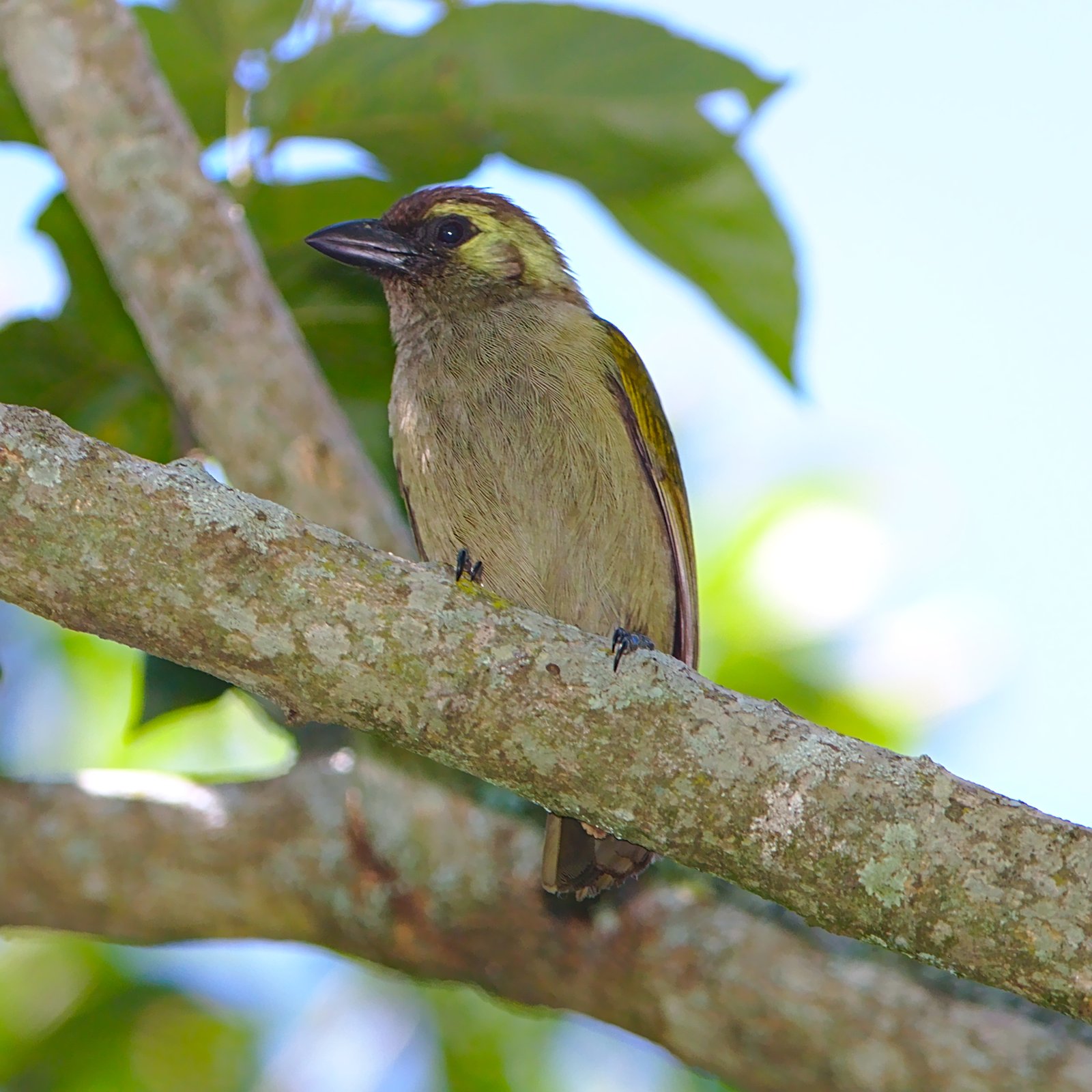
The Green Barbet is an inconspicuous green forest barbet with a few highly fragmented populations in the region, of which the one in Ngoye Forest in KwaZulu-Natal is the best known. Its endlessly repeated knocking call is often the only sign of its presence.
Voice
A long, even series of hollow knocking notes, tchok-tchok-tchok-tchok, sometimes sustained for minutes from the canopy; pairs often call together. Also a rattling krrr when agitated.
No recording with a suitable Creative Commons licence is available for this species yet.
Identification
About 17 cm, compact, with a heavy black bill. The plumage is plain olive-green, slightly yellower and paler below. The head is darker: in the Ngoye form (woodwardi) dark olive-brown with a yellow ear patch, in the Malawi and Mozambique forms dark brown to blackish without an obvious ear patch. Eye red to brown. The sexes are alike.
Confusion species
White-Eared Barbet (Stactolaema leucotis) is dark brown with a white stripe behind the eye and a white belly. Yellow-Rumped Tinkerbird (Pogoniulus bilineatus) is much smaller, black with yellow facial stripes and a yellow rump. Closer in colour is Sombre Greenbul (Andropadus importunus), but it has a slender bill and a whitish eye.
Habitat
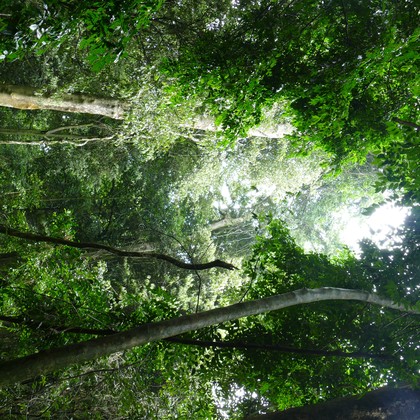
The canopy of moist indigenous forest: coastal and lowland forest in KwaZulu-Natal and montane and submontane forest in Malawi and Mozambique. It feeds mainly on fruit, especially figs, supplemented with insects. It nests in a self-excavated cavity in dead wood high in a tree.
Where the bird is most at home, classified by the vegetation units of southern Africa.

Range and movements
Within the region confined to a few isolated forests: Ngoye Forest in KwaZulu-Natal (race woodwardi, also in south-eastern Tanzania), the Misuku Hills in northern Malawi, and Mount Thyolo in Malawi and Mounts Namuli and Chiperone in Mozambique (race belcheri). Beyond the region in coastal and montane forests of Kenya and Tanzania.
- Resident
- Passage (Mar–Apr, Oct–Nov)
- dark = core range, pale = thinly spread
How and when to look
In South Africa Ngoye Forest near Eshowe is the only site: go with a local guide and listen for the knocking call in the crowns of fruiting trees. The bird often sits motionless among the leaves; a telescope helps to relocate it in the greenery.
Conservation status
Not globally threatened, but the separate populations in the region are small and wholly dependent on protected forest remnants. The Ngoye population is estimated at only a few hundred birds and is vulnerable to logging and fire; the forests of Thyolo and Namuli are shrinking through clearance.
Scientific name
Cryptolybia olivacea | (Shelley, 1880) (GBIF: Stactolaema olivacea)
Shelley described the species in 1880 as Barbatula olivacea; because it was later moved to another genus, the author and year stand in brackets. The genus Cryptolybia was introduced in 1979 by Clancey. Cryptolybia comes from the Greek kryptos, 'hidden', and the genus name Lybius — probably for this barbet's inconspicuous olive-green plumage. olivacea is Latin for 'olive-coloured' — for the uniformly olive-green plumage. The specimen the first description was based on came from Rabai, near Mombasa, Kenya.