All species › Woodpeckers and allies › African barbets › Bristle-Nosed Barbet
Bristle-Nosed Barbet | Gymnobucco peli
Pels borstelneus | Barbudo de Pinceles
The Bristle-Nosed Barbet is a dark brown forest barbet with conspicuous pale bristle tufts above the bill, a West and Central African species that reaches the region only in the extreme north-west of Angola. It breeds colonially in dead trees, often with dozens of holes in a single trunk.

Voice
Unmusical: nasal, squeaky and grating calls, nyeh and cher, and a constant hubbub of squeaks at the colony; there is no true song.
Recording: Étienne Leroy — CC BY-NC-SA 4.0 · converted to mono · xeno-canto
Identification
About 17 cm, uniformly dark chocolate-brown with a slightly paler, grey-brown throat and faintly streaked breast. Above the bill base sit two dense, pale yellowish-brown bristle tufts that cover the nostrils and give the species its name; unlike its relatives, the head is fully feathered. The bill is heavy and blackish, the eye dark. The sexes are alike; juveniles have smaller tufts and a paler bill base.
Confusion species
Naked-Faced Barbet (Gymnobucco calvus) has an almost bare, blackish head, much smaller nasal tufts, a pale horn-coloured bill and a paler throat. Hairy-Breasted Barbet (Tricholaema hirsuta) is spotted yellow and black with a striped head. Dark brown plumage with large pale nasal tufts is diagnostic.
Habitat
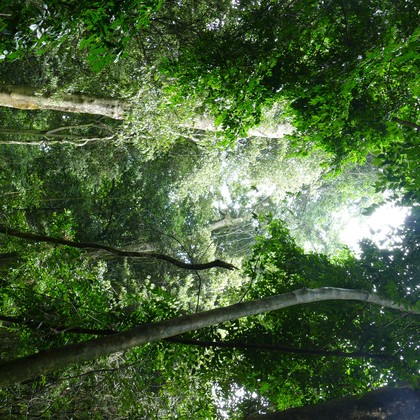
Edges and clearings of humid lowland forest, secondary forest, old clearings and wooded farmland where dead trees are left standing. It is social and eats mainly fruit, especially figs and oil palm, supplemented with insects. The colony excavates holes in one or a few dead trunks.
Where the bird is most at home, classified by the vegetation units of southern Africa.

Range and movements
Within the region only in the extreme north-west of Angola, in Cabinda and possibly locally in the forests south of the Congo River. Beyond the region from Ghana and southern Nigeria through Cameroon and Gabon to Congo-Brazzaville and western and central DR Congo.
- Resident
- dark = core range, pale = thinly spread
How and when to look
In Cabinda look for dead standing trees in clearings or fields bearing a row of round holes; there is always activity at the colony. Always check the head in a group: Naked-Faced Barbets may use the same trees.
Conservation status
Not threatened and common over most of its range. It benefits from clearings and secondary growth but depends on standing dead wood for its colonies; felling such trees can wipe out a local colony.
Scientific name
Gymnobucco peli | Hartlaub, 1857
Hartlaub described the species in 1857 and placed it straight away in the genus where it still stands. The genus Gymnobucco was introduced in 1850 by Bonaparte. Gymnobucco comes from the Greek gymnos, 'naked', and Bucco, an old genus name for barbets — for the largely bare head of these barbets. peli honours Hendrik Severinus Pel (1818–1876), Dutch administrator and collector on the Gold Coast (Ghana). The specimen the first description was based on came from Dabocrom, Ghana.