All species › Woodpeckers and allies › African barbets › Naked-Faced Barbet
Naked-Faced Barbet | Gymnobucco calvus
Kaalkopbaardvogel | Barbudo Calvo Común
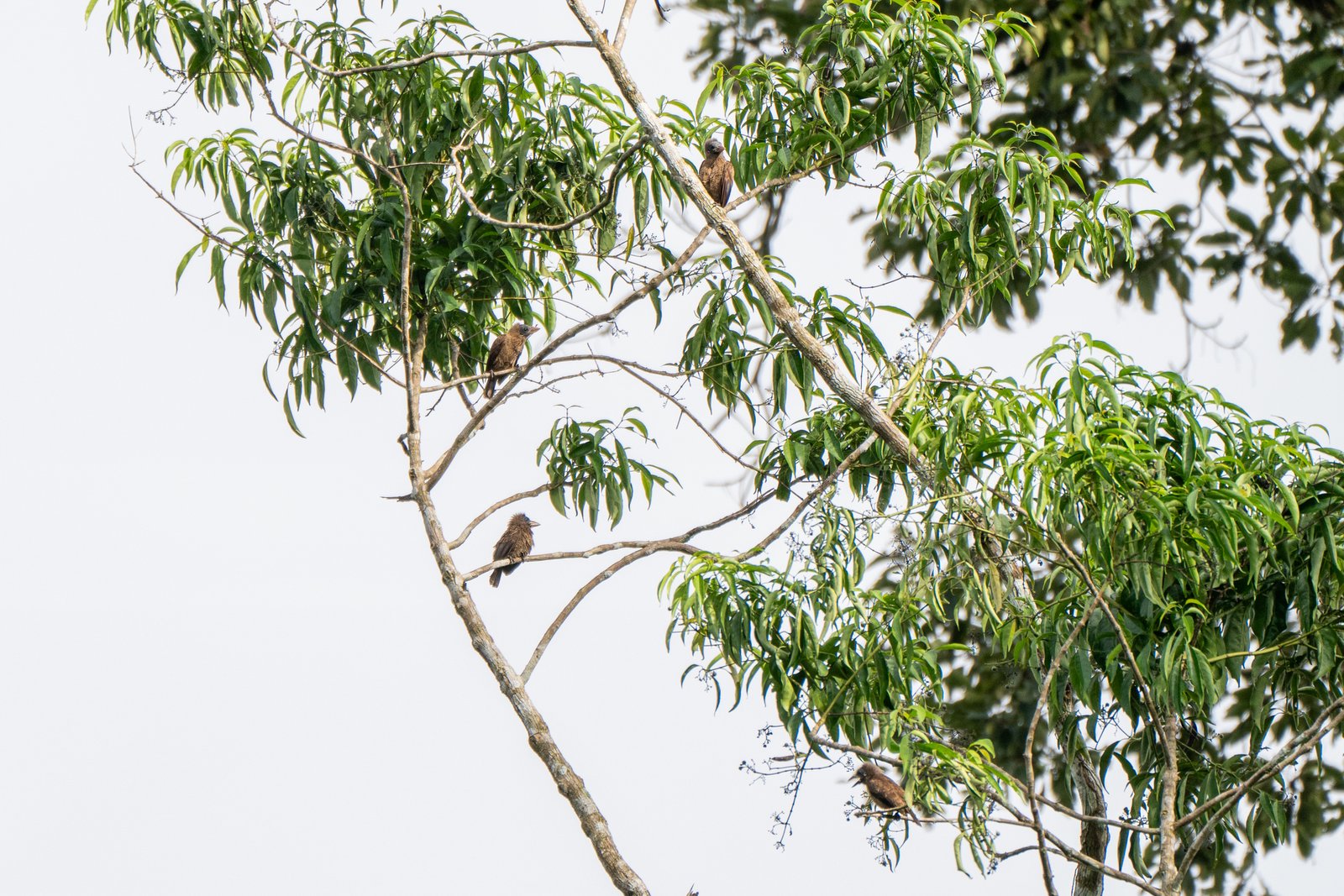
The Naked-Faced Barbet is a dark brown forest barbet with an almost unfeathered, blackish head and a heavy pale bill, reaching the region in north-western Angola. Like its relative the Bristle-Nosed Barbet, it breeds in colonies in dead trees.
Voice
Nasal, creaking and squeaky calls, kweh and kyer, and a constant chatter at the colony; also a dry clattering of bill-snapping. There is no true song.
Recording: Alain Verneau — CC BY-NC-SA 4.0 · converted to mono · xeno-canto
Identification
About 17–18 cm, largely dark olive-brown, with a paler grey-brown throat and finely pale-streaked breast and belly. The head is bare: dark grey to blackish skin with only a few scattered bristles, lending the bird a vulture-like look. The bill is heavy, pale horn to yellowish, with small inconspicuous bristle tufts at the nostrils. The Angolan subspecies vernayi has a slightly paler throat and breast. The sexes are alike; juveniles have a partly feathered, brownish head and a darker bill.
Confusion species
Bristle-Nosed Barbet (Gymnobucco peli) has a fully feathered brown head, large pale bristle tufts above the bill and a blackish bill. Anchieta's Barbet (Stactolaema anchietae) has a pale yellow feathered head and lives on the plateau, not in lowland forest. The bare head with a pale bill is diagnostic.
Habitat
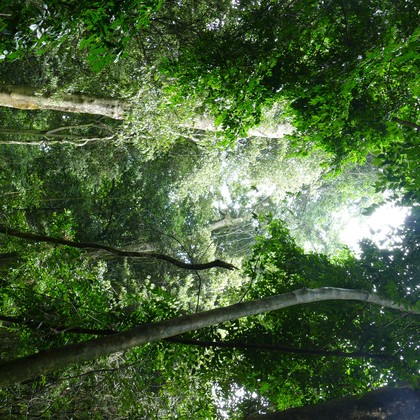
Edges of humid forest, clearings with dead trees, secondary forest, old plantations and wooded farmland; in Angola mainly in coffee forest and the forest strips along the western escarpment. It is social and frugivorous, especially on figs, supplemented with insects. Colonies of sometimes dozens of pairs excavate holes in a single dead trunk.
Where the bird is most at home, classified by the vegetation units of southern Africa.

Range and movements
Within the region in north-western Angola, from Cabinda and Zaire and Uíge provinces south along the escarpment into Cuanza Sul. Beyond the region from Sierra Leone and Guinea through Ghana, Nigeria and Cameroon to Gabon and Congo-Brazzaville.
- Resident
- dark = core range, pale = thinly spread
How and when to look
In north-western Angola look for dead standing trees in clearings or coffee plantations riddled with holes; the colony can be heard from afar. Birds sunning on a bare branch show the naked head best.
Conservation status
Not threatened and locally common. It adapts well to secondary forest and farmland as long as dead trees are left standing. In Angola continued clearance of escarpment forest reduces its habitat.
Scientific name
Gymnobucco calvus | (de Lafresnaye, 1841)
De Lafresnaye described the species in 1841 as Bucco calvus; because it was later moved to another genus, the author and year stand in brackets. The genus Gymnobucco was introduced in 1850 by Bonaparte. Gymnobucco comes from the Greek gymnos, 'naked', and Bucco, an old genus name for barbets — for the largely bare head of these barbets. calvus is Latin for 'bald' — for the unfeathered head. The specimen the first description was based on came from Ashanti, Ghana (designated later).