All species › Woodpeckers and allies › African barbets › Brown-Breasted Barbet
Brown-Breasted Barbet | Pogonornis melanopterus
Bruinborstbaardvogel | Barbudo Pechipardo
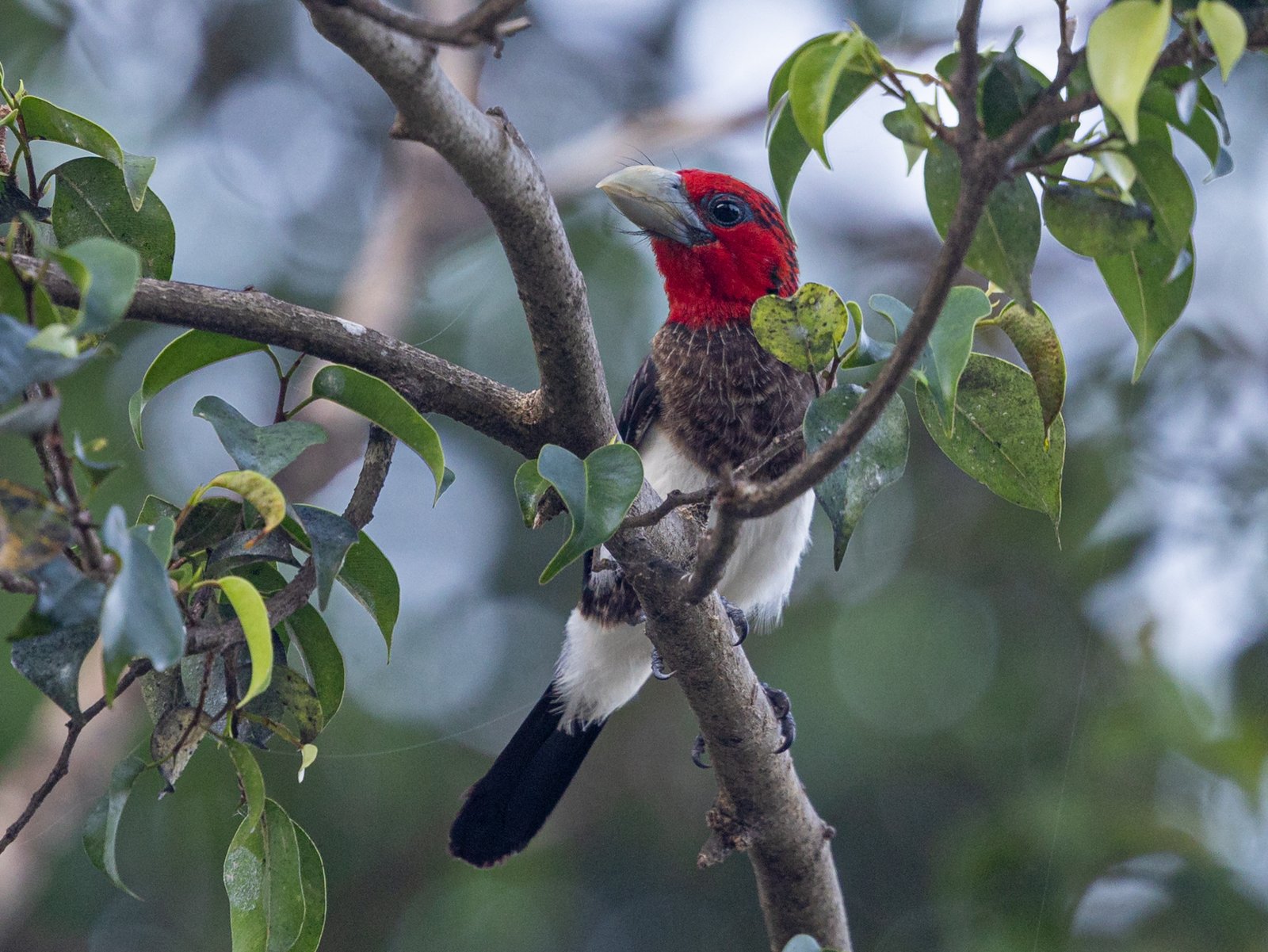
The Brown-Breasted Barbet is a large, pied barbet with a red head and a broad brown breast band, a species of the East African coastal lowlands that reaches the region only in the north. In southern Africa it is one of the least known barbets.
Voice
Loud, hoarse and nasal calls, a rasping kraa and grating series, less musical than the duets of Black-Collared Barbet. Pairs sometimes call briefly together. Relatively little has been published on its repertoire.
No recording with a suitable Creative Commons licence is available for this species yet.
Identification
About 19 cm, heavily built with a large, pale horn-coloured bill. Head, throat and upper breast bright red, sometimes with a black smudge behind the eye. Below this a broad brown breast band contrasts sharply with the white belly. Back, wings and tail dark brown to blackish, with a white patch or stripe on the lower back and rump. The sexes are alike; juveniles show less and duller red on the head.
Confusion species
Black-Collared Barbet (Lybius torquatus) also has a red face, but with a black collar instead of a brown breast band, a black bill and a yellowish belly. White-Headed Barbet (Lybius leucocephalus) has a white head. The combination of red head, pale bill and brown breast band is distinctive.
Habitat
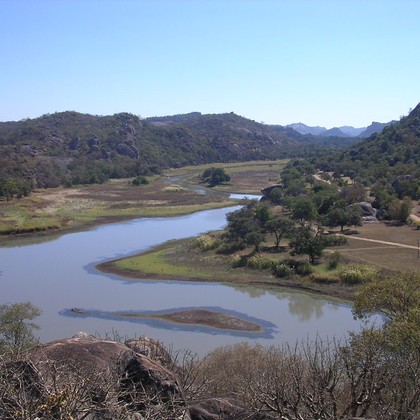
Riverine forest, dense thickets and evergreen copses in the lowlands, forest edges, mixed woodland with tall trees and cultivation with scattered fig trees. It eats mainly fruit, figs in particular, supplemented with insects. It nests in a self-excavated hole in a dead branch.
Where the bird is most at home, classified by the vegetation units of southern Africa.

Range and movements
The far north of the region: northern Mozambique, north of the Zambezi, and locally in Malawi. The core of the range lies further north, in eastern Tanzania, eastern and south-eastern Kenya and southern Somalia.
- Resident
- Passage (Mar–Apr, Oct–Nov)
- dark = core range, pale = thinly spread
How and when to look
A target species for visitors to northern Mozambique, for instance in Cabo Delgado and Nampula provinces. Check fruiting fig trees along rivers and in cultivation; the bird often sits conspicuously in the canopy but is wary. Records within the region are worth documenting.
Conservation status
Not threatened and locally common in East Africa. Within the region the species is scarce and poorly known; clearance of riverine forest and lowland thicket may matter locally.
Scientific name
Pogonornis melanopterus | (Peters, 1854) (GBIF: Lybius melanopterus)
Peters described the species in 1854 as Pogonias (Laimodon) melanopterus; because it was later moved to another genus, the author and year stand in brackets. The genus Pogonornis was introduced in 1828 by Billberg. Pogonornis comes from the Greek pōgōn, 'beard', and ornis, 'bird' — 'bearded bird', for the bristles around the heavy bill. melanopterus comes from the Greek melas, 'black', and pteron, 'wing' — for the dark wings. The specimen the first description was based on came from Mocímboa, Mozambique.