All species › Woodpeckers and allies › African barbets › Black-Backed Barbet
Black-Backed Barbet | Pogonornis minor
Roodbuikbaardvogel | Barbudo Frentirrojo Occidental
The Black-Backed Barbet is a chunky barbet with a pale bill, a red forecrown and an apricot to pinkish-red belly patch, a species of the northern miombo and riverine woodlands. In the region it is scarce and unobtrusive, and is heard more often than seen.

Voice
A harsh, dry krek, often repeated, and a trilled, toy-like buzzing reminiscent of Broad-Billed Roller; also bill-snapping.
No recording with a suitable Creative Commons licence is available for this species yet.
Identification
About 18 cm, chunky, with a heavy pale horn-coloured bill. Forehead and forecrown are red, and the belly carries an apricot to pinkish-red patch. The eastern subspecies macclounii (Zambia) has dark, almost black upperparts and a white face and underparts, giving strong contrast; the western nominate form (Angola) is largely brownish on the face and less contrasting. The sexes are nearly alike; juveniles are duller with less red.
Confusion species
Double-Toothed Barbet (Pogonornis bidentatus) is larger and has a red face, throat and breast. Black-Collared Barbet (Lybius torquatus) has an entirely red face with a black collar, a black bill and a grey-brown back. Brown-Breasted Barbet (Pogonornis melanopterus), further east, has a brown breast band and a red head.
Habitat
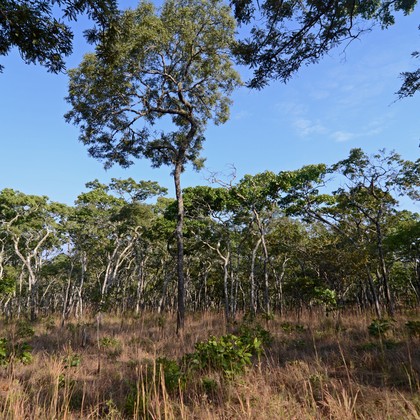
Riverine and gallery forest, forest edges and tall miombo with figs and other fruiting trees, also overgrown gardens and plantations near villages. It feeds on fruit and insects and nests in a cavity it excavates in a dead branch.
Where the bird is most at home, classified by the vegetation units of southern Africa.

Range and movements
Within the region restricted to the north: northern and eastern Angola and northern and north-eastern Zambia; scarce and local throughout. Beyond the region from Gabon and Congo-Brazzaville through southern DR Congo to western Tanzania.
- Resident
- Summer visitor (c. Oct–Mar)
- Winter visitor (c. Apr–Sep)
- Passage (Mar–Apr, Oct–Nov)
- dark = core range, pale = thinly spread
How and when to look
Search the gallery forests of northern and north-western Zambia, at fruiting figs where other barbets also gather. Pairs are resident but quiet and unobtrusive; follow the dry krek and look for the pale bill and coloured belly patch as the bird clambers upwards.
Conservation status
Not threatened; the IUCN lists it under the older name Lybius minor. Locally fairly common outside the region; within it scarce and little studied.
Scientific name
Pogonornis minor | (Cuvier, GLCFD, 1816) (GBIF: Lybius minor)
Cuvier, GLCFD described the species in 1816 as Pogonias minor; because it was later moved to another genus, the author and year stand in brackets. The genus Pogonornis was introduced in 1828 by Billberg. Pogonornis comes from the Greek pōgōn, 'beard', and ornis, 'bird' — 'bearded bird', for the bristles around the heavy bill. minor is Latin for 'smaller' — this barbet is smaller than its close relatives. The specimen the first description was based on came from northern Angola (designated later).