All species › Passerines › Orioles › Eurasian Golden Oriole
Eurasian Golden Oriole | Oriolus oriolus
Wielewaal | Oropéndola Europea
Eurasian Golden Oriole is a Palearctic migrant that spends the northern winter in the woodlands of southern Africa. Here it is much quieter than on its European breeding grounds and stays hidden in the foliage of tall trees; most sightings are of greenish females and young birds rather than golden males.
Voice
Mostly silent in Africa, with a harsh, nasal kweek or myeeh as a call. Especially in February and March, before migration, males sometimes sing the familiar fluting dudelio or wee-la-wee-oo from the treetops.
Recording: João Ferreira Tomás — CC BY-NC-SA 4.0 · shortened to the first 60 s, mono · xeno-canto
Identification
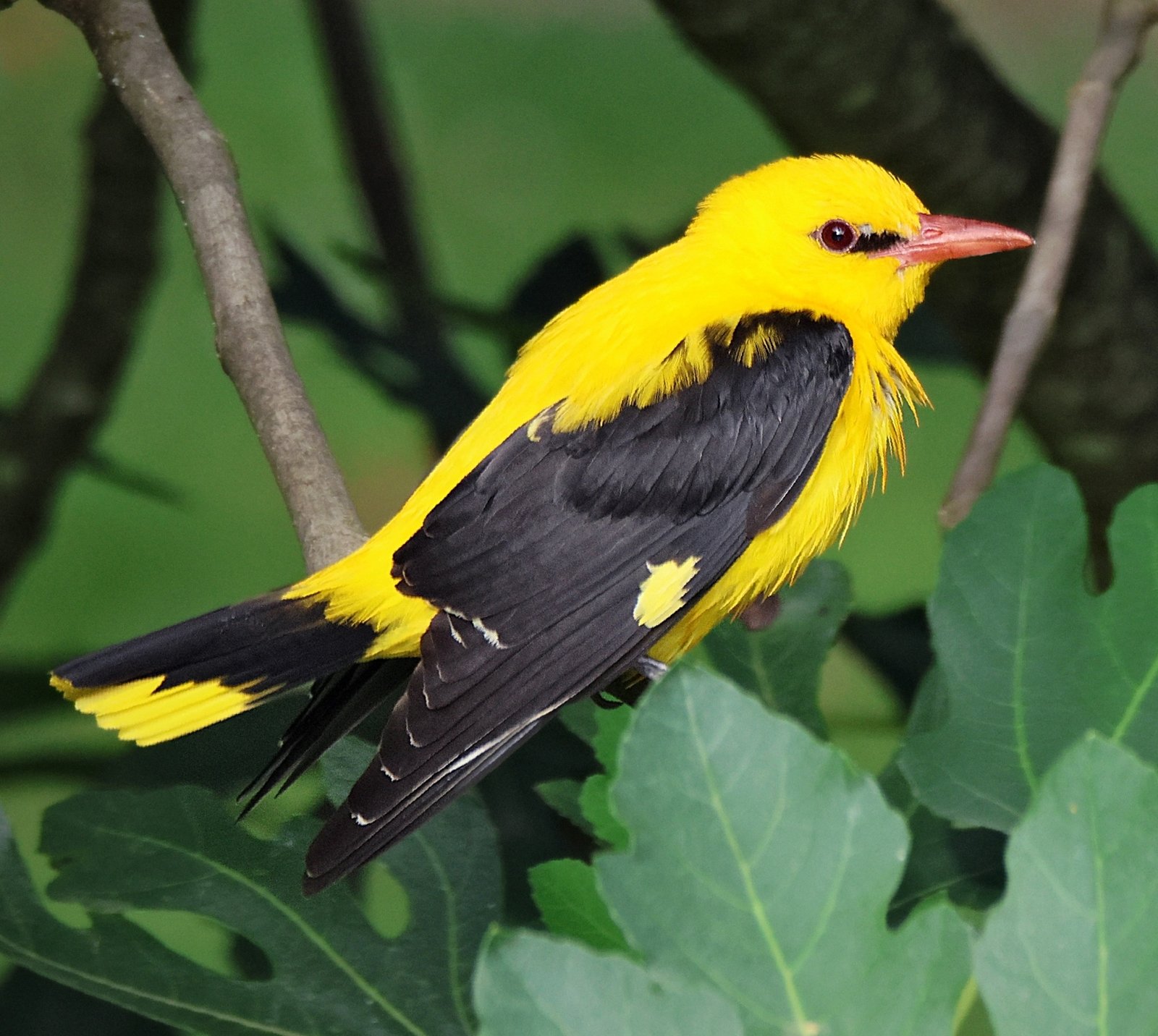
22–24 cm. The adult male is golden yellow with black wings, a small yellow spot on the primary coverts and a black tail with yellow corners; only the lores are black. Bill dark pink, eye red. The female is yellowish green above, whitish to pale yellow below with fine dark streaks and yellow flanks and undertail coverts; the wings are greyish brown. Juveniles resemble the female but are more heavily streaked and have a dark bill; young males only acquire full yellow plumage in their second or third year.
Confusion species
The male African Golden Oriole Oriolus auratus has a black stripe to behind the eye and broad yellow edges on the wing; females and young are yellower below and less streaked. Black-Headed Oriole Oriolus larvatus has a black head. A streaked young Eurasian Golden Oriole can suggest a green woodpecker or a greenbul in flight, but the undulating flight and long wings are typical.
Habitat
Broadleaved woodland, riverine forest and tall trees along rivers, figs and other fruiting trees, also in parks and gardens. It eats insects and much fruit, and often visits fruiting trees together with other frugivores.
Where the bird is most at home, classified by the vegetation units of southern Africa.



Range and movements
From November to April in the north and east of the region: Zambia, Malawi, Zimbabwe, Mozambique, northern Botswana, north-eastern Namibia and Angola, and in South Africa mainly in Limpopo, Mpumalanga, Gauteng and KwaZulu-Natal. Scarce to rare further west and south. It breeds in Europe, North Africa and western and central Asia and winters mostly in Africa south of the Sahara.
- Summer visitor (c. Oct–Mar)
- Passage (Mar–Apr, Oct–Nov)
- dark = core range, pale = thinly spread
How and when to look
From December to March search at fruiting figs and in tall riverine forest, for example in Kruger or along the Zambezi. Watch for the undulating flight and the yellow tail corners; in February and March song gives the males away.
Conservation status
Not threatened; the European population is large and roughly stable. Clearance of woodland and riverine forest plays a part on the wintering grounds, but the species is flexible in its choice of trees.
Scientific name
Oriolus oriolus | (Linnaeus, 1758)
Linnaeus described the species in 1758 as Coracias oriolus; because it was later moved to another genus, the author and year stand in brackets. The genus Oriolus was introduced in 1766 by Linnaeus. Oriolus is medieval Latin for the Golden Oriole; the name is onomatopoeic, echoing the Eurasian Golden Oriole's melodious calls. The specific name repeats the genus name. The specimen the first description was based on came from Sweden.