All species › Passerines › Orioles › African Golden Oriole
African Golden Oriole | Oriolus auratus
Afrikaanse wielewaal | Oropéndola Africana
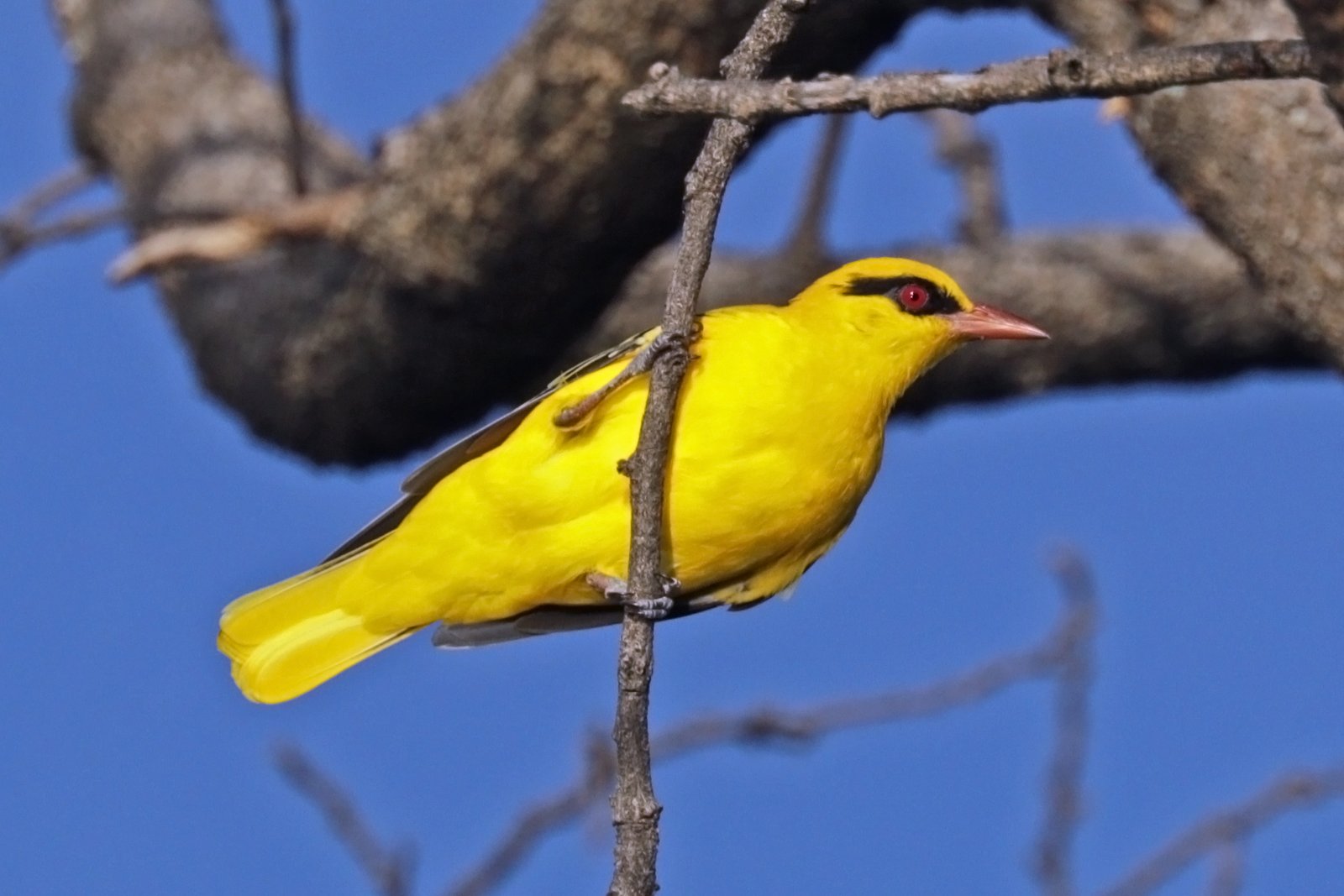
African Golden Oriole is the yellow oriole of the miombo: an intra-African migrant that returns from the north with the first rains in September to breed in the woodland. The male is the most brightly coloured oriole of the region, almost entirely golden yellow, with a black stripe through the eye as its key feature.
Voice
Liquid, fluty phrases such as wee-er-wee-oo or fee-yoo-lee, clearer and more varied than in Black-Headed Oriole, and a nasal, cat-like mweeh as a call. It sings mainly in the breeding season, often early in the morning.
Recording: Magnus Wadstein — CC BY-NC-SA 4.0 · converted to mono · xeno-canto
Identification
23–24 cm. The male is bright golden yellow with a black stripe from the bill through the eye to behind it. The wings are black with broad yellow edges to the coverts and secondaries, so that the closed wing looks largely yellow. The tail is yellow with black at the base of the central feathers. Bill reddish brown to pink, eye red. The female is greener above and paler yellow below with fine olive streaks on the breast; the eye-stripe is duller. Juveniles are greener still and more clearly streaked, with a dark bill.
Confusion species
The male Eurasian Golden Oriole Oriolus oriolus has only black lores, not a stripe to behind the eye, and much blacker wings with just a small yellow spot; females and young are whiter below and more heavily streaked. Black-Headed Oriole Oriolus larvatus has a wholly black head and throat. Golden Pipit Tmetothylacus tenellus is also bright yellow but lives on the ground in dry savanna.
Habitat
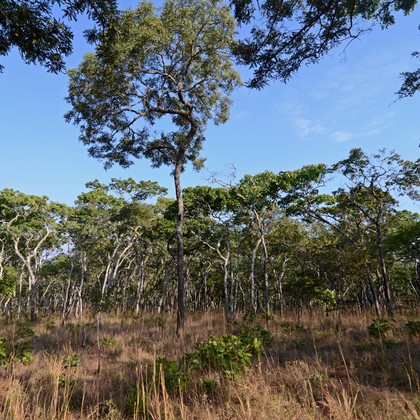
Miombo and other broadleaved woodland, also riverine forest and tall trees along rivers; outside the breeding season also in drier woodland. It forages in the canopy for caterpillars, other insects and fruit.
Where the bird is most at home, classified by the vegetation units of southern Africa.


Range and movements
Breeds in the miombo belt of Angola, Zambia, Malawi, northern and central Mozambique and northern Zimbabwe. In summer also in northern Botswana, north-eastern Namibia (Kavango and Zambezi) and scarcely in north-eastern South Africa (Limpopo and northern Kruger). After breeding a large part moves north to DR Congo and Tanzania; a second subspecies breeds in the savanna belt north of the equator, from Senegal to Ethiopia.
- Resident
- Summer visitor (c. Oct–Mar)
- Winter visitor (c. Apr–Sep)
- Passage (Mar–Apr, Oct–Nov)
- dark = core range, pale = thinly spread
How and when to look
Best from October to February in miombo in Zambia, Malawi or Zimbabwe, for example around Harare or at Kasanka. Listen at dawn for the fluty song and, with a yellow oriole, check the eye-stripe and the yellow wing.
Conservation status
Not threatened; common in miombo. The large-scale loss of miombo to charcoal production, farming and fire is a long-term risk, but the species is still widespread.
Scientific name
Oriolus auratus | Vieillot, 1817
Vieillot described the species in 1817 and placed it straight away in the genus where it still stands. The genus Oriolus was introduced in 1766 by Linnaeus. Oriolus is medieval Latin for the Golden Oriole; the name is onomatopoeic, echoing the Eurasian Golden Oriole's melodious calls. auratus is Latin for 'gilded', for the golden-yellow plumage. The specimen the first description was based on came from Africa (unspecified); later restricted to Ghana.