All species › Passerines › Orioles › Black-Winged Oriole
Black-Winged Oriole | Oriolus nigripennis
Zwartvleugelwielewaal | Oropéndola Alinegra
Black-Winged Oriole is a rainforest species which, within the region, lives only in northern Angola. It is the small, contrasting counterpart of Black-Headed Oriole: black head, black wings and a golden-yellow body, high in the canopy, where it often travels with mixed flocks.

Voice
Clear, liquid whistles in short phrases, softer and less full than in Western Oriole, such as oo-lee-oo, and a nasal, harsh nyeeh as a contact call.
Recording: Matthew L. Brady — CC BY-NC-SA 4.0 · shortened to the first 60 s, mono · xeno-canto
Identification
20–21 cm. Head, throat and upper breast are black, set off against golden-yellow underparts and a yellowish-green to yellow mantle, with a narrow yellow nape collar. The wings are almost wholly black, without a grey panel and with at most a small pale yellow spot on the primary coverts. The tail is black in the centre with broad yellow tips to the outer feathers. Bill pinkish red, eye red. The sexes are alike. Juveniles have a dull, streaked head and throat and a dark bill.
Confusion species
Western Oriole Oriolus brachyrynchus lives in the same forest and is the same size, but has blue-grey edges to the secondaries and tertials forming a grey wing panel, an olive-green mantle and olive-green central tail feathers. Black-Headed Oriole Oriolus larvatus is larger, has white edgings and a white patch on the black wing, and lives in woodland.
Habitat
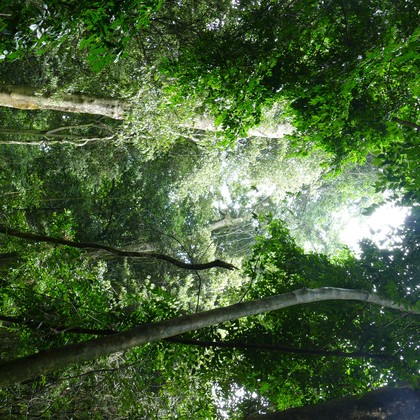
High canopy of moist lowland rainforest and gallery forest, also mature secondary forest and forest edges; often in mixed flocks of canopy birds. It eats insects, especially caterpillars, and fruit.
Where the bird is most at home, classified by the vegetation units of southern Africa.

Range and movements
Within the region only in northern Angola: Cabinda and the rainforest of the north-western provinces south to Cuanza Norte, with local records in gallery forest further east. Beyond the region from Sierra Leone and Liberia through the rainforest zone to South Sudan, western Uganda and the Congo Basin.
- Resident
- dark = core range, pale = thinly spread
How and when to look
In the Maiombe forest of Cabinda search for mixed flocks in the canopy and check every black-headed oriole for the wing: in this species it is all black. A telescope at a viewpoint above the forest helps.
Conservation status
Not threatened; widespread in the African rainforest. In Angola it is confined to a small forest area threatened by logging and clearance, but the species tolerates some disturbance.
Scientific name
Oriolus nigripennis | Verreaux & Verreaux, 1855
Verreaux & Verreaux described the species in 1855 and placed it straight away in the genus where it still stands. The genus Oriolus was introduced in 1766 by Linnaeus. Oriolus is medieval Latin for the Golden Oriole; the name is onomatopoeic, echoing the Eurasian Golden Oriole's melodious calls. nigripennis comes from the Latin niger, 'black', and penna, 'feather, wing' — for the black wings. The specimen the first description was based on came from Gabon River (Komo estuary), Gabon.