All species › Waders, gulls and terns › Sandpipers and snipes › Eurasian Whimbrel
Eurasian Whimbrel | Numenius phaeopus
Regenwulp | Zarapito Trinador
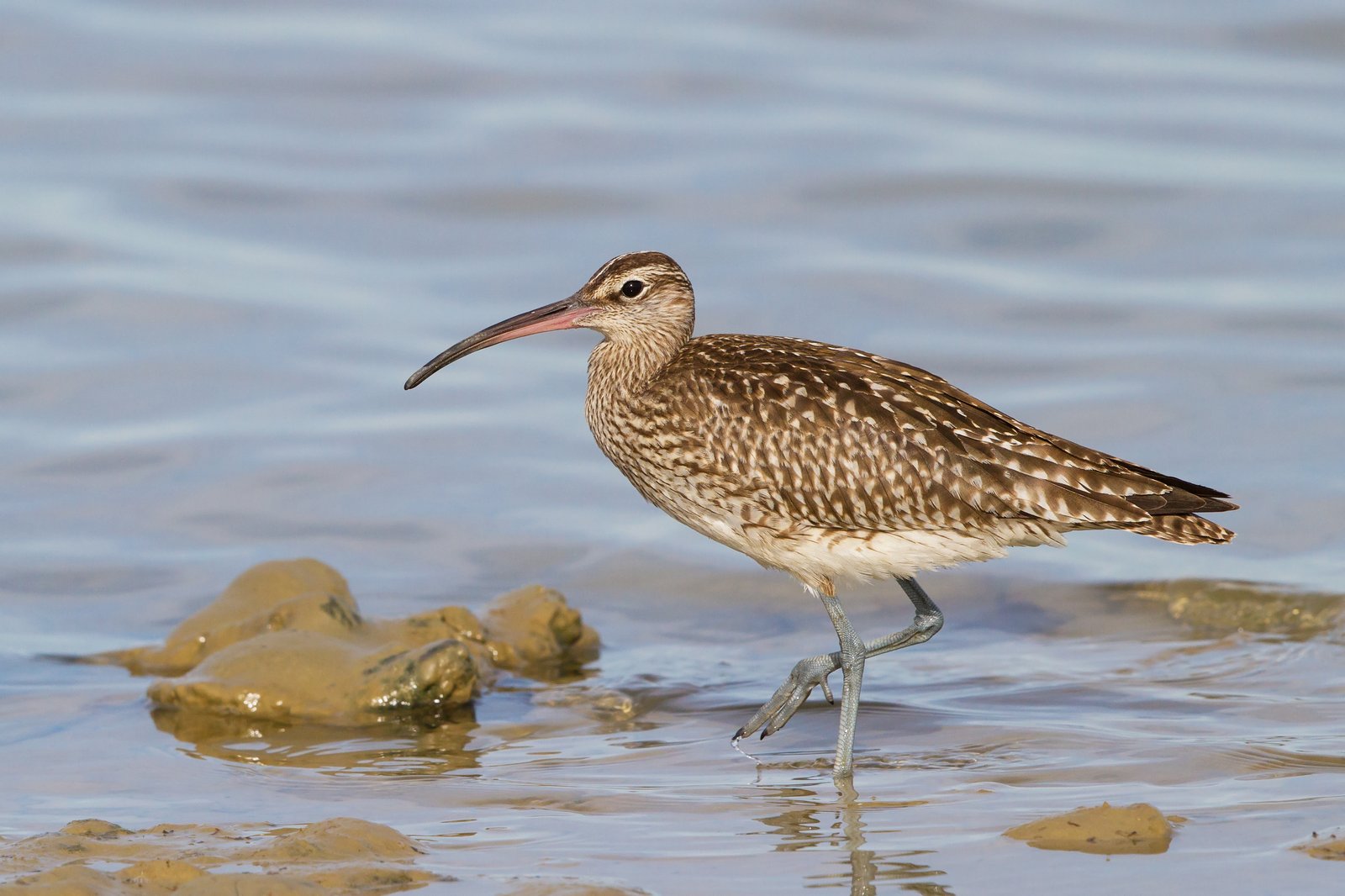
The Eurasian Whimbrel is a medium-sized brown curlew with a striped crown and a bill that bends down mainly towards the tip. Along the coast of southern Africa it is the common curlew of mangroves, rocky shores and estuaries, and its fast, whinnying whistled trill is often the first sign of its presence.
Voice
A fast, clear, whinnying whistled trill of usually seven even notes, pu-hu-hu-hu-hu-hu-hu, especially on taking off or flying over; the sound carries far across mudflats and mangroves.
Recording: Paul Kelly — CC BY-NC-SA 4.0 · converted to mono · xeno-canto
Identification
40–46 cm. Grey-brown with pale spots on the upperparts and fine streaking on the neck and breast; the belly is paler. The head has a dark crown with a pale central stripe, a pale supercilium and a dark eye-stripe. The bill is 6–9 cm long and bends mainly in the outer third, so that it looks kinked rather than evenly curved. The legs are blue-grey. In flight a white wedge shows on the lower back and rump; birds of the Asian subspecies have a more spotted, greyer rump.
Confusion species
Eurasian Curlew Numenius arquata is clearly larger and paler, with a much longer, evenly curved bill and an unstriped head. Bar-Tailed Godwit Limosa lapponica has a slightly upturned rather than decurved bill. In flight the whimbrel looks more compact than the curlew and has faster wingbeats.
Habitat
Tidal flats of mud and sand, mangroves, estuaries, rocky shores, reefs and sandy beaches; at high tide it roosts in mangroves or on rocks and coastal dunes. It feeds mainly on crabs, taken from the surface or pulled from their burrows, as well as worms and molluscs. Rare inland, usually on passage at large lakes or dams.
Where the bird is most at home, classified by the vegetation units of southern Africa.


Range and movements
Along almost the entire coast of the region, most numerous in Mozambique (Maputo Bay, Inhambane, Bazaruto) and KwaZulu-Natal, and also along the Eastern and Western Cape, the coast of Namibia (Walvis Bay, Sandwich Harbour) and Angola. Passage birds appear rarely inland, including in Zambia, Malawi and Botswana. It breeds in the subarctic zone from Iceland to eastern Siberia and winters along the coasts of Africa, southern Asia and Australasia.
- Resident
- Summer visitor (c. Oct–Mar)
- Winter visitor (c. Apr–Sep)
- Passage (Mar–Apr, Oct–Nov)
- dark = core range, pale = thinly spread
How and when to look
Best around high tide at roosts in mangroves and on rocky points, or at low tide on the flats of Mozambican and Natal estuaries. Listen for the seven-note trill: birds often fly over calling before they are seen on the ground.
Conservation status
Not threatened, but its flyways through East Asia and along the African coast are under pressure from land reclamation, mangrove loss and disturbance at roosts. In southern Africa numbers are fairly stable.
Scientific name
Numenius phaeopus | (Linnaeus, 1758)
Linnaeus described the species in 1758 as Scolopax Phaeopus; because it was later moved to another genus, the author and year stand in brackets. The genus Numenius was introduced in 1760 by Brisson. Numenius is Greek, from neos 'new' and mēnē 'moon', after the bill that recalls a crescent moon; noumēnios is the name of a bird in Hesychius. phaeopus is the Medieval Latin name for this bird, from Greek phaios 'dusky' and pous 'foot'. The specimen the first description was based on came from Sweden.