All species › Passerines › Grasshopper warblers › Fan-Tailed Grassbird
Fan-Tailed Grassbird | Catriscus brevirostris
Waaierstaartzanger | Yerbera Abanico
The Fan-Tailed Grassbird is a dark brown warbler of tall, wet grass in the east and north of the region, with a strikingly long, broad and graduated black tail. In the breeding season it gives its thin, high whistles from grass stems or in a short display flight; at other times it is secretive and easily overlooked.

Voice
A thin, high, metallic whistle, tseeee or trreeee, repeated at intervals from a grass stem or in a short display flight over the grass, sometimes followed by a soft wing-rattle. Call a soft tchek and a rattling alarm. It sings mainly in the wet summer.
Recording: Dries Van de Loock — CC BY-NC-SA 4.0 · converted to mono · xeno-canto
Identification
15–17 cm, almost half of it tail. Upperparts uniform dark brown, unstreaked, the crown slightly warmer. A narrow pale supercilium is weak. The throat is white, the breast and flanks pale buff, the belly white. The short, stubby bill is dark. The tail is long, broad and strongly graduated, blackish-brown, with pale to white tips below on the outer feathers; it is often fanned in flight and when excited. The sexes are alike. It clambers among the grass stems and flies low and heavily over the grass with the tail drooping.
Confusion species
Cape Grassbird Sphenoeacus afer is larger and heavily streaked on the back, with a rufous crown and a ragged, pointed tail. Moustached Grass Warbler Melocichla mentalis is larger and bulkier, with a rufous crown, a black malar stripe and a loud, bubbling song. Little Rush Warbler Bradypterus baboecala has a shorter, brown and rounder tail, fine spots on the breast and lives in reeds. Prinias and cisticolas are smaller, with a thinner bill. The combination of the long black fanned tail, uniform dark back and thin, high song is diagnostic.
Habitat
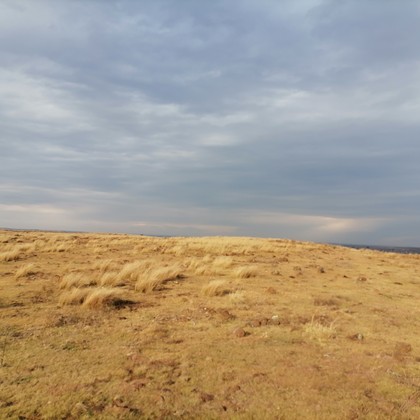
Tall, dense rank grass in vleis, damp hollows and along marshes and streams, also in montane grassland with bracken and in tall grass at forest edges, from sea level high into the mountains. It forages low among the stems and on the ground for insects.
Where the bird is most at home, classified by the vegetation units of southern Africa.


Range and movements
Within the region in eastern South Africa, from the Eastern Cape through KwaZulu-Natal and Eswatini to Mpumalanga and the Limpopo escarpment, then in the eastern highlands of Zimbabwe, central and northern Mozambique, Malawi, northern, eastern and western Zambia and on the Angolan plateau; scarce and local. Beyond the region widespread in East and Central Africa north to Ethiopia, and locally in West Africa.
- Resident
- Summer visitor (c. Oct–Mar)
- Passage (Mar–Apr, Oct–Nov)
- dark = core range, pale = thinly spread
How and when to look
Best from November to February when males sing: listen in tall, wet grass in vleis and montane grassland for the thin whistle and look for a dark bird with a long black tail flying up briefly above the grass, for example in the highlands at Wakkerstroom and Dullstroom and in the KwaZulu-Natal Midlands, or at Nyanga and on the Nyika Plateau. Outside the breeding season it is seldom seen.
Conservation status
Not threatened, but local and sensitive to the loss of tall, wet grassland through drainage, overgrazing, cultivation, afforestation and overly frequent fires. The species has declined for these reasons in parts of the south of its range.
Scientific name
Catriscus brevirostris | (Sundevall, 1850)
Sundevall described the species in 1850 as Bradypterus brevirostris; because it was later moved to another genus, the author and year stand in brackets. The genus Catriscus was introduced in 1851 by Cabanis. The origin of Catriscus is uncertain; the name may derive from a Greek verb meaning 'to chirp, to screech', for the call. brevirostris comes from the Latin brevis, 'short', and rostrum, 'bill' — for the short bill. The specimen the first description was based on came from upper Umlaas River, KwaZulu-Natal, South Africa.