All species › Passerines › Bulbuls › Fischer's Greenbul
Fischer's Greenbul | Phyllastrephus fischeri
Fischers loofbuulbuul | Bulbul de Fischer
Fischer's Greenbul is an olive-brown bulbul with a pale eye, of the coastal forests of East Africa. In the region it reaches only north-eastern Mozambique, where it can be one of the most frequently heard birds in the undergrowth of lowland forest.
No photograph of a living wild bird of this species with a suitable Creative Commons licence exists. Do you have one that meets the rules? Send it in.
Voice
A nasal, repeated chrrr and a dry, accelerating chatter, chuk-chuk-chrrrrr; when disturbed a grating alarm. Groups often call at length from dense undergrowth.
Recording: Kileo Jumah — CC0 · converted to mono · xeno-canto
Identification
17–18 cm. The upperparts are olive-brown, the tail more rufous brown. The head is slightly greyer olive, with pale lores. The throat is white and contrasts with the greyish-olive breast; the belly and undertail-coverts are pale yellowish. The most striking feature is the pale, creamy-white to pale grey eye. The bill is fairly long and slender, dark with a paler lower mandible; the legs are greyish pink. The sexes are alike, the male larger; juveniles have a darker eye and are more rufous above.
Confusion species
Sombre Greenbul Andropadus importunus also has a pale eye, but is greener, with a shorter bill and no white throat, and sings very differently; it sits higher and often alone. Terrestrial Brownbul Phyllastrephus terrestris is larger and browner, with a dark eye, and forages on the ground. Lowland Tiny Greenbul Phyllastrephus debilis is much smaller, with a grey head and yellow underparts. Cabanis's Greenbul Phyllastrephus cabanisi lives inland in higher forest; in the coastal forests of Mozambique Fischer's is the species to expect.
Habitat
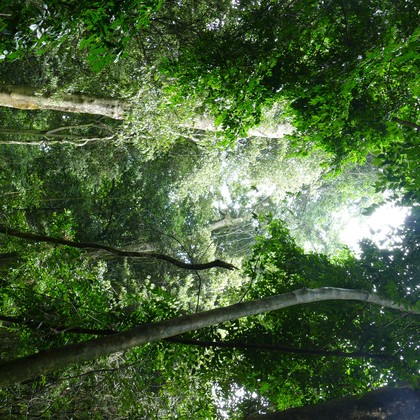
The understorey and mid-stratum of dry and moist coastal and lowland forest, dense thicket and riverine forest in the coastal belt. It forages in pairs or small groups for insects, low in shrubs and sometimes on the ground, often with mixed foraging flocks.
Where the bird is most at home, classified by the vegetation units of southern Africa.
Range and movements
In the region only in north-eastern Mozambique, in the coastal forests of Cabo Delgado and possibly Nampula. Reports from Malawi and inland Zambia probably involve confusion with other greenbuls. Beyond the region along the coast and in the coastal hinterland of Tanzania and Kenya to southern Somalia.
- Resident
- dark = core range, pale = thinly spread
How and when to look
All year. The pale eye combined with the white throat and life in small groups in the undergrowth is distinctive in the coastal forests of northern Mozambique. Record the sound with any observation: the nasal chatter separates the species from Sombre Greenbul, which also has a pale eye.
Conservation status
Not threatened and fairly common in the coastal forests of East Africa. Fragmentation of coastal forest by farming, charcoal production and development is the main threat.
Scientific name
Phyllastrephus fischeri | (Reichenow, 1879)
Reichenow described the species in 1879 as Criniger Fischeri; because it was later moved to another genus, the author and year stand in brackets. The genus Phyllastrephus was introduced in 1832 by Swainson. Phyllastrephus comes from the Greek phullon, 'leaf', and a form of strephō, 'to turn' — 'leaf-turner', for the way these birds search foliage for insects. fischeri honours the German physician and explorer Gustav Adolf Fischer (1848–1886), who collected birds in East Africa. The specimen the first description was based on came from Muniuni, near the mouth of the Tana River, Kenya.