All species › Waders, gulls and terns › Gulls and terns › Franklin's Gull
Franklin's Gull | Leucophaeus pipixcan
Franklins meeuw | Gaviota de Franklin
Franklin's Gull is a small dark-backed gull of the North American prairies, one of the few gulls that migrates across the equator to winter on the Pacific coast of South America. From there birds occasionally reach southern Africa, where the species is a rare but repeated vagrant.
Voice
A soft, nasal kuk or weeh-a; almost always silent in the region.
Recording: Dante Buzzetti — CC BY-NC-SA 4.0 · converted to mono · xeno-canto
Identification
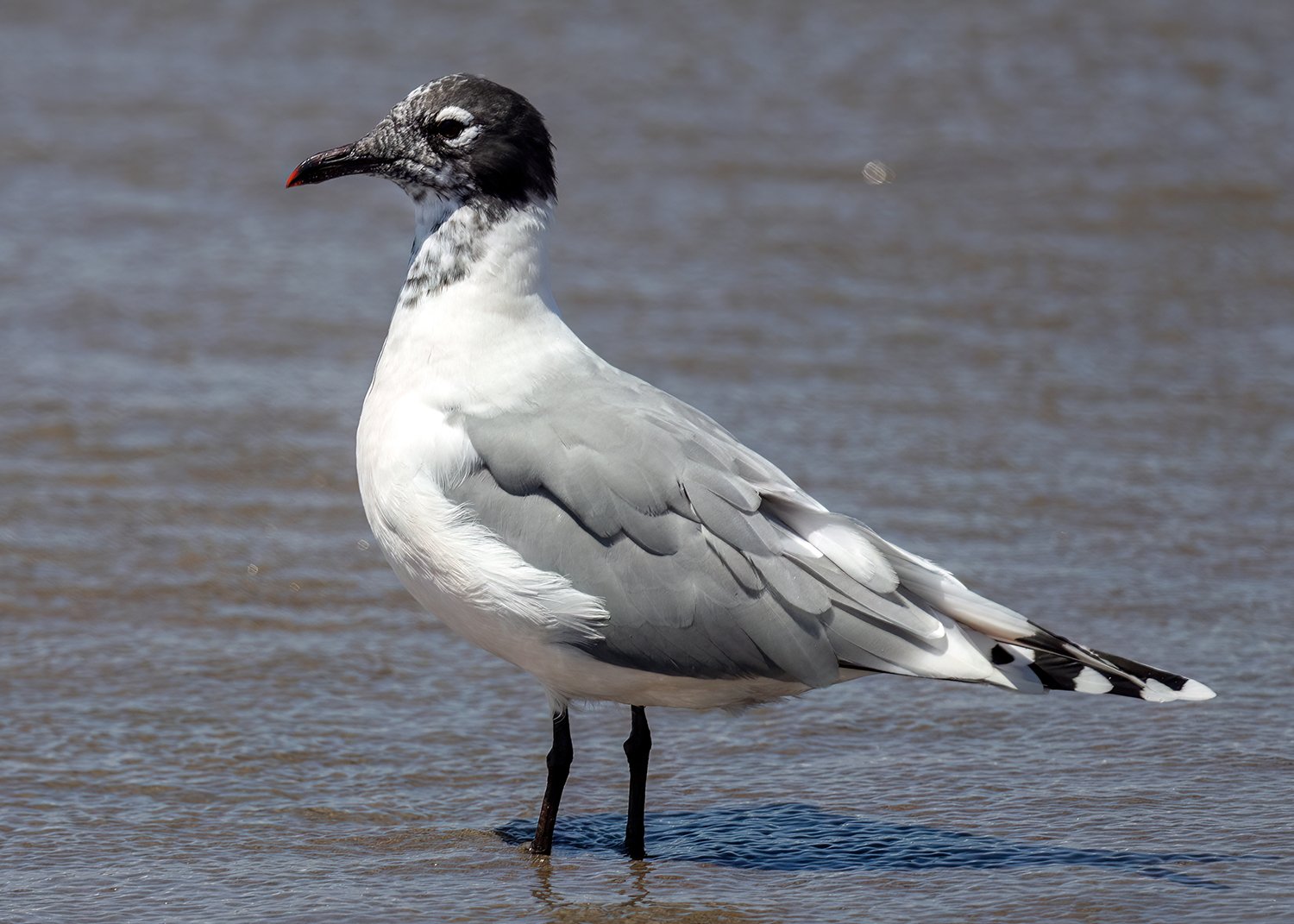
32–36 cm. A compact gull with a short, straight bill and fairly short legs. The upperparts are dark slate grey. The wingtip is distinctive: a white band separates the grey from a limited black area, and the primaries have broad white tips. In breeding plumage it has a black hood with broad white eye-crescents, a red bill and a pink flush on the breast; in non-breeding plumage a dark half-hood over the rear crown and ear coverts, with the white eye-crescents prominent. First-year birds have a white neck and underparts, a half-hood and a narrow black tail band that leaves the outer tail feathers white.
Confusion species
Laughing Gull Leucophaeus atricilla is larger, with a longer, drooping bill, less of a hood in non-breeding plumage and a wingtip without a white band or white tips. Grey-Headed Gull Chroicocephalus cirrocephalus is larger and paler grey, with a pale iris, a white wedge in the forewing and a grey rather than black hood. Black-Headed Gull Chroicocephalus ridibundus is paler grey, with only a dark ear spot in non-breeding plumage and a white forewing.
Habitat
Coastal lagoons, estuaries, harbours, sewage works and reservoirs, usually among Grey-headed or Hartlaub's Gulls. It eats insects, small fish and refuse, and often hawks insects in flight.
Where the bird is most at home, classified by the vegetation units of southern Africa.


Range and movements
A series of records in the region, mainly on the coast of the Western Cape and the central coast of Namibia, with a few inland in South Africa and rarely elsewhere. It breeds on the prairies of Canada and the northern United States and winters along the Pacific coast of Peru and Chile; it wanders to Europe, Africa and Asia.
How and when to look
Scan the gull flocks at the sewage works and lagoons around Cape Town and at Walvis Bay for a small dark-backed gull with a black half-hood. In flight the white band before the black wingtip stands out at once.
Conservation status
Not threatened; the IUCN lists it under the older name Larus pipixcan. The breeding population depends heavily on prairie marshes and fluctuates with drought. Of no conservation significance in southern Africa.
Scientific name
Leucophaeus pipixcan | (Wagler, 1831)
Wagler described the species in 1831 as Larus Pipixcan; because it was later moved to another genus, the author and year stand in brackets. The genus Leucophaeus was introduced in 1855 by Bruch. Leucophaeus is Ancient Greek, from leukos 'white' and phaios 'dusky'. pipixcan is a Nahuatl name for a kind of gull. The specimen the first description was based on came from Mexico.