All species › Woodpeckers and allies › Woodpeckers › Golden-Tailed Woodpecker
Golden-Tailed Woodpecker | Campethera abingoni
Goudstaartspecht | Pito Colidorado
The Golden-Tailed Woodpecker is the most widespread streaked woodpecker of the region, a bird of thornveld, savanna woodland and riverine forest. Its odd, nasal scream is one of the characteristic sounds of the bushveld.

Voice
A loud, nasal, rising scream, wheeeeaa or wheeeeaah, often repeated once, and a soft chik between pair members. It drums briefly and weakly.
Recording: Tony Archer — CC BY-NC-SA 4.0 · converted to mono · xeno-canto
Identification
About 21 cm. The back is olive-green with fine yellow to white barring and spots, the tail olive with golden-yellow shafts. The underparts are white to pale yellowish with dense black streaking, finer on the throat. The male has a red crown with black feather bases and a red, black-flecked moustachial stripe. The female has a black forehead and forecrown dotted white, a red hind crown and a black, white-flecked moustachial stripe. The eye is reddish-brown.
Confusion species
Bennett's Woodpecker (Campethera bennettii) and Speckle-Throated Woodpecker (Campethera scriptoricauda) are spotted, not streaked, below. Knysna Woodpecker (Campethera notata) is much darker and densely spotted, and occurs only along the south coast. Cardinal Woodpecker (Dendropicos fuscescens) is smaller, with a clearly barred back and brown forehead.
Habitat
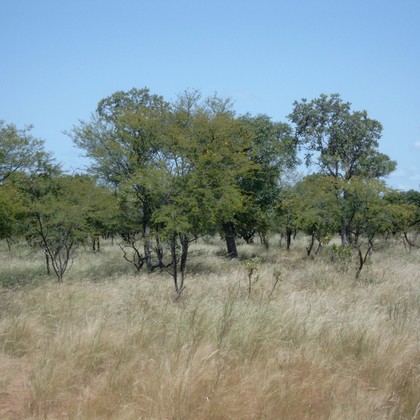
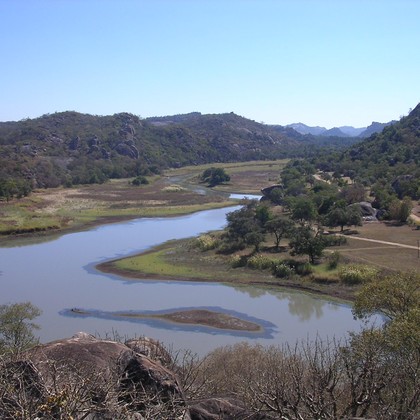
Acacia savanna, broadleaved woodland, mopane with taller trees, riverine and coastal forest; in the dry west mainly in riverine woodland. It forages singly or in pairs in the middle storey on branches and trunks, feeding mainly on ants and wood-boring beetle larvae.
Where the bird is most at home, classified by the vegetation units of southern Africa.

Range and movements
Widespread in the north and east of the region: Angola, Zambia, Malawi, Mozambique, Zimbabwe, northern and eastern Botswana, northern Namibia and eastern South Africa from Limpopo and Mpumalanga through KwaZulu-Natal to the Eastern Cape, and Eswatini. Absent from the dry Karoo and the south-west. Beyond the region patchily across sub-Saharan Africa, from Senegal to Sudan and in East Africa.
- Resident
- Summer visitor (c. Oct–Mar)
- Winter visitor (c. Apr–Sep)
- Passage (Mar–Apr, Oct–Nov)
- dark = core range, pale = thinly spread
How and when to look
In the bushveld of the Kruger National Park, Zululand and Zimbabwe the scream is the best lead; follow it and look for a woodpecker hitching up a trunk or thick branch. The female with her black-and-white flecked moustachial stripe is the easiest to identify.
Conservation status
Not threatened and common over most of its range. Loss of riverine forest and old savanna trees reduces nest sites locally.
Scientific name
Campethera abingoni | (Smith, 1836)
Smith described the species in 1836 as Chrysoptilus Abingoni; because it was later moved to another genus, the author and year stand in brackets. The genus Campethera was introduced in 1841 by Gray. Campethera comes from the Greek kampē, 'caterpillar', and thēras, 'hunter' — 'caterpillar hunter', for the insect diet of these woodpeckers. abingoni honours Montagu Bertie, 5th Earl of Abingdon (1784–1854), a British nobleman. The specimen the first description was based on came from Durban, KwaZulu-Natal, South Africa.