All species › Woodpeckers and allies › Woodpeckers › Yellow-Crested Woodpecker
Yellow-Crested Woodpecker | Chloropicus xantholophus
Geelkruinspecht | Pito Coronado
The Yellow-Crested Woodpecker is a Central African forest woodpecker that reaches the region only in the far north-west. The male has a yellow patch on the hind crown, a colour otherwise almost absent from the heads of African woodpeckers.

Voice
A fast, dry, harsh series, kweek-kweek-kweek, and a loud, long drum that slows slightly towards the end, the most conspicuous sound of the species.
Recording: Étienne Leroy — CC BY-NC-SA 4.0 · converted to mono · xeno-canto
Identification
About 21 cm, a fairly large, dark woodpecker with a powerful bill. The upperparts are plain olive-brown, the tail dark. The face is pale with a brown ear-patch and a brown moustachial stripe that together form a dark mask. The underparts are dark olive-brown, densely scaled and spotted with white. The male has a dark brown forehead and a golden-yellow hind crown; the female has an all dark brown crown without yellow.
Confusion species
Elliot's Woodpecker (Dendropicos elliotii) is smaller and greener, with plain olive-yellow underparts and no yellow crown. Cardinal Woodpecker (Dendropicos fuscescens) is smaller, streaked and barred on the back. Bearded Woodpecker (Chloropicus namaquus) has a black-and-white face pattern and lives in open savanna; the two barely overlap in the region.
Habitat
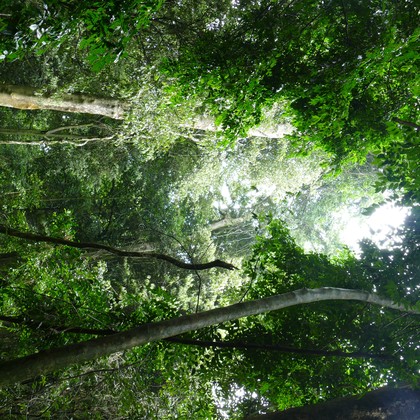
Rainforest edges, gallery forest, old secondary growth and clearings with dead trees in forest country. It forages in the middle and upper storeys on trunks and thick branches, hammering hard into dead wood for beetle larvae.
Where the bird is most at home, classified by the vegetation units of southern Africa.

Range and movements
Within the region only in northern and north-eastern Angola and the far north-west of Zambia (Mwinilunga). Beyond the region from Cameroon and Gabon east through the DR Congo and the Central African Republic to South Sudan, Uganda and western Kenya.
- Resident
- dark = core range, pale = thinly spread
How and when to look
In gallery forest around Mwinilunga or along forest edges in northern Angola listen for a long, powerful drum; the bird often sits high on a dead trunk at the forest edge. Check the crown: only the male shows the golden yellow.
Conservation status
Not threatened and fairly common in the core of its range; the IUCN lists it under the older name Dendropicos xantholophus. On the fringe within the region it is scarce and little studied; clearance of gallery forest is the main threat.
Scientific name
Chloropicus xantholophus | (Hargitt, 1883)
Hargitt described the species in 1883 as Dendropicus xantholophus; because it was later moved to another genus, the author and year stand in brackets. The genus Chloropicus was introduced in 1845 by Malherbe. Chloropicus comes from the Greek chlōros, 'green', and the Latin picus, 'woodpecker' — for the olive-green upperparts of these woodpeckers. xantholophus comes from the Greek xanthos, 'yellow', and lophos, 'crest' — for the male's yellow hindcrown. The specimen the first description was based on came from Gabon.