All species › Passerines › Bushshrikes › Gorgeous Bushshrike
Gorgeous Bushshrike | Telophorus viridis
Bonte bosklauwier | Bubú Verde
Gorgeous Bushshrike is one of the most colourful birds of the region: green above, with a scarlet throat bordered by a black breast band and a yellow to orange belly. Yet it is heard far more often than seen, for it lives low in dense thicket. In southern Africa the eastern form is also known as Four-Coloured Bushshrike.

Voice
A clear, whistled and endlessly repeated kong-kong-koit or gok-gok-weet, often as a duet in which the female adds a rattling chrrrr. Also a sharp tchik and a rasping alarm call. The call is one of the standard sounds of the coastal forests of Zululand and Mozambique.
Recording: Nathan Mixon — CC BY-NC-SA 4.0 · converted to mono · xeno-canto
Identification
18–20 cm. Crown, back, wings and tail are bright green; the lores and a short stripe above the eye are yellow to orange-yellow. The throat is fiery red, bordered by a broad black band that runs down from the gape along the throat and continues across the breast. Breast and belly are orange-yellow, becoming yellower towards the rear. The tail is green in the southern and western forms, black in the form of the East African coast. The female has a narrower, sometimes broken black band and a slightly duller throat. Juveniles are green above and greenish-yellow below, without red or black.
Confusion species
Bokmakierie Telophorus zeylonus has a yellow throat with a black gorget and a grey head, and lives in open country. Orange-Breasted Bushshrike Chlorophoneus sulfureopectus has a grey head, a yellow throat and no black band. The olive morph of Olive Bushshrike Chlorophoneus olivaceus is greenish-yellow below with no red throat. Juveniles can be told by their wholly green upperparts and the lack of grey on the head.
Habitat
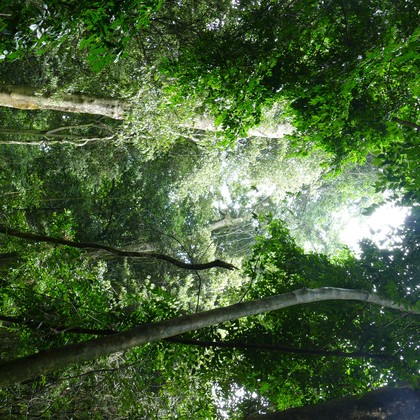
Dense evergreen thicket and the understorey of lowland forest: coastal and sand forest, riverine forest, dense thicket on termite mounds and forest edges, locally also in thick gardens. It forages low in the vegetation and on the ground, taking mainly insects.
Where the bird is most at home, classified by the vegetation units of southern Africa.

Range and movements
In South Africa in the north-eastern Eastern Cape, along the coast and in the lowlands of KwaZulu-Natal, in Eswatini and in eastern Mpumalanga and Limpopo; further through southern and central Mozambique, south-eastern Zimbabwe and southern Malawi. A separate form lives in northern Angola and north-western Zambia. Beyond the region along the coast of Tanzania and Kenya and in the forests of the Democratic Republic of the Congo, Congo and Gabon.
- Resident
- Summer visitor (c. Oct–Mar)
- Winter visitor (c. Apr–Sep)
- Passage (Mar–Apr, Oct–Nov)
- dark = core range, pale = thinly spread
How and when to look
Year-round in the coastal forests of Zululand, such as at St Lucia, Mkhuze and Ndumo, and in the sand forest of southern Mozambique. Follow the call right up to the bush and wait: the bird sometimes creeps out to an open branch to call, and then shows its red throat.
Conservation status
Not threatened and common in suitable thicket. Habitat is lost locally as coastal and sand forest is cleared for farming, tourism and timber, especially in Mozambique and KwaZulu-Natal.
Scientific name
Telophorus viridis | (Vieillot, 1817)
Vieillot described the species in 1817 as Laniarius viridis; because it was later moved to another genus, the author and year stand in brackets. The genus Telophorus was introduced in 1832 by Swainson. Telophorus was given without explanation; possibly from the Greek telos, 'perfect', and -phoros, 'bearing', for the Bokmakierie's colourful plumage. viridis is Latin for 'green' — for the green upperparts. The specimen the first description was based on came from Malembo on the Loango Coast, Cabinda (Angola).