All species › Passerines › Bushshrikes › Bocage's Bushshrike
Bocage's Bushshrike | Chlorophoneus bocagei
Grijze bosklauwier | Bubú de Bocage
Bocage's Bushshrike is a small, soberly marked bushshrike of the edges of the Central African rainforest, which within the region occurs only in northern Angola. With its black cap, white throat and grey back it looks more like a large flycatcher than its colourful relatives.

Voice
A loud, clear, repeated whistle, wheet-oo or hoo-wheet, often answered by a harsh rattling chrrr from the partner; also dry clicking calls. Pairs call a great deal from the canopy.
Recording: Martin St-Michel — CC BY-NC-SA 4.0 · converted to mono · xeno-canto
Identification
15–16 cm. Forehead and a narrow stripe above the lores are white; crown, nape and a mask through the eye are black. The back is grey with a greenish wash, the wings and tail dark grey with grey-green edges. Throat and underparts are white, with a light buff or cinnamon wash on the breast and flanks. The bill is black, the eye dark and the legs grey. The sexes are nearly alike. Juveniles have a greyer crown and fine dark barring on the upperparts, with buff edges to the wing coverts.
Confusion species
Brubru Nilaus afer has a broad white supercilium, a white wing stripe and a chestnut flank stripe, and lives in open woodland. Pink-Footed Puffback Dryoscopus angolensis lacks the black cap and white forehead and has pink legs. Chinspot Batis Batis molitor is much smaller, with a white wing stripe and a dark breast band or chin spot.
Habitat
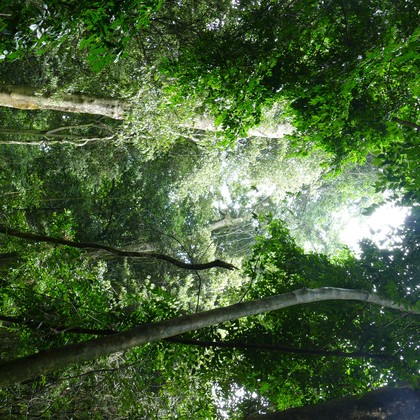
Edges of moist lowland and hill forest, secondary forest, old plantations and wooded patches in tall-tree savanna. It forages in the canopy and mid-storey for insects, often in mixed flocks with other arboreal birds.
Where the bird is most at home, classified by the vegetation units of southern Africa.

Range and movements
Within the region only in northern Angola, where it occurs on the southern fringe of the Congo Basin and in forest of the north-west. Elsewhere from south-eastern Nigeria and Cameroon east through Gabon, Congo, the Central African Republic and the Democratic Republic of the Congo to Uganda, Rwanda and western Kenya.
- Resident
- dark = core range, pale = thinly spread
How and when to look
A species for those birding in northern Angola. Listen along forest edges for the clear whistle from the canopy, then look for a small black, grey and white bird moving slowly through the foliage. Pairs call most in the early morning.
Conservation status
Not threatened; fairly common over most of its range and tolerant of secondary growth. In Angola the species is little known and probably local.
Scientific name
Chlorophoneus bocagei | (Reichenow, 1894)
Reichenow described the species in 1894 as Laniarius bocagei; because it was later moved to another genus, the author and year stand in brackets. The genus Chlorophoneus was introduced in 1851 by Cabanis. Chlorophoneus comes from the Greek khlōros, 'green', and phoneus, 'murderer' — a green shrike, for the predatory habits of shrikes. bocagei honours the Portuguese zoologist José Vicente Barbosa du Bocage (1823–1907). The specimen the first description was based on came from Yaoundé, Cameroon.