All species › Passerines › Bushshrikes › Orange-Breasted Bushshrike
Orange-Breasted Bushshrike | Chlorophoneus sulfureopectus
Oranje bosklauwier | Bubú Azufrado
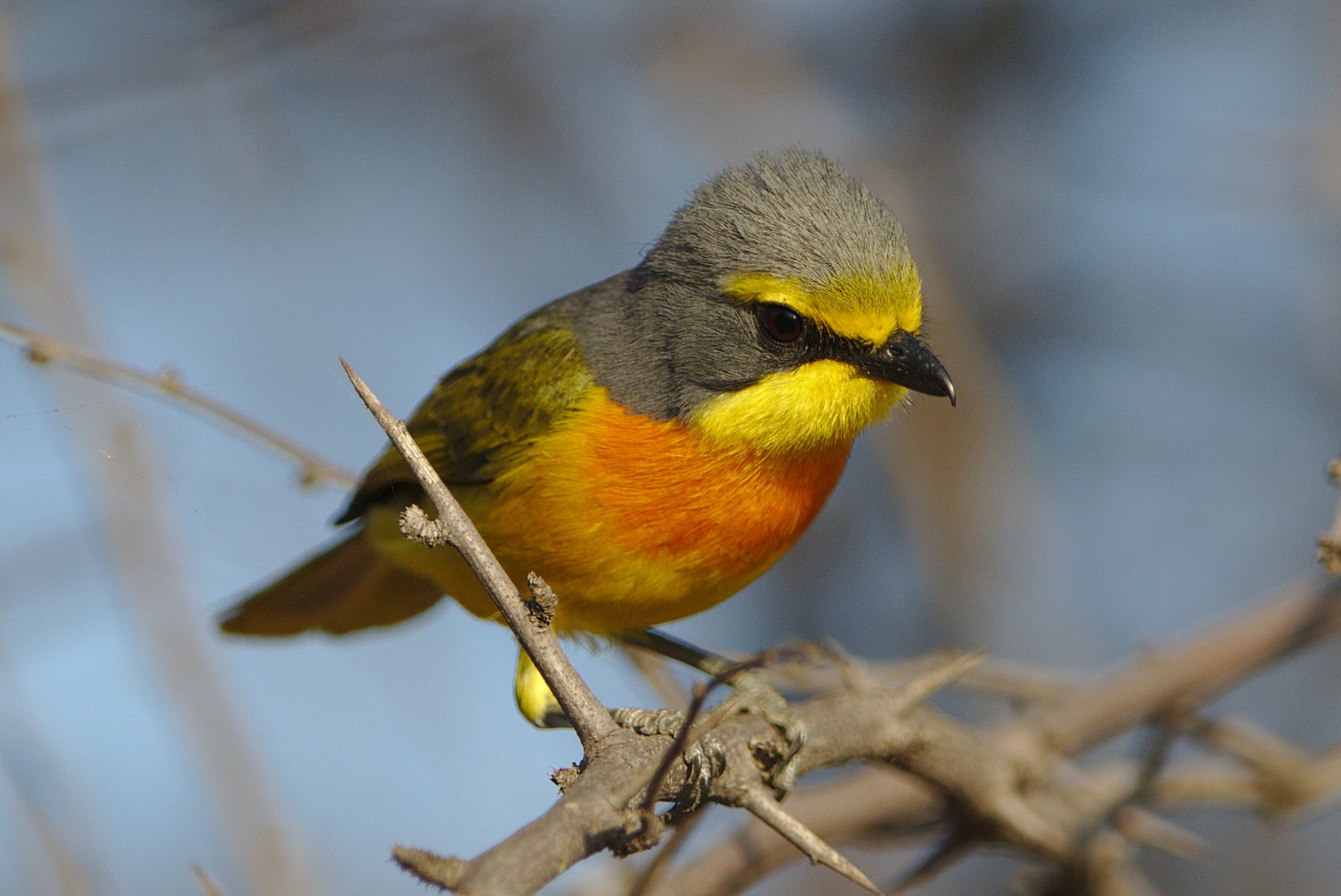
Orange-Breasted Bushshrike is the bushshrike of open woodland: a slim bird with a grey head, a green back and yellow underparts with an orange breast. It keeps to the canopy and is hard to see, but its monotonous whistled call carries a long way in the hot midday. It is the most widespread bushshrike in Africa.
Voice
A drawn-out series of even whistles, poo-poo-poo-poo-poooo, and a clear tee-oo, both repeated for hours, even in the heat of the day. Also a ticking tchik-tchik and a rattling alarm. The call is ventriloquial, which makes the bird hard to locate.
Recording: Jonathan Onongo — CC BY-NC-SA 4.0 · converted to mono · xeno-canto
Identification
18–19 cm. Crown and nape are grey; the forehead and a short supercilium are yellow. The male has a black mask through the eye, the female a grey mask. Back, wings and tail are olive-green, the tail feathers with yellow tips. The throat is bright yellow, the breast warm orange and the belly yellow again. The bill is black and slender for a bushshrike, the eye dark. Juveniles have a grey head without a yellow supercilium, are pale greenish-yellow below without orange and finely barred.
Confusion species
Grey-Headed Bushshrike Malaconotus blanchoti has a similar colour pattern but is much larger, with a heavy hooked bill, a yellow eye, white lores and no yellow supercilium. Olive Bushshrike Chlorophoneus olivaceus lives in forest and lacks the yellow supercilium; the ruddy morph has white lores. Black-Fronted Bushshrike Chlorophoneus nigrifrons of montane forest has a black forehead in the male and no yellow stripe.
Habitat
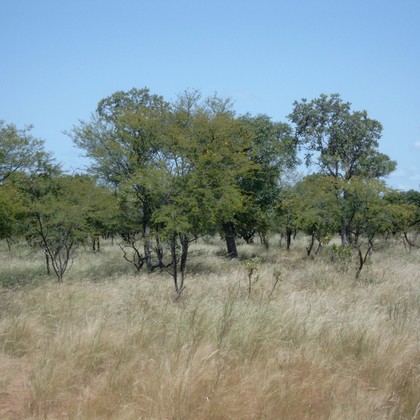
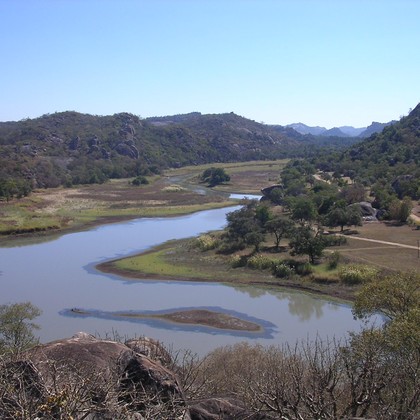
Acacia savanna, mixed woodland, miombo and mopane with dense patches, riverine woodland along rivers and dry watercourses, and into parks and large gardens with tall trees. It forages in the canopy and mid-storey for insects, especially caterpillars.
Where the bird is most at home, classified by the vegetation units of southern Africa.

Range and movements
Over most of the north and east of the region: Angola, Zambia, Malawi, Mozambique and Zimbabwe, northern and eastern Botswana, north-eastern Namibia, and in South Africa Limpopo, Mpumalanga, Eswatini, KwaZulu-Natal and the eastern Eastern Cape. Absent from the dry Kalahari and the south-west. Beyond the region over much of sub-Saharan Africa, from Senegal to Ethiopia and East Africa.
- Resident
- Summer visitor (c. Oct–Mar)
- Winter visitor (c. Apr–Sep)
- Passage (Mar–Apr, Oct–Nov)
- dark = core range, pale = thinly spread
How and when to look
Year-round in almost any wooded savanna in the north-east, such as the Kruger National Park, and along rivers in Zimbabwe and Botswana. Listen at midday for the monotonous poo-poo-poo-poo and then search the canopy patiently; the yellow throat catches the eye first.
Conservation status
Not threatened; common and widespread. The species tolerates disturbed savanna and plantings well, as long as enough trees with dense foliage remain.
Scientific name
Chlorophoneus sulfureopectus | (Lesson, 1831)
Lesson described the species in 1831 as Lanius (Tchagra) sulfureopectus; because it was later moved to another genus, the author and year stand in brackets. The genus Chlorophoneus was introduced in 1851 by Cabanis. Chlorophoneus comes from the Greek khlōros, 'green', and phoneus, 'murderer' — a green shrike, for the predatory habits of shrikes. sulfureopectus means 'sulphur-breasted', from the Latin sulfur, 'sulphur', and pectus, 'breast' — for the yellow-orange breast. The specimen the first description was based on came from Senegal (designated).