All species › Passerines › Bushshrikes › Olive Bushshrike
Olive Bushshrike | Chlorophoneus olivaceus
Olijfgroene bosklauwier | Bubú Oliváceo
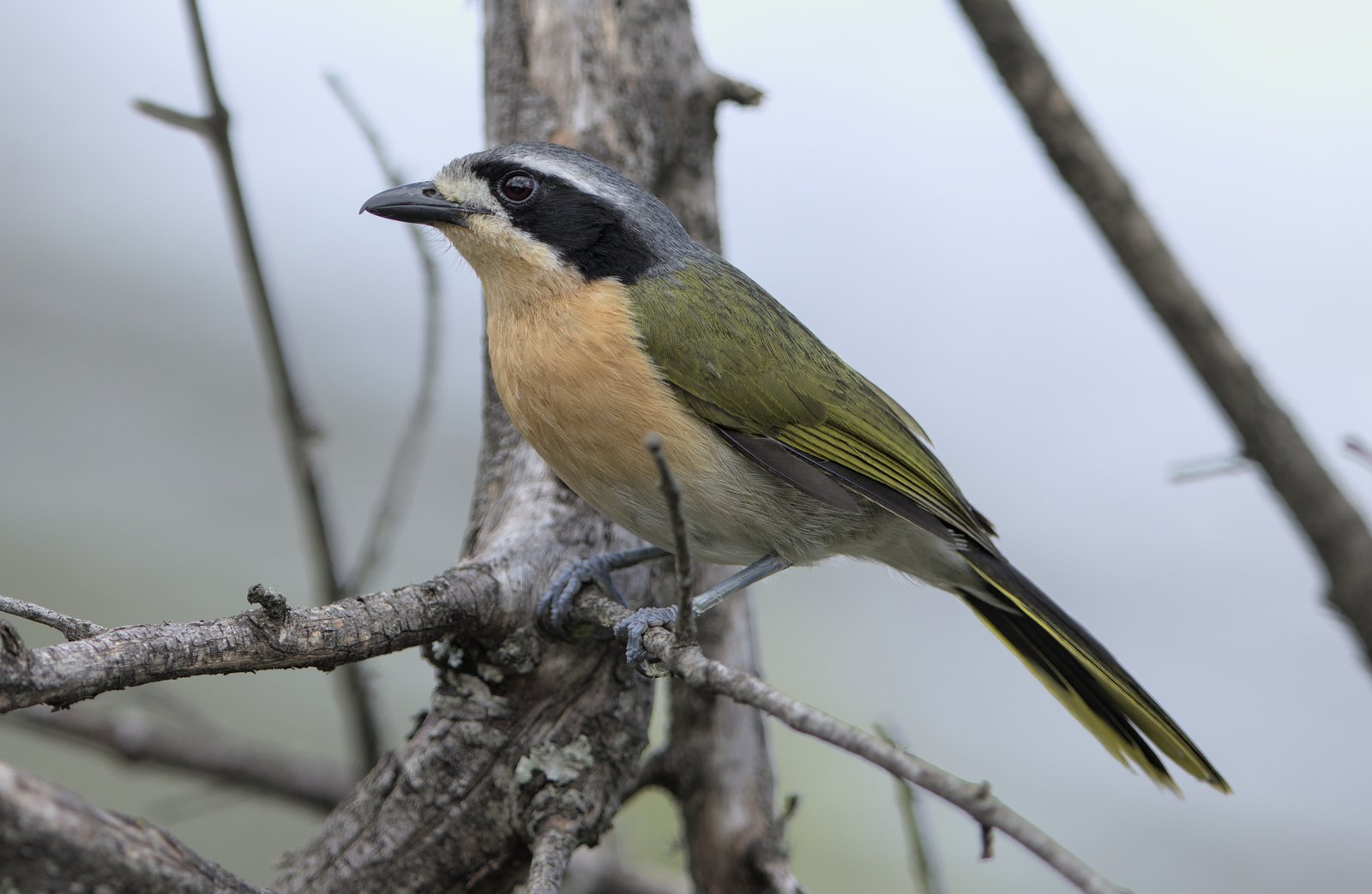
Olive Bushshrike is the bushshrike of the evergreen forests of the east and south of southern Africa. It occurs in two colour morphs, a ruddy and an olive one, which live side by side in the same forests. Its slow, whistled call is one of the familiar sounds of the forest from the Garden Route to the Zimbabwe highlands.
Voice
A series of four to eight clear, slow whistles, tew-tew-tew-tew, and a fast descending trill. Also a rattling chrrr from the female in duet and a ticking tchik. The repertoire varies from district to district, and the bird calls all year, most in the breeding season.
Recording: Walter Wallner — CC BY-NC-SA 4.0 · converted to mono · xeno-canto
Identification
17–18 cm. The ruddy morph has a grey crown and nape, white lores and a short white supercilium, a black mask in the male and a grey mask in the female, an olive-green back, and a buff to rufous throat and breast that become yellower towards the belly. The olive morph is green above, including the head, and greenish-yellow below, the male with a black eye mask. The tail is green with yellow tips. The bill is black and the eye dark. Juveniles are green above, pale yellow below with fine barring and a horn-coloured bill.
Confusion species
Orange-Breasted Bushshrike Chlorophoneus sulfureopectus has a yellow forehead and supercilium, a bright yellow throat and an orange breast, and lives in open woodland. Black-Fronted Bushshrike Chlorophoneus nigrifrons has a black forehead in the male and lacks the white lores. Gorgeous Bushshrike Telophorus viridis has a scarlet throat with a black band. Grey-Headed Bushshrike Malaconotus blanchoti is much larger, with a heavy bill and a yellow eye.
Habitat
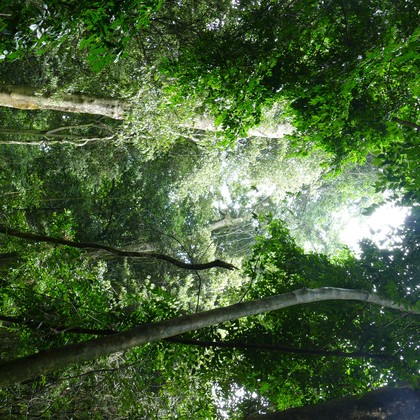
Evergreen montane forest, coastal forest and the denser parts of riverine forest, with their edges and thick understorey, and in winter also dense gardens and scrub near forest. It forages in the mid-storey and canopy, often in mixed flocks, for insects and their larvae.
Where the bird is most at home, classified by the vegetation units of southern Africa.

Range and movements
In South Africa from the forests of the southern coast in the Western Cape east through the Eastern Cape and KwaZulu-Natal to Eswatini and the escarpment of Mpumalanga and Limpopo. Further in the eastern highlands of Zimbabwe, in montane and coastal forest in Mozambique and in the highlands of Malawi. Beyond the region only in south-eastern Tanzania.
- Resident
- Summer visitor (c. Oct–Mar)
- Winter visitor (c. Apr–Sep)
- dark = core range, pale = thinly spread
How and when to look
Year-round in the forests of the Garden Route, such as at Knysna and in Tsitsikamma, and in Magoebaskloof and the Vumba. Listen for the slow whistles and then search the mid-storey; both morphs can occur in the same pair, which makes identification a nice puzzle.
Conservation status
Not threatened and common in larger forests. The species is sensitive to loss of indigenous forest, but also uses older gardens and forest edges near plantations.
Scientific name
Chlorophoneus olivaceus | (Shaw, 1809)
Shaw described the species in 1809 as Lanius olivaceus; because it was later moved to another genus, the author and year stand in brackets. The genus Chlorophoneus was introduced in 1851 by Cabanis. Chlorophoneus comes from the Greek khlōros, 'green', and phoneus, 'murderer' — a green shrike, for the predatory habits of shrikes. olivaceus is Latin for 'olive-green', for the olive-green upperparts. The specimen the first description was based on came from Algoa Bay, South Africa.