All species › Passerines › Bushshrikes › Many-Colored Bushshrike
Many-Colored Bushshrike | Chlorophoneus multicolor
Veelkleurige bosklauwier | Bubú Multicolor
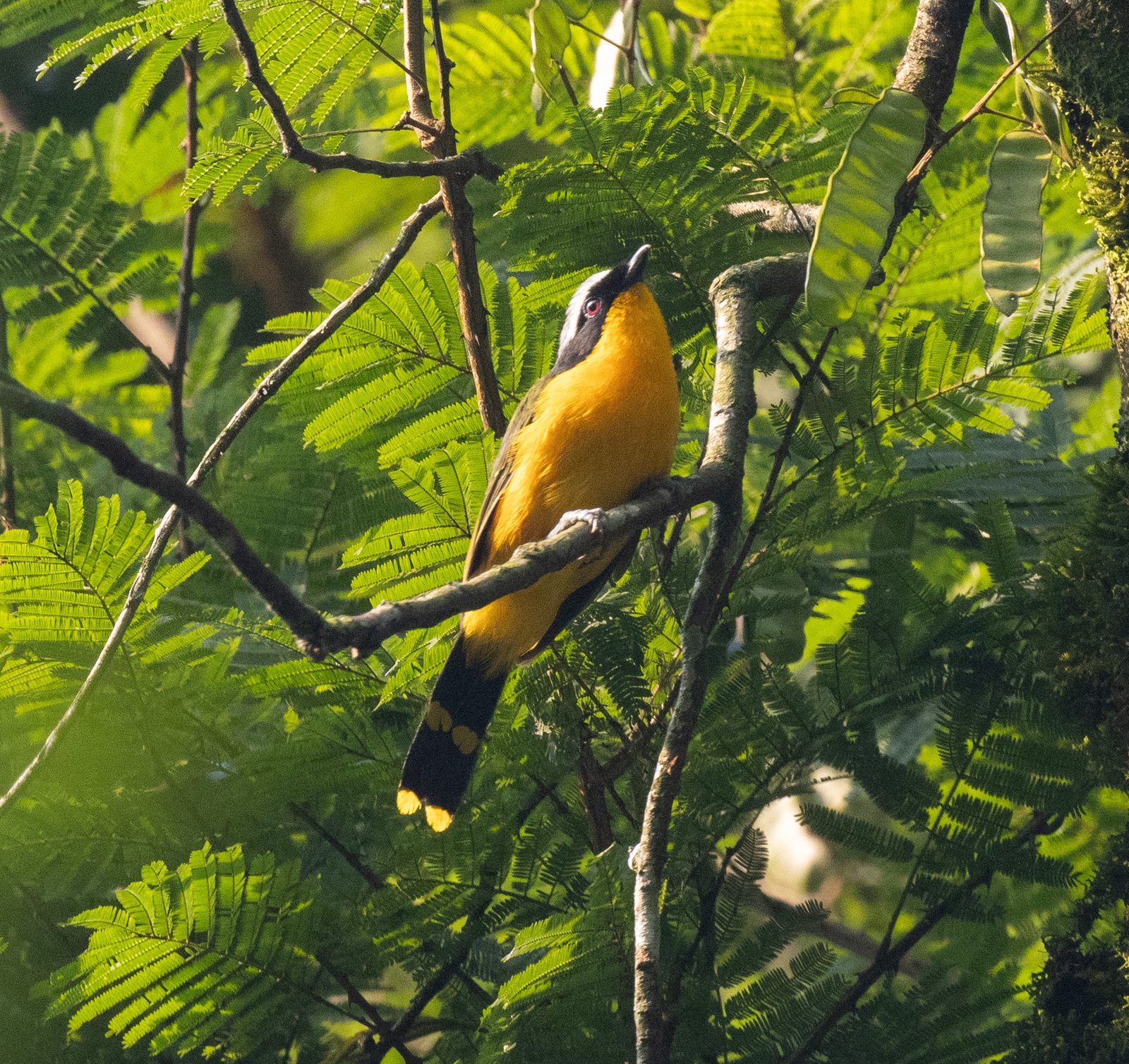
Many-Colored Bushshrike is a bushshrike of the Central and West African rainforest, which within the region occurs only in north-western Angola. The name refers to the different colour morphs of the underparts, from scarlet through orange and yellow to almost black. It lives high in the canopy and is found mainly by its call.
Voice
A soft, hollow and ventriloquial whistle, hoop or hoo-hoo, repeated endlessly from the canopy, and a buzzing or croaking kworr; the female answers with a rasping, swelling sound. The call carries far but is hard to locate.
Recording: Étienne Leroy — CC BY-NC-SA 4.0 · converted to mono · xeno-canto
Identification
19–20 cm. The male has a black forehead and a broad black mask, above it a narrow white or pale grey line, and a blue-grey crown and nape. Back and wings are green, the tail black to green with yellow tips. Throat and underparts are, depending on the morph, scarlet, orange, yellow or blackish, often with a redder breast and a yellower belly. The female has a grey instead of black mask and duller underparts. Juveniles are green above and pale greenish-yellow below with fine barring.
Confusion species
Black-Fronted Bushshrike Chlorophoneus nigrifrons is very similar, with the same morphs, but is slightly smaller, lacks the white line above the mask and lives in eastern montane forest; the ranges do not overlap. Gorgeous Bushshrike Telophorus viridis has a green head, a red throat with a black band and a yellow belly, and lives low in thicket. Bocage's Bushshrike Chlorophoneus bocagei is white below.
Habitat
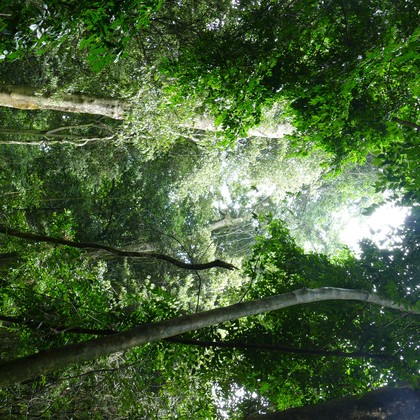
Tall, moist lowland and hill forest and its edges, old secondary forest and gallery forest. It forages high in the canopy and among creepers for large insects, often in mixed flocks.
Where the bird is most at home, classified by the vegetation units of southern Africa.

Range and movements
Within the region only in north-western Angola, on the southern fringe of the rainforest zone. Elsewhere from Sierra Leone along the Gulf of Guinea to Cameroon, and through Gabon, Congo and the Democratic Republic of the Congo to the montane forests of the Albertine Rift and western Uganda.
How and when to look
A species for those birding in northern Angola. Listen along forest edges for the hollow hoop and then search the highest canopy patiently; a telescope helps to establish the colour morph of the underparts.
Conservation status
Not threatened and fairly common over most of its range. In Angola the species is scarce and poorly known, and depends on what little rainforest remains.
Scientific name
Chlorophoneus multicolor | (Gray, 1845)
Gray described the species in 1845 as Laniarius multicolor; because it was later moved to another genus, the author and year stand in brackets. The genus Chlorophoneus was introduced in 1851 by Cabanis. Chlorophoneus comes from the Greek khlōros, 'green', and phoneus, 'murderer' — a green shrike, for the predatory habits of shrikes. multicolor is Latin for 'many-coloured', for the plumage of green, yellow, red and black. The specimen the first description was based on came from Accra, Ghana (designated later).