All species › Tubenoses › Petrels and shearwaters › Great Shearwater
Great Shearwater | Ardenna gravis
Grote pijlstormvogel | Pardela Capirotada
The Great Shearwater is a large, contrasting shearwater with a dark cap that breeds almost entirely on a handful of islands in the South Atlantic, chiefly in the Tristan da Cunha group and on Gough. After breeding almost the entire population migrates in a great loop to the North Atlantic.
Voice
Usually silent at sea, but loud, squealing and quarrelsome in feeding frenzies around trawlers. At the colonies a sustained, wailing eeoo-eeoo at night, produced by thousands of birds at once.
Recording: Sven Normant — CC BY-NC-SA 4.0 · converted to mono · xeno-canto
Identification
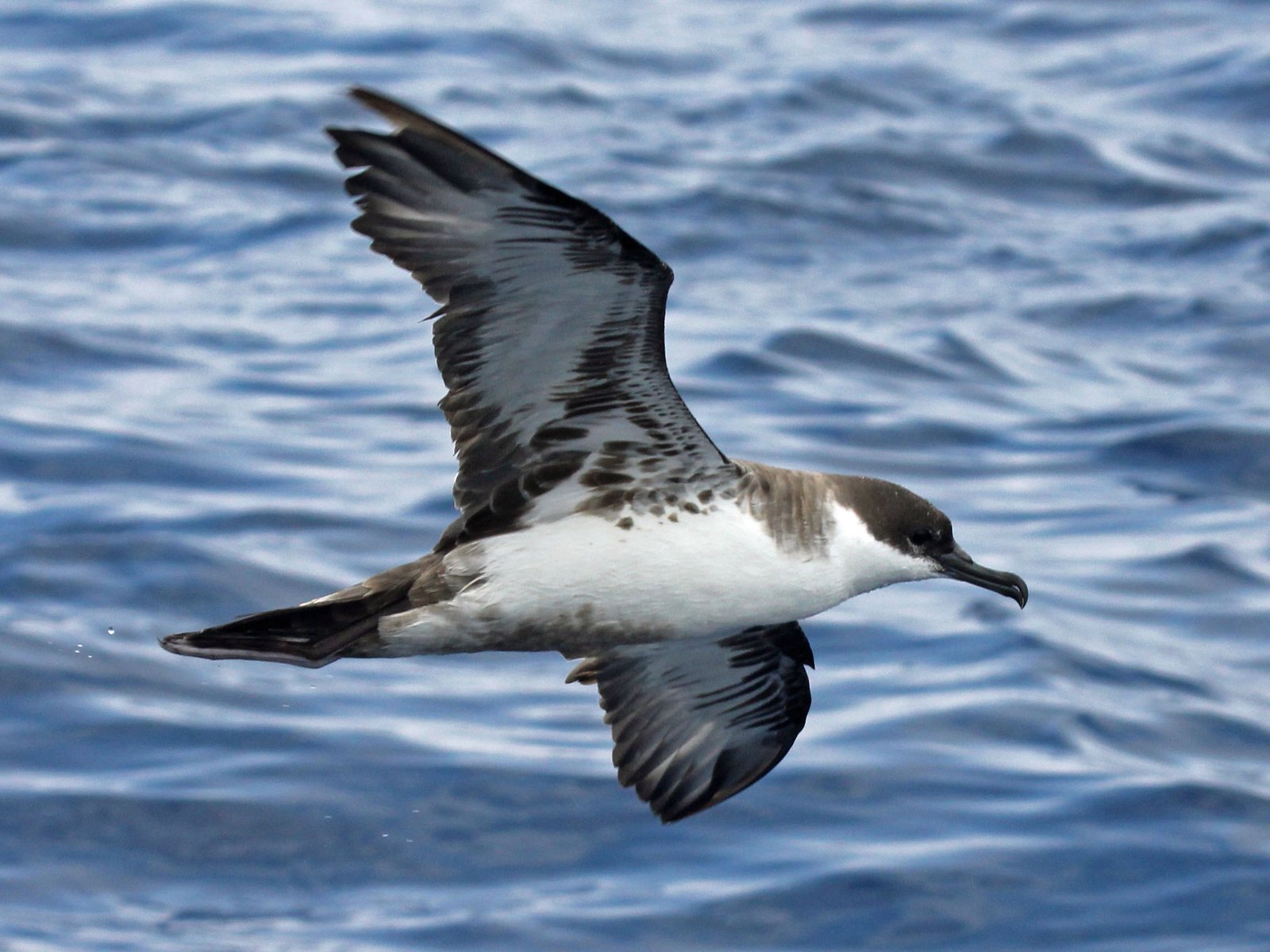
Large, 43 to 51 cm, with long, fairly narrow wings. The upperparts are grey-brown with pale fringes forming a scaly pattern. A sharply demarcated blackish-brown cap extends below the eye and is separated from the back by a white nape collar. The rump shows an obvious white horseshoe-shaped band above the dark tail. The underparts are white with a dusky belly patch and dark undertail coverts; the white underwing has dark margins and dark streaks across the coverts. The slender bill is dark. It flies more stiffly and faster than Scopoli's Shearwater, with rapid wingbeats and short glides.
Confusion species
Scopoli's Shearwater (Calonectris diomedea) has a yellow bill, a soft grey head without a sharp cap, no white rump band and a clean white belly. White-Headed Petrel (Pterodroma lessonii) has a white head and a dark underwing. Atlantic Petrel (Pterodroma incerta) has a dark breast and a wholly dark underwing. At distance the combination of cap, collar and rump band can also suggest a young albatross, but that is much larger.
Habitat
Open sea, especially over the edge of the continental shelf and in cold, productive water. It dives and seizes fish and squid at the surface and readily follows trawlers and whales. It rests in dense rafts on the water. It breeds in burrows among tussock grass on subantarctic islands.
Where the bird is most at home, classified by the vegetation units of southern Africa.
Range and movements
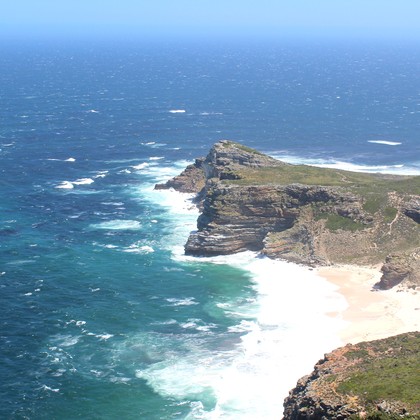
Passes in large numbers along the west coast, from Namibian waters to the Western and Southern Cape, especially in spring and autumn; in summer also regular at trawlers on the Agulhas Bank. Rare east of Port Elizabeth and only exceptional off KwaZulu-Natal and Mozambique. It breeds on Tristan da Cunha, Nightingale, Inaccessible, Gough and in small numbers in the Falkland Islands, and winters in the North Atlantic, north to Greenland and off western Europe.
- Resident
- Passage (Mar–Apr, Oct–Nov)
- dark = core range, pale = thinly spread
How and when to look
Pelagic trips from Cape Town in October–November and March–April sometimes produce hundreds at the trawlers. Look for the dark cap with white collar and the white rump, best seen as the bird banks over the water. The species is seldom seen from shore.
Conservation status
Not threatened. The world population numbers millions of pairs, almost all on Nightingale, Inaccessible and Gough. Bycatch in longline fisheries and the impact of introduced mice on Gough, which attack chicks, are the main threats; a mouse eradication project is under way on Gough.
Scientific name
Ardenna gravis | (O'Reilly, 1818)
O'Reilly described the species in 1818 as Procellaria Gravis; because it was later moved to another genus, the author and year stand in brackets. The genus Ardenna was introduced in 1853 by Reichenbach. Ardenna goes back to Artenna, the spelling the Italian naturalist Ulisse Aldrovandi used for a seabird in 1603 and which Reichenbach cited when naming the genus. gravis is Latin for 'heavy' or 'weighty'. The specimen the first description was based on came from Cape Farewell, Greenland.