All species › Woodpeckers and allies › Honeyguides › Green-Backed Honeybird
Green-Backed Honeybird | Prodotiscus zambesiae
Grijze honingspeurder | Indicador del Zambeze
The Green-Backed Honeybird is a small grey-green honeyguide of miombo woodland, no bigger than a white-eye. It seeks its food, wax and scale insects, high in the canopy and lays its eggs in the nests of small passerines.

Voice
Usually silent. A thin, high tseet and a soft crackling wing sound during the display flight.
Recording: Carl Beel — CC BY-NC-SA 4.0 · converted to mono · xeno-canto
Identification
About 11–12 cm, small and slim, with a short, fine bill. The upperparts are olive-green with a grey head, the underparts pale grey to dingy white, whitest on throat and belly. The outer tail feathers are white and show as the bird flies off; the white downy tufts at the sides of the rump are sometimes visible in display. The sexes are alike.
Confusion species
Brown-Backed Honeybird (Prodotiscus regulus) is larger, browner on the back and greyer below, and lives more in forest edges and gardens. Willow Warbler (Phylloscopus trochilus) and white-eyes lack the white outer tail feathers and forage more actively. Least Honeyguide (Indicator exilis) has a thicker bill and a dark malar stripe.
Habitat
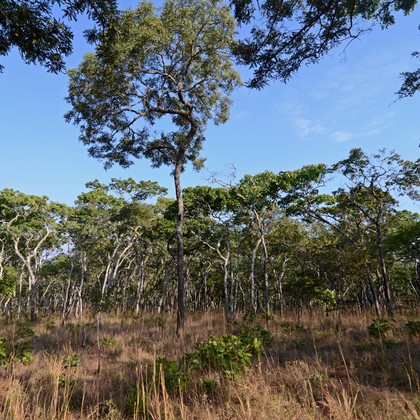
Miombo and other broadleaved woodland, also forest edges and riverine woodland. It gleans scale insects and wax from branches and leaves high in the canopy and hawks insects in flight. It lays in the nests of small passerines, probably mainly white-eyes and eremomelas.
Where the bird is most at home, classified by the vegetation units of southern Africa.
Range and movements
The miombo of the north and east of the region: Angola (centre and east), Zambia, Malawi, Zimbabwe (chiefly the north and east) and central and northern Mozambique. Beyond the region to southern DR Congo, Tanzania and Kenya.
- Resident
- dark = core range, pale = thinly spread
How and when to look
Hard to find; in mixed feeding flocks in miombo, watch for a small grey-green bird that shows white tail sides as it takes off. The breeding season, from September to December, is the best time, when the display flight is visible above the canopy.
Conservation status
Not threatened. Its inconspicuousness makes it under-recorded; large-scale clearance of miombo for charcoal and agriculture reduces habitat locally.
Scientific name
Prodotiscus zambesiae | Shelley, 1894
Shelley described the species in 1894 and placed it straight away in the genus where it still stands. The genus Prodotiscus was introduced in 1850 by Sundevall. Prodotiscus is a diminutive of Prodotes, an old name for honeyguides, from the Greek prodotēs, 'betrayer' — for birds that 'betray' bees' nests to people and honey badgers. zambesiae refers to the Zambezi and its surrounding region, where the species was discovered. The specimen the first description was based on came from Zomba, Malawi.