All species › Passerines › Hylias › Green Hylia
Green Hylia | Hylia prasina
Hylia | Hilia Verde
The Green Hylia is a sturdy, olive-green forest warbler with a long pale eyebrow and a short tail. With the Tit Hylia it forms a small family of its own of West and Central African forest birds, and it is heard far more often than seen. In the region it occurs only in north-western Angola.

Voice
A loud, clear, penetrating whistle of two equal notes, tee-tee or wheet-wheet, often repeated for long periods and audible from far off. Also a harsh, rasping chrrr in alarm. The voice is much louder than the small bird suggests.
Recording: Paul Lenrumé — CC BY-NC-SA 4.0 · converted to mono · xeno-canto
Identification
11–12 cm. Upperparts dark olive-green, crown slightly darker. A long, broad yellowish to dull yellow supercilium extends well behind the eye, bordered by a dark eye-stripe. The underparts are greyish olive-green, slightly paler and yellower on throat and belly. The bill is rather short, stout and dark; the legs are olive-brown. The tail is short and square. The sexes are alike; juveniles are greener with a weaker supercilium. It moves quietly through dense foliage and creepers at mid-level and in the canopy, often in mixed flocks.
Confusion species
Yellow Longbill Macrosphenus flavicans has a much longer, slightly curved bill, a yellower belly and lacks the long supercilium. Yellow-Browed Camaroptera Camaroptera superciliaris also has a yellow eyebrow, but whitish underparts, a pale bill and a cocked tail. Little Greenbul Eurillas virens is larger, with no supercilium. Green Crombec Sylvietta virens is smaller, brownish, with a practically absent tail. The two-note whistle is often the best clue.
Habitat
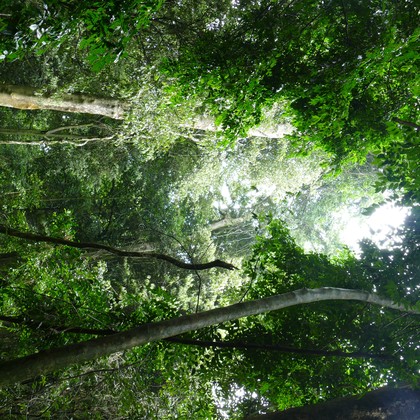
Moist lowland forest, gallery forest, secondary forest and forest edge with dense creepers, also old coffee and cocoa plantations under shade trees. It forages from mid-level up into the canopy, gleaning insects and spiders from leaves and twigs, and travels with mixed flocks of greenbuls, longbills and sunbirds. It builds a globular nest with a side entrance, low in dense foliage.
Where the bird is most at home, classified by the vegetation units of southern Africa.

Range and movements
In the region confined to north-western Angola: Cabinda and the forested slopes of the western escarpment, from Uíge and Cuanza Norte south to Cuanza Sul. Beyond the region widespread in the forest belt of West and Central Africa, from Gambia and Senegal to Uganda, western Kenya and north-western Tanzania, and on Bioko.
- Resident
- dark = core range, pale = thinly spread
How and when to look
In the forests of Cabinda and the escarpment at Kumbira and Uíge listen for the repeated two-note whistle; the bird itself usually stays hidden in creepers. With mixed flocks, wait for the moment it appears on an open branch and then look for the long pale supercilium.
Conservation status
Not threatened; common across its large range. In Angola vulnerable to ongoing clearance and conversion of forest on the escarpment, but the species tolerates secondary forest and shade plantations.
Scientific name
Hylia prasina | (Cassin, 1855)
Cassin described the species in 1855 as Sylvia prasina; because it was later moved to another genus, the author and year stand in brackets. The genus Hylia was introduced in 1859 by Cassin. Hylia comes from the Greek hulēeis, 'dwelling in the woods', from hulē, 'woodland, forest'. prasina comes from the Greek prasinos, 'leek-green' — for the green upperparts. The specimen the first description was based on came from Mondah River, Gabon.