All species › Passerines › Cisticolas › Grey-Backed Cisticola
Grey-Backed Cisticola | Cisticola subruficapilla
Rotsgraszanger | Cistícola Dorsigrís
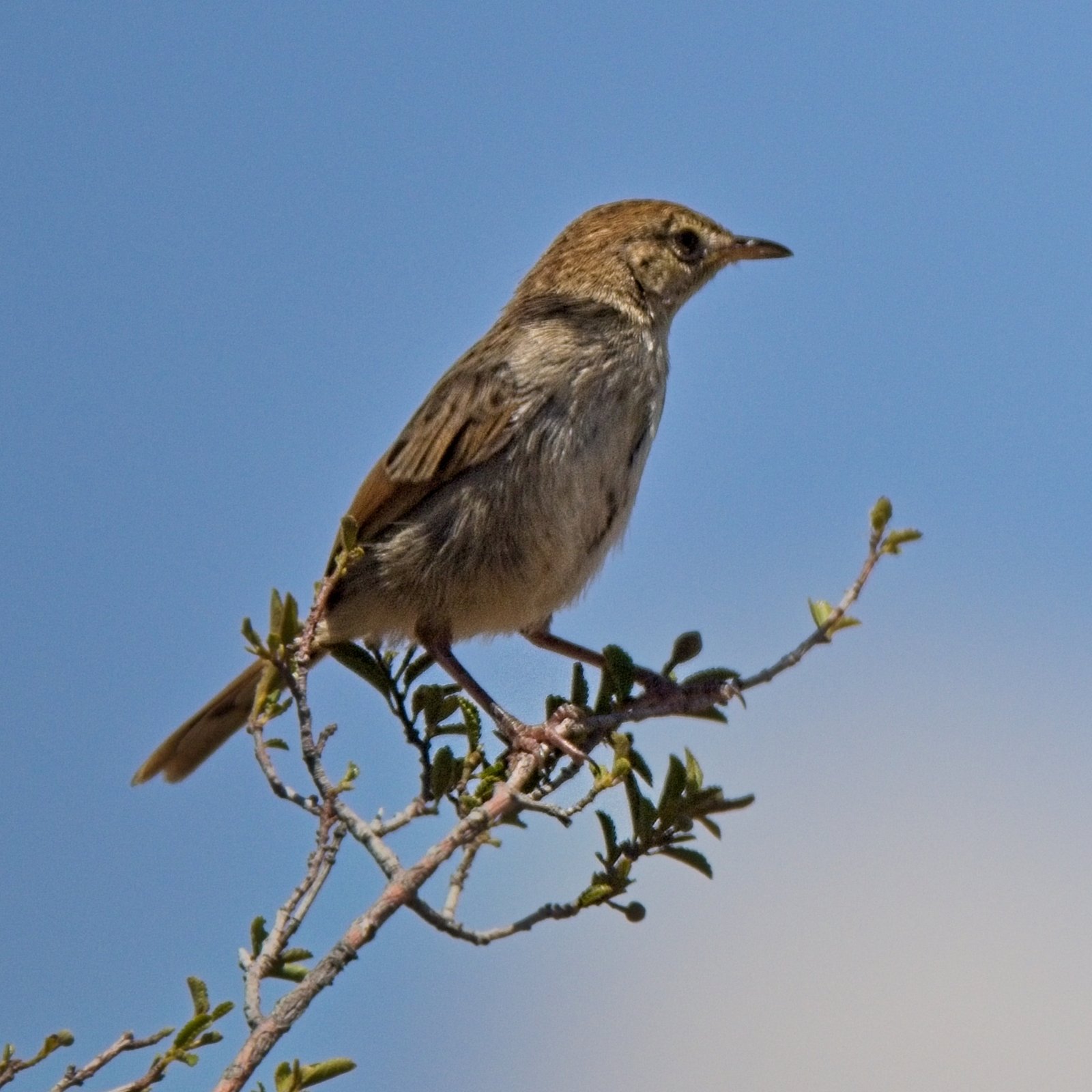
The Grey-Backed Cisticola is the cisticola of fynbos, renosterveld and Karoo shrubland in the west of southern Africa: a grey, heavily black-streaked bird with a rufous cap. It is almost endemic to the region and in the west replaces the Wailing Cisticola of the eastern grasslands.
Voice
A soft, rolling prrrrt followed by a sharp, whistled wheee-phweee, and variations on this with quick trills and high whistles, sung from a bush top. Contact and alarm calls are a dry tsik and a scolding trrrr. Pairs often answer each other.
Recording: Walter Wallner — CC BY-NC-SA 4.0 · shortened to the first 60 s, mono · xeno-canto
Identification
13–14 cm. The crown is dark rufous, little or not streaked, merging into a rufous-tinged nape. The back is cool grey with broad black streaks, so that the bird looks grey-and-black striped above. The flight feathers are edged rufous-brown. The face is greyish with pale lores, and the underparts are greyish white with a faint buff wash on the flanks. The fairly long tail is grey-brown with a black band before the white tips, well visible from below. The sexes are alike and there is hardly any seasonal difference. Northern birds (Namibia, southern Angola) are browner on the back and warmer buff below. Juveniles have a browner, streaked crown.
Confusion species
Wailing Cisticola Cisticola lais of the eastern montane grasslands is larger, browner and buff below, and gives a characteristic plaintive wheeeuu; in the Eastern Cape the two meet and intermediates are known. Zitting Cisticola Cisticola juncidis is smaller and shorter-tailed, has a streaked crown and sings a monotonous zit-zit-zit in song flight. Karoo Prinia Prinia maculosa has a much longer tail, no rufous cap and black spots on a yellow-tinged breast. Rufous-Eared Warbler Malcorus pectoralis has rufous ear patches, a narrow black breast-band and a very long, cocked tail. Tinkling Cisticola Cisticola rufilatus has a white supercilium and a rufous tail and lives further north-east on Kalahari sand. A grey, black-streaked back, rufous cap and life in low shrubland are distinctive together.
Habitat
Low shrubland: fynbos, renosterveld, strandveld, Succulent and Nama Karoo, grassy slopes and saltmarsh flats along estuaries. It occurs from sea level high into the mountains. It forages low among the shrublets and at the base of bushes, usually singly or in pairs.
Where the bird is most at home, classified by the vegetation units of southern Africa.



Range and movements
Within the region in the Western Cape (almost throughout, from the Cape Peninsula to the Karoo), the Northern Cape (Namaqualand, Bushmanland and the western Karoo) and the west and centre of the Eastern Cape, where it grades into Wailing Cisticola. Further through western and central Namibia, from the Orange River north over the interior and escarpment into extreme south-western Angola. It does not occur outside southern Africa.
- Resident
- Summer visitor (c. Oct–Mar)
- Winter visitor (c. Apr–Sep)
- Passage (Mar–Apr, Oct–Nov)
- dark = core range, pale = thinly spread
How and when to look
Present all year and common; in the winter-rainfall Western Cape the song is heard most from July to November. Good sites are West Coast National Park, Cape Point, Namaqua National Park and the Tankwa Karoo. Look for a bird singing on a bush top and then diving into the bush; watch for the grey, black-streaked back as soon as it turns.
Conservation status
Not threatened. Common across much of its range and not choosy within low shrubland. Locally habitat is lost to ploughing of renosterveld and to coastal development.
Scientific name
Cisticola subruficapilla | (Smith, 1843)
Smith described the species in 1843 as Drymoica subruficapilla; because it was later moved to another genus, the author and year stand in brackets. The genus Cisticola was introduced in 1829 by Kaup. Cisticola combines the Ancient Greek kisthos 'rock-rose' with the Latin colere 'to dwell'. subruficapilla comes from the Latin sub, 'somewhat', rufus, 'rufous', and capillus, 'hair of the head' — for the faintly rufous crown. The specimen the first description was based on came from Cape Town area, South Africa.