All species › Passerines › Cisticolas › Tinkling Cisticola
Tinkling Cisticola | Cisticola rufilatus
Roodstaartgraszanger | Cistícola Gris
The Tinkling Cisticola is a slim, fairly long-tailed cisticola of dry woodland on Kalahari sand, with a warm rufous crown and tail and an obvious white supercilium. For a cisticola it has a strikingly patterned head, and its clear, tinkling song gives it away from afar.

Voice
The song is a series of clear, somewhat melancholy, bell-like notes, tee-tee-tee-tee or tink-tink-tink, delivered from a bush top or low branch. There is also a drawn-out, plaintive tuuuu-ee. The alarm is a dry, scolding tsik-tsik and a churring trrrrr, often given by both members of a pair.
Recording: Tony Archer — CC BY-NC-SA 4.0 · converted to mono · xeno-canto
Identification
13–14 cm. The crown, ear coverts and tail are bright rufous; a long white supercilium separates the crown from the rufous cheek and gives the head a pattern lacking in other cisticolas of the region. The back is grey-brown with at most faint, narrow dark streaks and often looks plain in the field. The flight feathers are edged rufous. The underparts are dirty white with a warm buff wash on the breast and flanks. The tail is long and graduated, rufous-brown with a dark spot before the pale tip, and is often fanned or flicked up. The sexes are alike, the male slightly larger; there is no distinct seasonal plumage. Juveniles are duller and yellower below.
Confusion species
Rattling Cisticola Cisticola chiniana often shares the same woodland but is larger and bulkier, has a clearly streaked back, a barely rufous crown without a white supercilium and sings a harsh rattle from a bush top. Neddicky Cisticola fulvicapilla also has a rufous cap, but a plain grey-brown back, a shorter tail, no white supercilium and a monotonous series of equal notes. Grey-Backed Cisticola Cisticola subruficapilla has a grey, black-streaked back and lives in the Karoo and fynbos, outside the range of Tinkling Cisticola. The long tail can suggest a prinia, but no prinia has the rufous crown and tail. The combination of white supercilium, rufous tail, almost unstreaked back and tinkling song on sandy ground is decisive.
Habitat
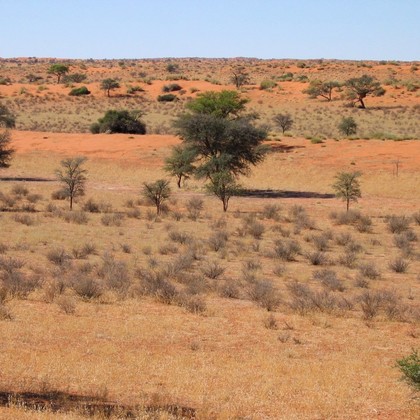
Dry, open woodland and scrub on deep sand: Kalahari woodland with silver cluster-leaf (Terminalia sericea), Burkea and low acacias, with tall grass and open patches between, also overgrown old fields. It forages low in the grass and beneath bushes, usually in pairs; outside the breeding season it is unobtrusive and shy.
Where the bird is most at home, classified by the vegetation units of southern Africa.

Range and movements
Within the region in northern and central Namibia (inland of the escarpment and east into the Kalahari), across much of Botswana except the far south-west, in western Zimbabwe (Matabeleland and Hwange), in northern South Africa (western Limpopo, North West and the north of the Northern Cape), in southern and central Angola and in western Zambia. Beyond the region north into the savannas of south-western DR Congo, Republic of the Congo and Gabon.
- Resident
- Summer visitor (c. Oct–Mar)
- Winter visitor (c. Apr–Sep)
- Passage (Mar–Apr, Oct–Nov)
- dark = core range, pale = thinly spread
How and when to look
Present all year; easiest in the rains (November–March), when males sing from bush tops. Good sites are the Waterberg Plateau in Namibia, Hwange NP and the Central Kalahari Game Reserve. Listen for the tinkling series, then look for a bird on a bush fanning its rufous tail. Outside the breeding season it flies off low when disturbed and drops into the grass; soft pishing sometimes brings it back to a lookout.
Conservation status
Not threatened. Common to fairly common in suitable woodland on sand and spread over a large range. Locally habitat is lost to conversion to farmland and to thickening of the shrub layer under overgrazing.
Scientific name
Cisticola rufilatus | (Hartlaub, 1870)
Hartlaub described the species in 1870 as Drymoica rufilata; because it was later moved to another genus, the author and year stand in brackets. The genus Cisticola was introduced in 1829 by Kaup. Cisticola combines the Ancient Greek kisthos 'rock-rose' with the Latin colere 'to dwell'. rufilatus comes from the Latin rufus, 'rufous', and latus, 'flank' — for the rusty tones on the flanks and tail. The specimen the first description was based on came from Damaraland, Namibia.