All species › Tubenoses › Southern storm petrels › Grey-Backed Storm Petrel
Grey-Backed Storm Petrel | Garrodia nereis
Grijsrugstormvogeltje | Paíño Dorsigrís
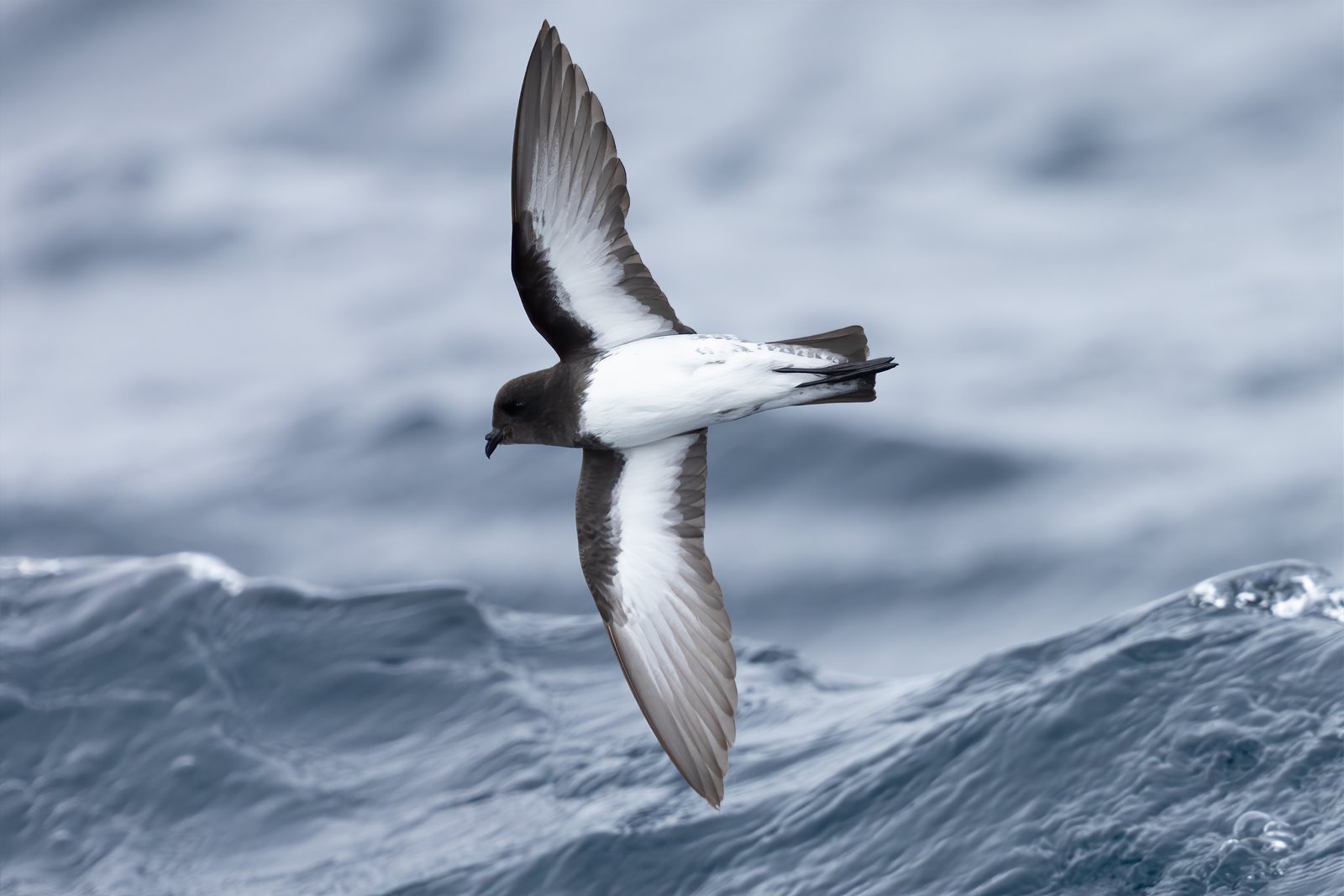
The Grey-Backed Storm Petrel is a small, compact storm petrel of the cold Southern Ocean and the only storm petrel with a grey rather than white rump. Within the region it breeds on the Prince Edward Islands; off the mainland coast it is a great rarity.
Voice
Silent at sea. In the breeding colony at night a high, insect-like squeaking or chirping from the burrows.
No recording with a suitable Creative Commons licence is available for this species yet.
Identification
About 17 cm. Head, neck and breast are black, the back is dark grey with pale feather edges, and the rump and uppertail coverts are clear ash-grey. The tail is grey with a broad black terminal band. The underparts from the breast down are white, sharply demarcated from the black breast. The upperwing is dark with grey coverts, the underwing white with a black leading edge and tip. The tail is square and the feet reach to or just beyond the tail tip. The sexes are alike. The flight is low and fast, weaving between the waves, with brief moments in which the bird hangs over the water with pattering feet.
Confusion species
Black-Bellied Storm Petrel (Fregetta tropica) and White-Bellied Storm Petrel (Fregetta grallaria) are larger and have a white rump. Prions such as Fairy Prion (Pachyptila turtur) are also grey with a black tail band, but much larger, with a grey rather than black head and a dark M-mark across the upperwings.
Habitat
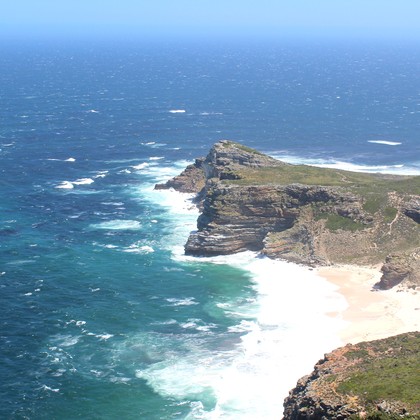
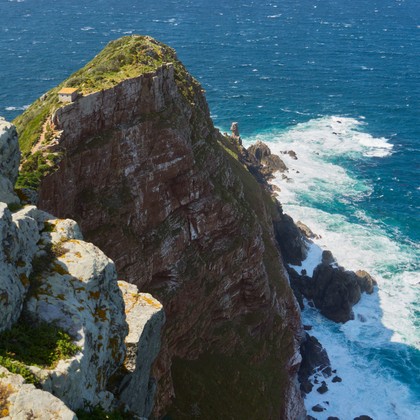
Cold subantarctic waters, especially around islands and over kelp beds. Feeds on small crustaceans, such as goose barnacle larvae, and fish larvae at the surface, often close to drifting kelp. Breeds in burrows and cavities under tussock grass clumps and in dense vegetation on subantarctic islands.
Where the bird is most at home, classified by the vegetation units of southern Africa.
Range and movements
Breeds on Marion and Prince Edward in the Prince Edward Islands. Off the mainland of South Africa and Namibia only a handful of records far offshore, after strong southerly gales. Elsewhere breeds circumpolarly on subantarctic islands, from the Falklands and South Georgia via Gough, Crozet and Kerguelen to the Chatham and Antipodes Islands, and stays in the cold waters of the Southern Ocean.
- Passage (Mar–Apr, Oct–Nov)
- dark = core range, pale = thinly spread
How and when to look
Almost only seen from the relief ships to Marion or on the island itself, where birds return to the colony at night. At sea it is an inconspicuous little bird that disappears low among the waves; watch for the grey rump and the black tail band.
Conservation status
Not threatened globally. On islands with introduced rats, mice and cats the species has declined sharply or disappeared; on Marion house mice, which attack chicks, are a threat. The eradication of cats on Marion has already helped the breeding birds.
Scientific name
Garrodia nereis | (Gould, 1841)
Gould described the species in 1841 as Thalassidroma Nereis; because it was later moved to another genus, the author and year stand in brackets. The genus Garrodia was introduced in 1881 by Forbes. Garrodia honours the English zoologist Alfred Henry Garrod (1846–1879), who studied the anatomy and relationships of birds. nereis refers to the Nereids, the sea nymphs of Greek mythology — fitting for this dainty bird that dances over the waves. The specimen the first description was based on came from Bass Strait, Australia.