All species › Tubenoses › Southern storm petrels › Wilson's Storm Petrel
Wilson's Storm Petrel | Oceanites oceanicus
Wilsons stormvogeltje | Paíño de Wilson
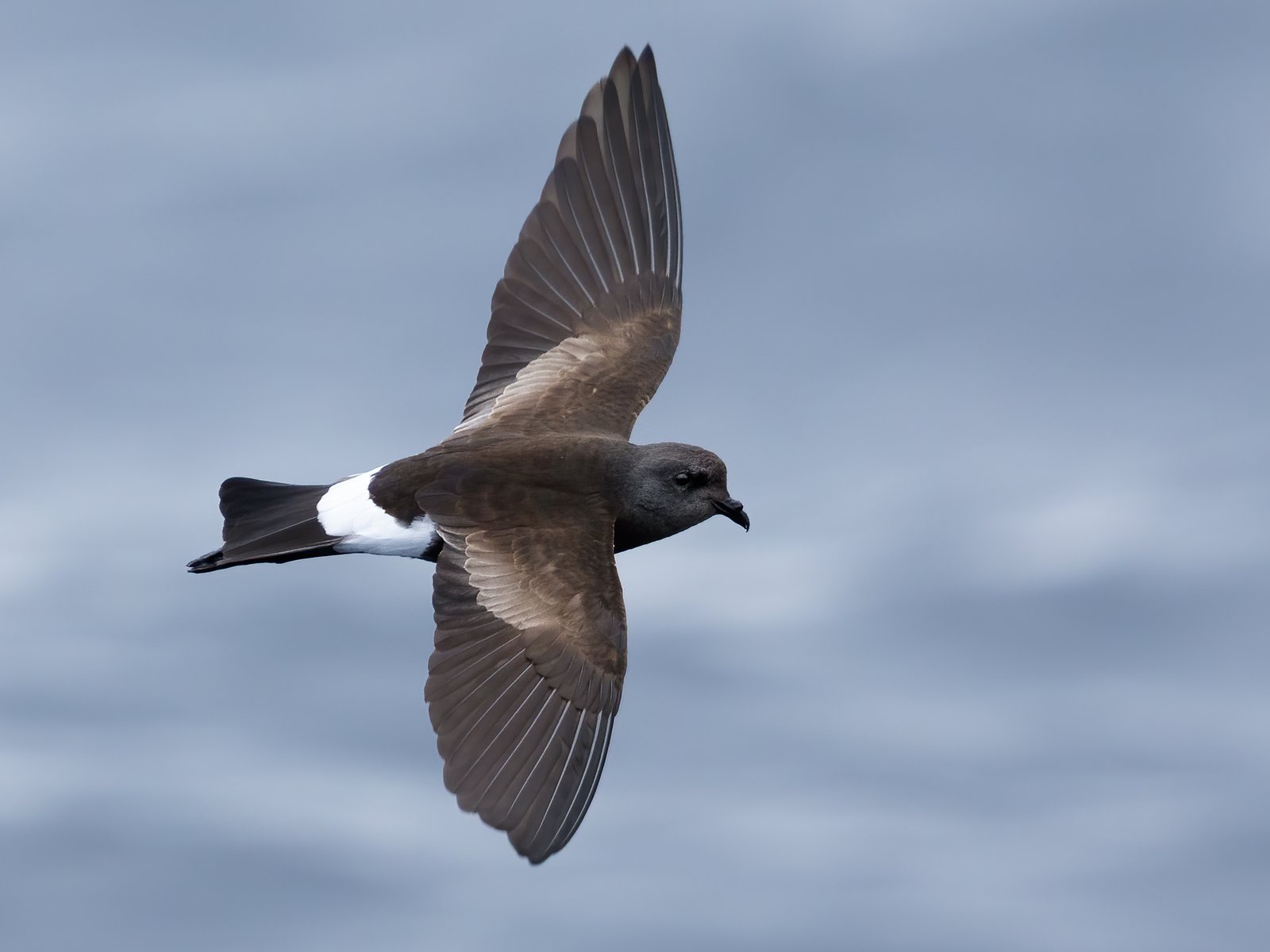
Wilson's Storm Petrel is the most numerous storm petrel in the waters around southern Africa and probably one of the most numerous birds in the world. It breeds on the coasts of Antarctica and subantarctic islands and after breeding crosses the equator far into the North Atlantic. Behind fishing boats it flutters over the sea with dangling legs, as if walking on the waves.
Voice
Usually silent at sea; feeding groups sometimes give a soft, rapid chatter, tsik-tsik-tsik. In the breeding colony a rasping churr comes from the burrows.
Recording: Fabrice Schmitt — CC BY-NC-SA 4.0 · converted to mono · xeno-canto
Identification
About 18 cm, blackish-brown with a broad, bright white rump that wraps around onto the sides of the undertail coverts. A pale grey-brown panel across the upperwing coverts shows well in flight. The wings are fairly short and rounded at the hand, with an almost straight trailing edge; the tail is square. The long legs project clearly beyond the tail tip, and the webs have yellow centres visible only at close range. The sexes are alike. The flight is direct and fairly straight, on shallow wingbeats with short glides; when feeding the bird hangs over one spot with raised wings and pattering feet.
Confusion species
European Storm Petrel (Hydrobates pelagicus) is smaller, has a white stripe on the underwing, no feet beyond the tail and a more fluttering, bat-like flight. Leach's Storm Petrel (Hydrobates leucorhous) has a forked tail, longer angled wings, a narrower rump often divided in the centre and an erratic, tern-like flight. Band-Rumped Storm Petrel (Hydrobates castro) has a narrower white rump that extends less onto the undertail, shorter legs and a flight with more gliding.
Habitat
Open sea over the continental shelf and slope, especially in the cold, productive Benguela Current and along upwelling fronts. Gathers in groups around fishing boats, trawlers and slicks of fish offal. Picks small crustaceans, fish larvae and oil droplets from the surface. Breeds in rock crevices and burrows on Antarctic coasts and islands.
Where the bird is most at home, classified by the vegetation units of southern Africa.
Range and movements
At sea off the entire coast of the region, most numerous off Namibia and the west and south coasts of South Africa, in smaller numbers off Angola and along the east coast to Mozambique. A passage migrant around the Prince Edward Islands. Breeds on the Antarctic Peninsula, along the Antarctic coast and on subantarctic islands, and in the austral winter migrates into all oceans far into the northern hemisphere.
- Resident
- Summer visitor (c. Oct–Mar)
- Winter visitor (c. Apr–Sep)
- Passage (Mar–Apr, Oct–Nov)
- dark = core range, pale = thinly spread
How and when to look
On a pelagic trip from Cape Town or Simon's Town to the trawlers at the shelf edge the species is almost guaranteed, often dozens at a time in the wake. Rarely seen from land, at most after strong north-westerly gales in Table Bay or at Cape Point. Watch for the feet pattering on the water and the white rump flashing on and off like a small light.
Conservation status
Not threatened; the world population runs to many millions of pairs. Rats and other introduced predators on breeding islands, and ship lighting that attracts birds at night, are local threats. Changes in krill abundance in the Southern Ocean may have consequences in the longer term.
Scientific name
Oceanites oceanicus | (Kuhl, 1820)
Kuhl described the species in 1820 as Procellaria oceanica; because it was later moved to another genus, the author and year stand in brackets. The genus Oceanites was introduced in 1840 by Keyserling & Blasius. Oceanites is Greek, Ōkeanitēs: an Oceanid, one of the sea nymphs held to be daughters of Oceanus and Tethys. oceanicus is Latin for 'of the ocean', after its life on the open sea. The specimen the first description was based on came from South Georgia.