All species › Passerines › Bushshrikes › Grey-Headed Bushshrike
Grey-Headed Bushshrike | Malaconotus blanchoti
Spookklauwier | Gladiador Cabecigrís
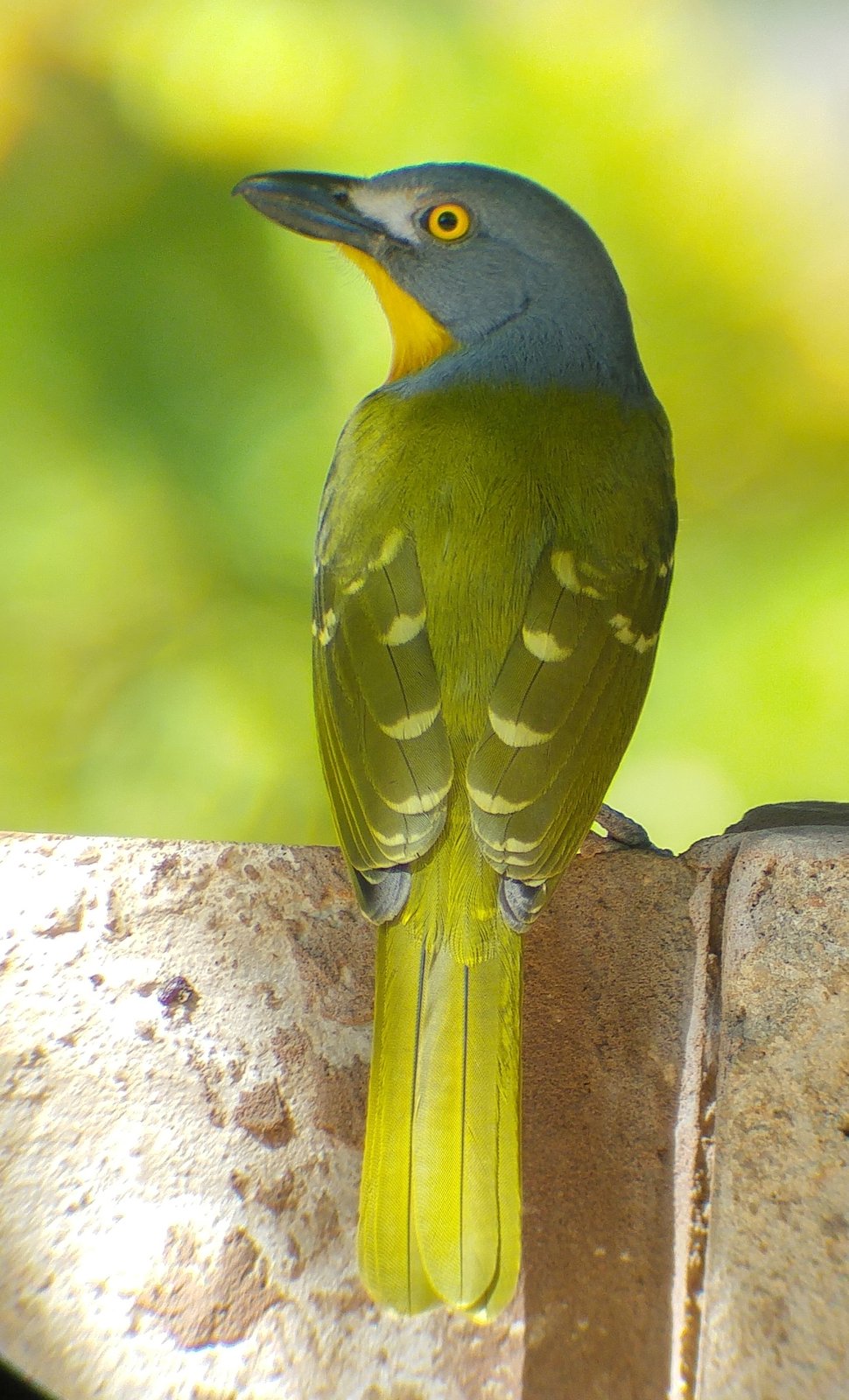
The Grey-Headed Bushshrike is the largest bushshrike of the region: a heavy green-and-yellow bird with a massive grey head, a huge hooked bill and a yellow eye. Its drawn-out, mournful whistle from a dense tree crown earned it the Afrikaans name spookvoël, the ghost bird.
Voice
A drawn-out, mournful, swelling whistle, hoooooooo or oooooo-p, lasting over a second and often repeated from cover. Also loud clicks, bill-snapping and a rasping chrrt when alarmed.
Recording: Marc Languy — CC BY-NC-SA 4.0 · converted to mono · xeno-canto
Identification
25–27 cm. The head and neck are blue-grey, with a white loral spot and a bright yellow eye. The bill is black, very heavy and strongly hooked. The back, wings and tail are olive-green, with yellow spots on the tips of the tertials and greater coverts. The underparts are bright yellow, with an orange wash on the breast that can vary considerably. The sexes are alike. Juveniles have a paler, grey-brown head, a horn-coloured bill and a dark eye. It moves slowly and deliberately through the canopy.
Confusion species
Orange-Breasted Bushshrike Chlorophoneus sulfureopectus is much smaller, with a yellow forehead band and supercilium and a finer bill. Olive Bushshrike Chlorophoneus olivaceus of the eastern forests is smaller and has a black mask or a plain olive head. Gorgeous Bushshrike Telophorus viridis has a red throat with a black breast band. In western Angola, Monteiro’s Bushshrike Malaconotus monteiri is larger, with a grey eye and more white around the eye.
Habitat
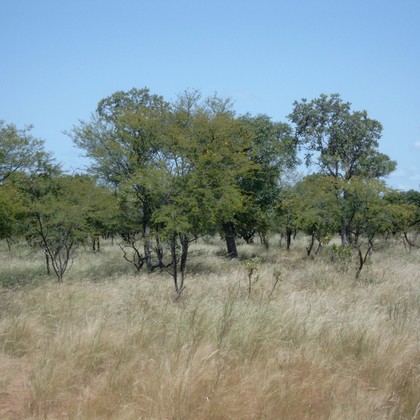
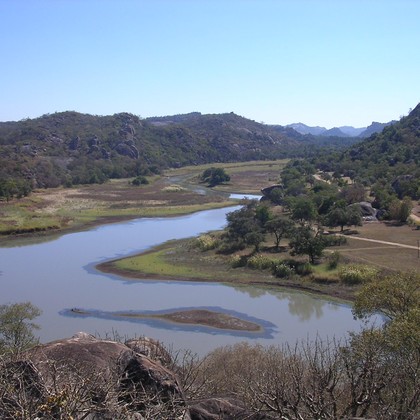
Riverine forest and dense woodland with tall trees: acacia savanna and thornveld, mixed woodland, miombo and the edges of dry forest, as well as large gardens with old trees. It hunts from the canopy for large insects, lizards, chameleons, frogs and the nestlings of other birds.
Where the bird is most at home, classified by the vegetation units of southern Africa.

Range and movements
Widespread in the north and east of the region: Angola, Zambia, Malawi, Mozambique, Zimbabwe, northern and eastern Botswana and north-eastern Namibia, and in South Africa from Limpopo and Mpumalanga through KwaZulu-Natal to the Eastern Cape; also in Eswatini. Absent from the arid west, the Karoo, Lesotho and the Western Cape. Beyond the region it occurs over much of sub-Saharan Africa, from Senegal to Ethiopia and Somalia.
- Resident
- Summer visitor (c. Oct–Mar)
- Winter visitor (c. Apr–Sep)
- Passage (Mar–Apr, Oct–Nov)
- dark = core range, pale = thinly spread
How and when to look
Year-round. The ghostly whistle is the best clue; it carries far but is hard to pinpoint. Search patiently in dense tree crowns along rivers and in tall acacias, where the bird sits still for long spells and then moves on with a few hops. It is easiest to see in the dry season, when the trees are barer.
Conservation status
Not threatened; fairly common but inconspicuous because of its secretive habits. It has declined locally through the felling of riverine forest and large trees. No large-scale threats are known.
Scientific name
Malaconotus blanchoti | Stephens, 1826
Stephens described the species in 1826 and placed it straight away in the genus where it still stands. The genus Malaconotus was introduced in 1824 by Swainson. Malaconotus comes from the Greek malakos, 'soft', and nōtos, 'back' — for the dense, soft feathers of the back and rump. blanchoti honours Colonel François Michel Émile Blanchot de Verly (1735–1807), French Army officer and Governor of Senegal 1787–1807. The specimen the first description was based on came from Senegal.