All species › Passerines › Bushshrikes › Monteiro's Bushshrike
Monteiro's Bushshrike | Malaconotus monteiri
Monteiro's klauwier | Gladiador de Monteiro
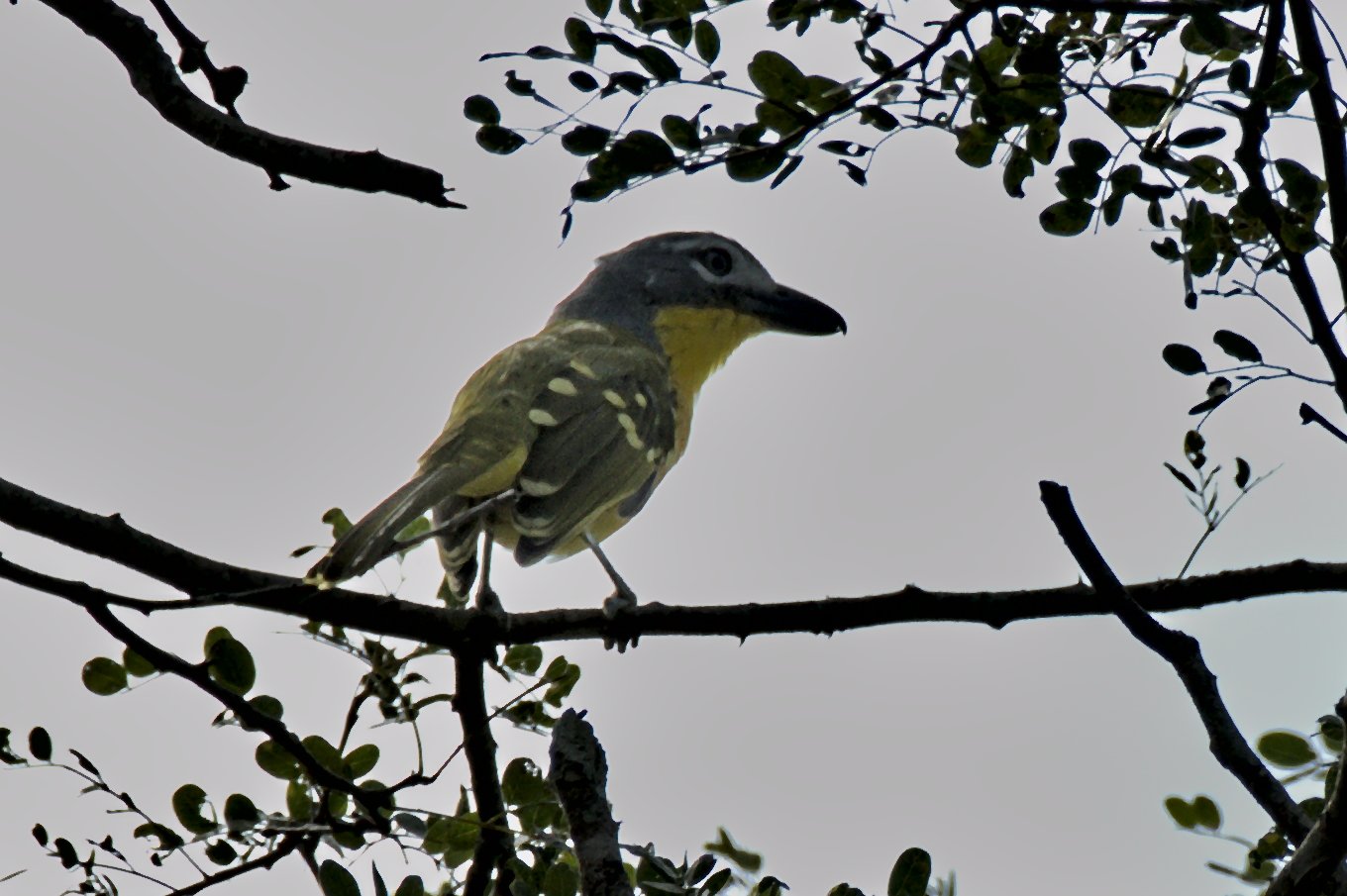
Monteiro’s Bushshrike is a large, heavily built bushshrike that in the region occurs only in the forests of western Angola. It closely resembles Grey-Headed Bushshrike, but lives in forest rather than savanna and has a grey eye and more white on the face. It is one of the sought-after species of the Angolan escarpment.
Voice
A low, drawn-out, mournful whistle, hoooooo, similar to that of Grey-Headed Bushshrike, interspersed with loud clicks, bill-snapping and rasping notes.
Recording: Niall Perrins — CC BY-NC-SA 4.0 · converted to mono · xeno-canto
Identification
About 25–27 cm. The head is large and grey, with a white patch running from the lores to above and below the eye, so that the eye is framed in white. The eye is grey, the bill black, massive and strongly hooked. The back, wings and tail are olive-green, with yellow spots on the wing. The underparts are yellow, with at most a faint orange wash on the breast. The sexes are alike. It moves slowly and deliberately through the middle and upper levels of the canopy.
Confusion species
Grey-Headed Bushshrike Malaconotus blanchoti is slightly smaller, has a yellow eye, a white patch confined to the lores and usually a more obviously orange breast; it lives in savanna and open woodland. Many-Colored Bushshrike Chlorophoneus multicolor and Orange-Breasted Bushshrike Chlorophoneus sulfureopectus are much smaller and more finely built.
Habitat
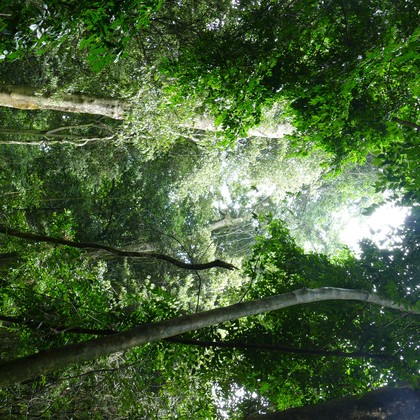
Montane forest, gallery forest and the edges of moist forest on the escarpment, as well as old shade-coffee plantations with tall trees. It forages methodically in the middle and upper canopy for large insects and small vertebrates.
Where the bird is most at home, classified by the vegetation units of southern Africa.

Range and movements
In the region only in western Angola, in the forests of the escarpment zone, mainly in Cuanza Sul (including around Gabela and Kumbira). Beyond the region only in south-western Cameroon, around Mount Cameroon and the Bakossi Mountains.
- Resident
- dark = core range, pale = thinly spread
How and when to look
Year-round. Best found in the forests around Gabela and Kumbira in Cuanza Sul, preferably with a local guide. Listen early in the morning for the low whistle and then search the canopy patiently; the bird often sits still for long periods.
Conservation status
Near Threatened. Its habitat in Angola is shrinking through forest clearance for agriculture and charcoal and the conversion of old shade coffee to fields. The species is little studied and the population is small and fragmented.
Scientific name
Malaconotus monteiri | (Sharpe, 1870)
Sharpe described the species in 1870 as Laniarius monteiri; because it was later moved to another genus, the author and year stand in brackets. The genus Malaconotus was introduced in 1824 by Swainson. Malaconotus comes from the Greek malakos, 'soft', and nōtos, 'back' — for the dense, soft feathers of the back and rump. monteiri honours the Portuguese mining engineer and naturalist Joachim John Monteiro (1833–1878), who collected in Angola. The specimen the first description was based on came from Donde River, Luanda province, Angola.