All species › Passerines › Bushshrikes › Marsh Tchagra
Marsh Tchagra | Bocagia minuta
Kleine tsjagra | Chagra Marismeña
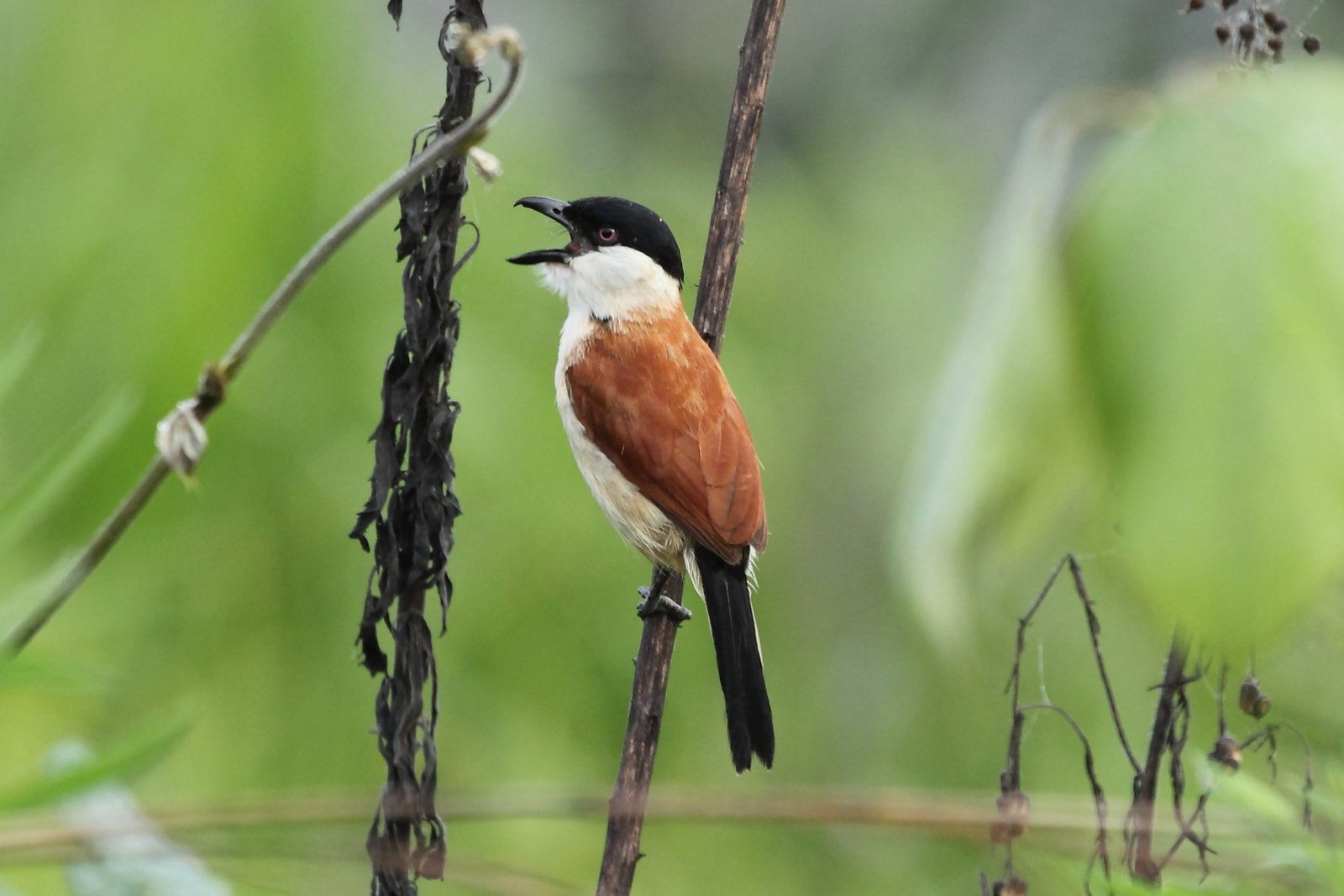
The Marsh Tchagra is a tchagra of wet grassland and vleis, warm rufous-brown with a black cap and a red eye. In the region it is scarce and local, and it reveals itself mainly in its display flight above tall grass.
Voice
In display flight the male rises above the grass on rattling wings and gives a series of clear whistled notes, chew-chew-chew or twee-oo-twee-oo. Also rasping and chattering calls from cover, sometimes in duet.
Recording: Brian Cox — CC BY-NC-SA 3.0 · converted to mono · xeno-canto
Identification
17–18 cm. The crown is black; in the southern form anchietae the black extends onto the nape and upper mantle. The back is warm rufous-brown and the wing bright cinnamon-rufous. The underparts are warm buff-brown, paler on the throat. The tail is blackish with pale tips. The eye is red and the bill black, heavy and slightly hooked. The female often shows a narrow pale supercilium below the black crown. Juveniles have a browner crown and a horn-coloured bill. It keeps low and hidden in dense grass and reeds.
Confusion species
Black-Crowned Tchagra Tchagra senegalus is larger and greyer, with a broad white supercilium and a black eye-stripe, and lives in drier woodland. Brown-Crowned Tchagra Tchagra australis has a brown crown, a white supercilium and greyish underparts. Neither has the plain rufous-brown back with a black cap.
Habitat
Tall rank grass, sedges, bracken and scrub in vleis, marsh margins and damp hollows, as well as overgrown plantation edges and abandoned fields; in Zimbabwe mainly in the highlands. It forages on or just above the ground for insects, especially grasshoppers and beetles.
Where the bird is most at home, classified by the vegetation units of southern Africa.


Range and movements
In the region local in the highlands of central Angola, in northern and western Zambia and in Malawi, and at the southern edge of its range scarce in the Eastern Highlands of Zimbabwe and adjacent central Mozambique. Beyond the region it occurs over much of tropical Africa, from West Africa to Ethiopia, Kenya and Tanzania.
- Resident
- dark = core range, pale = thinly spread
How and when to look
Year-round, but best in the rainy season (November–March), when males display above vleis and wet grassland. Search early in the morning along the edges of overgrown vleis and wait for a bird to pop up briefly above the grass.
Conservation status
Not threatened and widespread in tropical Africa, but scarce and local at the southern edge of its range. Drainage and burning of vleis, overgrazing and conversion to fields and plantations are local threats.
Scientific name
Bocagia minuta | (Hartlaub, 1858)
Hartlaub described the species in 1858 as Telephonus minutus; because it was later moved to another genus, the author and year stand in brackets. The genus Bocagia was introduced in 1894 by Shelley. Bocagia honours the Portuguese zoologist José Vicente Barbosa du Bocage (1823–1907), an authority on the fauna of Angola. minuta is Latin for 'small' — it is the smallest tchagra. The specimen the first description was based on came from Ashanti, Ghana (uncertain).