All species › Passerines › Penduline tits › Grey Penduline Tit
Grey Penduline Tit | Anthoscopus caroli
Acaciakapokmees | Pájaro-moscón Africano
At 8 centimetres the Grey Penduline Tit is one of Africa's smallest birds: a grey ball with a short, sharply pointed bill that moves in parties of three to eight through the outer twigs of the woodland. Its most remarkable feature is the nest, a thick felted bag of plant down with a false entrance.

Voice
Very high, thin contact notes, tsee-tsee or tseet, exchanged constantly by members of the party and above the hearing range of many observers. The song is a rapid repetition of a high, rather sharp phrase, chee-wee-chee-wee, and a sharp trill.
Recording: James Bradley — CC BY-NC-SA 4.0 · converted to mono · xeno-canto
Identification
8–9 cm. Upperparts plain grey, sometimes with a greenish or olive tinge; forehead and lores pale, with no black marking on the head at all. Throat and breast dirty white to pale grey; belly, flanks and undertail coverts warm buff to ochre-brown, the intensity varying by subspecies. Wings and tail grey-brown with pale edges. The bill is short, pointed and dark; the tail is short. The sexes are alike. It moves restlessly, often hanging from twig tips and leaves like a miniature tit.
Confusion species
Cape Penduline Tit Anthoscopus minutus has a black forehead speckled white, a black eyestripe and a yellowish belly; the two barely overlap, as Cape Penduline Tit lives in dry scrub and the Karoo in the south-west. Yellow-Bellied Eremomela Eremomela icteropygialis is longer-tailed, with a dark eyestripe and a yellow lower belly. Long-Billed Crombec Sylvietta rufescens has a curved bill, almost no tail and rufous underparts. In northern Angola Tit Hylia Pholidornis rushiae is even smaller, streaked on head and breast and tied to forest. Grey Penduline Tit is quickest identified by the plain grey head, buff belly and behaviour in small parties.
Habitat
Broadleaf and open woodland, especially miombo and other broadleaved woodland, but also mixed acacia savanna and the edges of riverine forest. It forages in the canopy and outer twigs for small insects, spiders and larvae. The nest of plant down and cobweb hangs from the tip of a branch; above the true, closable entrance is a blind pocket that serves as a false entrance.
Where the bird is most at home, classified by the vegetation units of southern Africa.
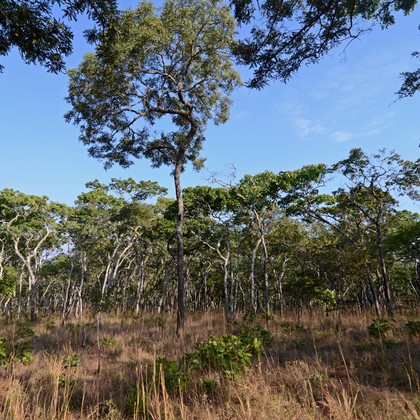

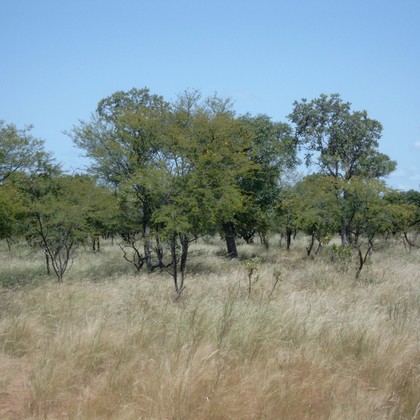
Range and movements
Within the region in Angola (except the coastal desert), Zambia, Malawi, Mozambique, Zimbabwe, northern and eastern Botswana, north-eastern Namibia (Kavango and Zambezi Region), north-eastern South Africa (Limpopo, Mpumalanga and northern KwaZulu-Natal) and Eswatini. Beyond, north through southern DR Congo and Tanzania to Rwanda, Uganda and Kenya.
- Resident
- Summer visitor (c. Oct–Mar)
- Winter visitor (c. Apr–Sep)
- Passage (Mar–Apr, Oct–Nov)
- dark = core range, pale = thinly spread
How and when to look
Year-round; most often seen in mixed bird parties moving through miombo in the dry season. Listen for the very high notes and look for a group of tiny birds in the outer twigs. A nest found is unmistakable; keep your distance and watch the bird pinch the true entrance shut with its bill.
Conservation status
Not threatened; widespread and locally fairly common, but easily overlooked because of its small size and high voice. Large-scale clearance of miombo for charcoal and farming does remove habitat.
Scientific name
Anthoscopus caroli | (Sharpe, 1871)
Sharpe described the species in 1871 as Aegithalus caroli; because it was later moved to another genus, the author and year stand in brackets. The genus Anthoscopus was introduced in 1851 by Cabanis. Anthoscopus comes from the Greek anthos, 'flower, blossom', and skopos, 'searcher' — for these tiny tits searching blossoms and foliage for insects. caroli honours the Swedish explorer Karl Johan (Charles John) Andersson (1827–1867), who travelled in south-west Africa; Carolus is the Latin form of Charles. The specimen the first description was based on came from Ovaquenyama, Damaraland, Namibia.