All species › Passerines › Penduline tits › Cape Penduline Tit
Cape Penduline Tit | Anthoscopus minutus
Kaapse kapokmees | Pájaro-moscón del Cabo
Cape Penduline Tit is the dry, south-western counterpart of Grey Penduline Tit: a tiny bird with a black-speckled forehead and a yellowish belly that moves in family parties through Karoo bushes, fynbos and thornveld. It builds the felted hanging nest with a false entrance typical of its genus.

Voice
Very high, thin contact notes, tsip or tseep-tseep, and a rapid, sibilant trill. The song consists of repeated high notes, tsee-tsee-tsee or cheep-cheep, sometimes interspersed with soft twittering.
Recording: Lynette Rudman — CC BY-NC-SA 4.0 · converted to mono · xeno-canto
Identification
9–10 cm. Forehead black with fine white speckling, a narrow black eyestripe and a white throat. Crown and back grey with an olive tinge, wings and tail darker grey. Breast pale yellow, belly and flanks brighter lemon to buffy yellow. The bill is short, pointed and blackish. The sexes are alike; juveniles largely lack the black head marking. Small, round and short-tailed; forages restlessly among the outer twigs of bushes and small trees.
Confusion species
Grey Penduline Tit Anthoscopus caroli of the north and east lacks the black forehead and eyestripe and has a buff rather than yellow belly. Yellow-Bellied Eremomela Eremomela icteropygialis is longer and longer-tailed, with a grey breast and yellow only on the lower belly. Karoo Eremomela Eremomela gregalis is larger, greener above and has a pale iris. Orange River White-Eye Zosterops pallidus has an obvious white eye-ring and no black on the head. Besides plumage, note the behaviour in small parties and the very high voice.
Habitat
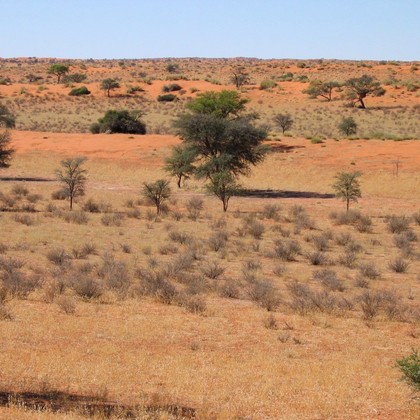
Dry shrubland: Nama and Succulent Karoo, fynbos and renosterveld, dry Kalahari thornveld, bushes along dry watercourses and scrub on the highveld. It forages for small insects and spiders in bushes and low acacias. The nest often hangs in a thorn bush or acacia; this species too has a blind false entrance above the true one.
Where the bird is most at home, classified by the vegetation units of southern Africa.


Range and movements
Almost endemic to southern Africa: in South Africa in the Western, Northern and Eastern Cape, the Free State, North West and the western highveld; also western Lesotho, southern and western Botswana, almost all of Namibia except the north-east, and south-western Angola. Locally into south-western Zimbabwe.
- Resident
- Summer visitor (c. Oct–Mar)
- Winter visitor (c. Apr–Sep)
- Passage (Mar–Apr, Oct–Nov)
- dark = core range, pale = thinly spread
How and when to look
Year-round. In Karoo scrub or fynbos, listen for the thin notes of a party and then search the outer parts of the bushes. The species is less shy than it is small; parties often allow close views. Namaqualand and the western Karoo are good areas.
Conservation status
Not threatened; widespread and locally common. Its tiny size and high voice mean it is often missed. No large-scale threats are known.
Scientific name
Anthoscopus minutus | (Shaw, 1812)
Shaw described the species in 1812 as Sylvia minuta; because it was later moved to another genus, the author and year stand in brackets. The genus Anthoscopus was introduced in 1851 by Cabanis. Anthoscopus comes from the Greek anthos, 'flower, blossom', and skopos, 'searcher' — for these tiny tits searching blossoms and foliage for insects. minutus is Latin for 'very small' — for the tiny size of this penduline tit. The specimen the first description was based on came from Heerenlogement, Western Cape, South Africa.