All species › Passerines › Starlings › Violet-Backed Starling
Violet-Backed Starling | Cinnyricinclus leucogaster
Amethistspreeuw | Estornino Amatista
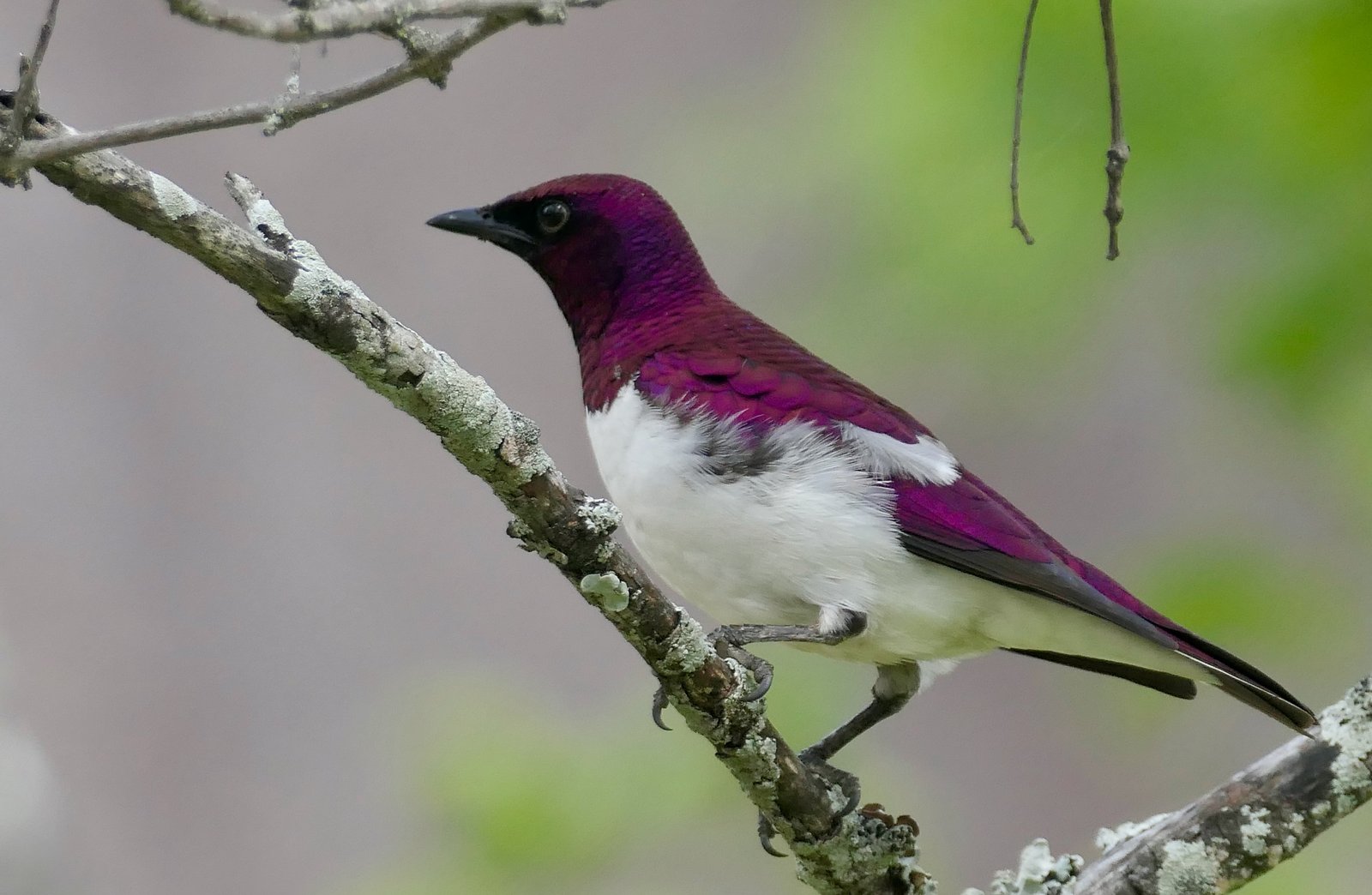
The Violet-Backed Starling is a small starling with a striking difference between the sexes: the male is glossy violet above and on the breast, like a gemstone, while the female is brown with heavily streaked white underparts, like a small thrush. In the region it is a summer visitor to broadleaved woodland that arrives to breed in the rains.
Click a thumbnail to switch the photo above.
Voice
Not very vocal. A soft, thin tsip or tip-tip as a contact call, and a short song of a few clear, chattering and whistled notes, tsip-tsip-tseeoo-tseeoo, repeated quickly.
Recording: David C. Moyer — CC BY-NC-SA 4.0 · shortened to the first 60 s, mono · xeno-canto
Identification
16–18 cm. The male has head, upperparts, throat and upper breast glossy metallic violet, varying with the light from amethyst to purple-blue or coppery; belly, flanks and undertail-coverts are bright white, sharply demarcated from the violet breast. The female is brown above with rufous feather edges and has white to pale buff underparts with dense, dark brown teardrop streaks. In both sexes the eye is yellow and the bill black and short. Juveniles resemble the female; young males gradually acquire violet patches.
Confusion species
The male is unmistakable in the region; other glossy starlings are blue-green and lack a white belly. The female resembles a small thrush such as Groundscraper Thrush Turdus litsitsirupa or Kurrichane Thrush Turdus libonyana, but usually sits high in a tree, has a shorter black bill, a yellow eye, no face pattern and a starling's posture.
Habitat
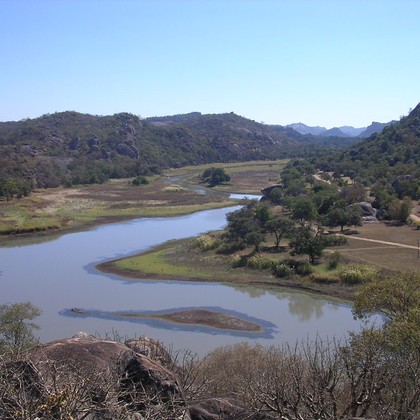
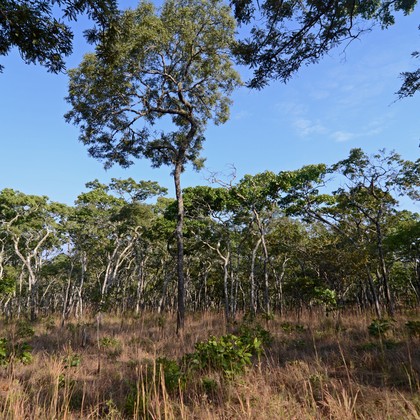
Open broadleaved woodland, miombo, mixed woodland, riverine forest and forest edges, also gardens with fruiting trees. It feeds mainly on fruit, such as figs and the fruits of Lannea and Ekebergia, and on insects, often caught in flight. It breeds in natural tree holes or old woodpecker holes, the nest lined with fresh leaves and dung.
Where the bird is most at home, classified by the vegetation units of southern Africa.

Range and movements
In the region in the north and east: Angola, Zambia, Malawi, Mozambique, Zimbabwe, northern Botswana and Namibia, and in South Africa in Limpopo, Mpumalanga, eastern North West, Eswatini and KwaZulu-Natal, with a few birds south into the Eastern Cape. It arrives in October and leaves in April; partly present all year in the north of the region. Beyond the region throughout almost all of sub-Saharan Africa and in south-western Arabia.
- Resident
- Summer visitor (c. Oct–Mar)
- Winter visitor (c. Apr–Sep)
- Passage (Mar–Apr, Oct–Nov)
- dark = core range, pale = thinly spread
How and when to look
October to April, best at fruiting figs and other trees in woodland, where pairs and small groups feed. The male only sparkles in sunlight; in shade it looks black with a white belly. Check the eye of every streaked 'thrush' high in a tree: a yellow eye means a female Violet-backed.
Conservation status
Not threatened and widespread. For breeding it depends on tree holes in mature woodland, so the felling of old trees can be locally harmful.
Scientific name
Cinnyricinclus leucogaster | (Boddaert, 1783)
Boddaert described the species in 1783 as Turdus leucogaster; because it was later moved to another genus, the author and year stand in brackets. The genus Cinnyricinclus was introduced in 1840 by Lesson. Cinnyricinclus combines Cinnyris, the sunbird genus, with the New Latin cinclus, 'thrush' — a 'sunbird-thrush', presumably for the male's iridescent plumage. leucogaster comes from the Greek leukos, 'white', and gastēr, 'belly' — for the white belly contrasting sharply with the male's violet upperparts. The specimen the first description was based on came from no locality given; later fixed as Ouidah, Benin.