All species › Passerines › Thrushes › Groundscraper Thrush
Groundscraper Thrush | Turdus litsitsirupa
Acacialijster | Zorzal Litsitsirupa
The Groundscraper Thrush is a robust, upright thrush of open savanna and woodland, with a white face striped with black and a heavily spotted breast. It runs across bare ground in short sprints and frequently raises one wing, a gesture that gives it away from afar.

Voice
The song is a loud, fast, clear series of varied whistled phrases, often from a high branch, especially early in the breeding season (August–November). The call is a dry chuk-chuk; the name litsitsirupa is an onomatopoeic Setswana word. The alarm is a high, rapid rattle.
Recording: Marna Buys — CC BY-NC-SA 4.0 · converted to mono · xeno-canto
Identification
21–23 cm. Upperparts plain grey-brown; underparts white to pale cream with large, round black spots on breast, flanks and belly. The white face has a vertical black bar through the eye, a black bar behind the ear coverts and a black malar stripe. The bill is dark with a yellow base to the lower mandible. In flight the rufous inner webs of the flight feathers show as a warm wing panel. The sexes are alike. Stands noticeably upright, runs a short distance, stops, and often briefly lifts one wing.
Confusion species
Dusky Lark (Pinarocorys nigricans), a migrant from the north that appears in the same woodland in summer, has a similarly spotted breast and face pattern and a habit of flicking its wings, but has pale bill and legs, a darker back with pale fringes and no rufous in the wing, and walks with a typically horizontal, lark-like gait. Spotted Ground Thrush (Geokichla guttata) is smaller, has white wing bars and lives hidden on the forest floor. Kurrichane Thrush (Turdus libonyana) has an orange bill, orange flanks and an unspotted breast.
Habitat
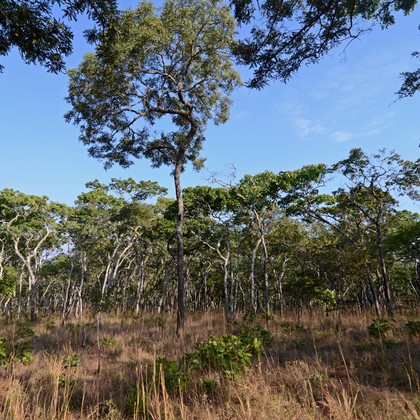
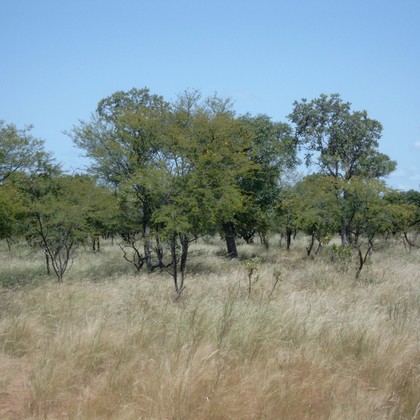
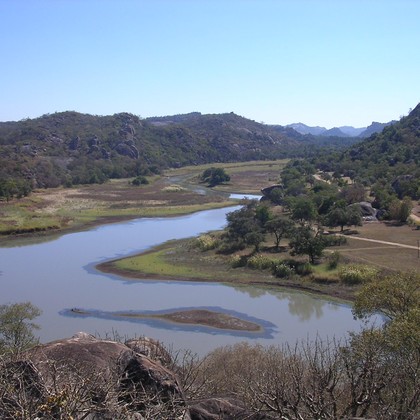
Open miombo, mopane, acacia savanna and mixed woodland with bare or closely grazed ground, and also in parks, camps, golf courses and around farmsteads. Forages on the ground for termites, ants, beetles and other insects, often on burnt or freshly grazed patches. The nest is a cup in a tree fork, often decorated with cobweb and lichen.
Where the bird is most at home, classified by the vegetation units of southern Africa.
Range and movements
Widespread in the northern part of the region: most of Angola, Zambia, Malawi (mainly centre and south), Zimbabwe, northern and eastern Botswana, northern and central Namibia, western and central Mozambique, and in South Africa in Limpopo, Mpumalanga, Gauteng, North West and northern KwaZulu-Natal, and Eswatini. Absent from the Cape provinces, Lesotho and the arid south-west. Beyond, north to Tanzania; a separate subspecies in the highlands of Ethiopia and Eritrea.
- Resident
- Summer visitor (c. Oct–Mar)
- Winter visitor (c. Apr–Sep)
- Passage (Mar–Apr, Oct–Nov)
- dark = core range, pale = thinly spread
How and when to look
In the dry season, when the grass is short and burnt, it is often seen along the roads in Kruger, Hwange or South Luangwa. Look for an upright bird that keeps lifting one wing. In summer it pays to check bill and wing on every “spotted thrush”, because Dusky Lark is then in the same habitat.
Conservation status
Not threatened. Common and widespread with a stable population. It benefits locally from grazing and open ground around settlements, but disappears where woodland is cleared entirely.
Scientific name
Turdus litsitsirupa | (Smith, 1836)
Smith described the species in 1836 as Merula litsitsirupa; because it was later moved to another genus, the author and year stand in brackets. The genus Turdus was introduced in 1758 by Linnaeus. Turdus is the ordinary Latin word for 'thrush'. litsitsirupa is a Tswana name for this bird, imitating its call. The specimen the first description was based on came from between the Orange River and the Tropic of Capricorn, South Africa.