All species › Passerines › Cisticolas › Hartert's Camaroptera
Hartert's Camaroptera | Camaroptera harterti
Harterts camaroptera | Camaróptera de Hartert
Hartert's Camaroptera is a small, short-tailed warbler of scrub and forest edges on the escarpment of north-western Angola. It was long treated as a subspecies of Bleating Camaroptera and is now recognised as a separate species by most lists. It is one of the Angolan endemics of the region.
Voice
Similar to Bleating Camaroptera: a nasal, plaintive bleat, mbeeh, and a loud, rapidly repeated series of clicking notes, chik-chik-chik, from dense scrub.
Recording: Paulina Meller — CC BY-NC-SA 4.0 · converted to mono · xeno-canto
Identification
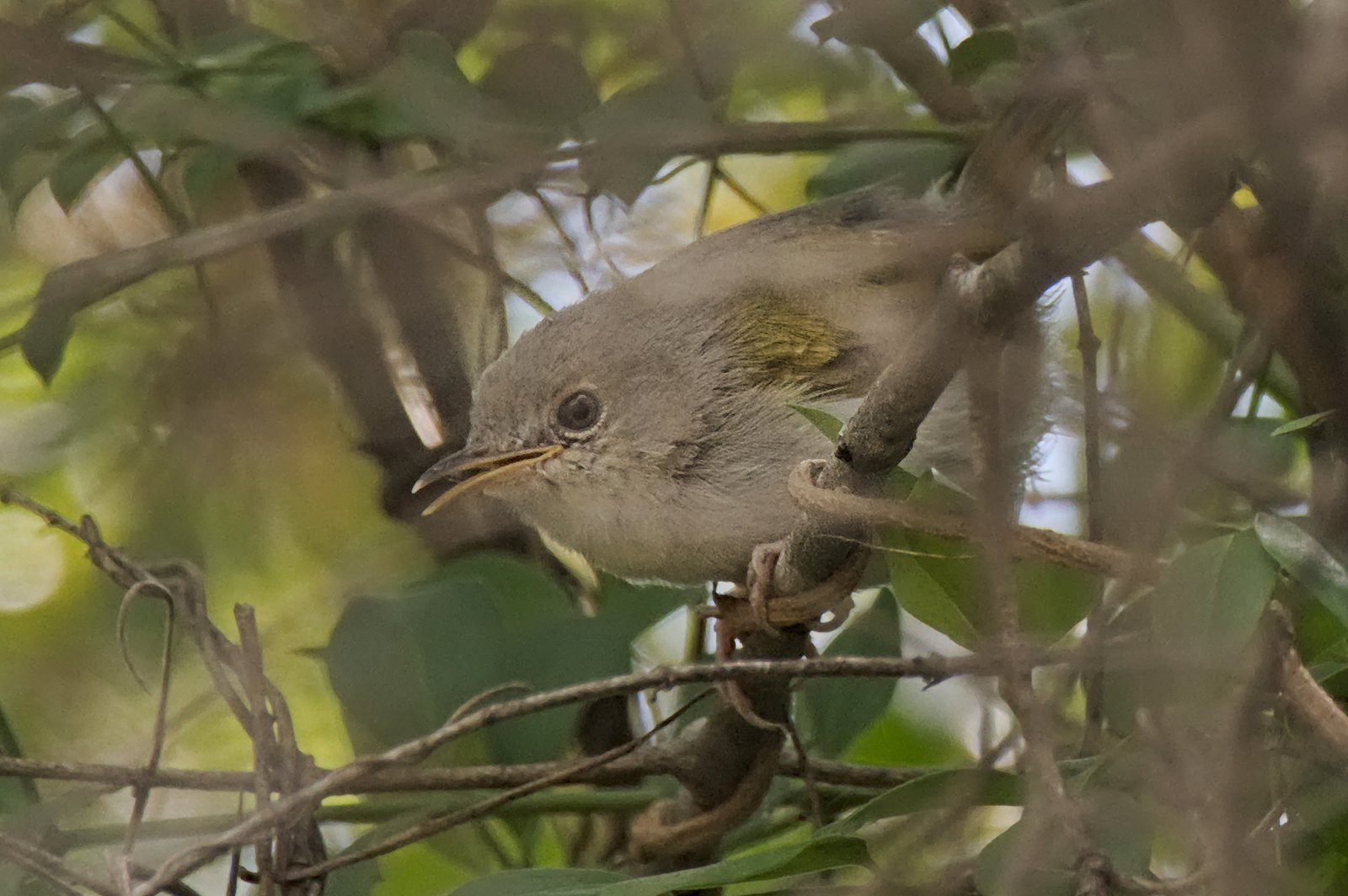
10–11 cm, compact, with a short, often cocked tail. The upperparts, including the wings, are olive-green, head and nape greyer; the underparts are off-white with a grey wash on breast and flanks. The iris is pale brown, the bill dark, the legs pink. The sexes are alike. In structure and behaviour it closely resembles the green-backed form of Bleating Camaroptera; certainty comes mainly from range and habitat.
Confusion species
Bleating Camaroptera Camaroptera brachyura occurs in the Angolan interior in grey-backed forms, with grey back and tail and only the wings green; Hartert's Camaroptera is green on the back as well. Yellow-Browed Camaroptera Camaroptera superciliaris of the lowland forests in the north has a striking yellow supercilium, a grey face and a very short tail. White-Chinned Prinia Schistolais leucopogon is dark grey with a long tail.
Habitat
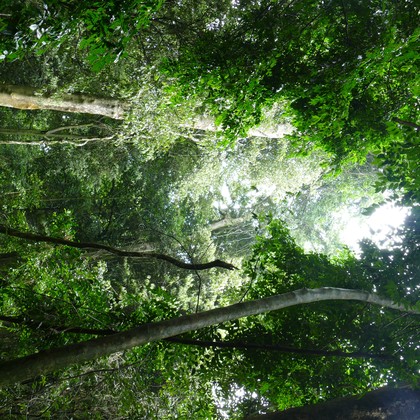
Undergrowth, rank growth and dense scrub in moist forest and at forest edges, in gallery forest, in overgrown coffee plantations under shade trees and in secondary growth on the slopes of the escarpment. It lives low in the scrub and on the ground.
Where the bird is most at home, classified by the vegetation units of southern Africa.

Range and movements
Endemic to Angola: the escarpment and adjacent lowlands in the north-west, from Cuanza Norte (including Canhoca, the type locality) and Bengo south through Cuanza Sul to about 12° S. It does not occur outside Angola.
- Resident
- dark = core range, pale = thinly spread
How and when to look
Year-round; the escarpment forests at Kumbira and around Kalandula and Cuanza Norte are the best places, and there it is fairly common in the undergrowth. The bleat gives it away; check for the green back to separate it from grey-backed Bleating Camaropteras in the area.
Conservation status
Not threatened according to the IUCN, despite its small range. However, the escarpment forests of Angola are being heavily degraded by logging, charcoal production and farming; because the species also lives in secondary growth and overgrown coffee plantations, it is less vulnerable than the true forest endemics of the escarpment.
Scientific name
Camaroptera harterti | Zedlitz, 1911
Zedlitz described the species in 1911 and placed it straight away in the genus where it still stands. The genus Camaroptera was introduced in 1850 by Sundevall. Camaroptera comes from the Greek kamara, 'arch, vault', and pteron, 'wing' — for the short, strongly rounded wings. harterti honours the German ornithologist Ernst Hartert (1859–1933), for many years curator of Walter Rothschild's museum at Tring. The specimen the first description was based on came from Canhoca, northern Angola.