All species › Gamebirds › Pheasants and partridges › Hildebrandt's Spurfowl
Hildebrandt's Spurfowl | Pternistis hildebrandti
Hildebrandts frankolijn | Francolín de Hildebrandt
Hildebrandt's Spurfowl is an East African species that within the region occurs only in Malawi and the far north-east of Zambia. The sexes differ clearly: the male is spotted black and white, the female plain rufous below.

Voice
A loud, harsh, grating kerak-kerak-kerak, often accelerating and given as a duet or chorus, mainly at dawn and in the evening. Also a soft cackling within the group.
Recording: Stein Ø. Nilsen — CC BY-NC-SA 4.0 · shortened to the first 60 s, mono · xeno-canto
Identification
About 35 cm. The male has grey-brown, finely vermiculated upperparts and white underparts with large black drop- to arrow-shaped spots on the breast and flanks; the head and neck are finely streaked black and white. The female has similar upperparts but plain rufous-orange-brown underparts. Both sexes have an orange-red bill and red legs; bare skin is absent or limited to a small dull patch behind the eye. The male is spurred.
Confusion species
The Natal Spurfowl, further south, has scaled rather than spotted underparts and a female that resembles the male; the two barely overlap within the region. The Red-Necked Spurfowl has a bare red throat and eye-ring. The Scaly Spurfowl of forest is plain dark brown with an orange-red bill and no white pattern. The Crested Francolin has a white supercilium.
Habitat
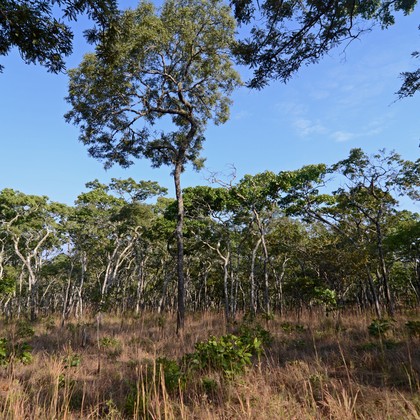
Wooded rocky hills, slopes with dense scrub and grass tufts, the edges of miombo and thicket on steep slopes, up to above 2,000 m. It forages on the ground in pairs or small groups for seeds, bulbs, tubers, berries and insects.
Where the bird is most at home, classified by the vegetation units of southern Africa.

Range and movements
Within the region in the highlands and hills of Malawi, from north to south (for example around Dedza, Zomba and the Viphya), and in the far north-east of Zambia. Beyond the region in Tanzania, Kenya and south-eastern DR Congo.
- Resident
- dark = core range, pale = thinly spread
How and when to look
In Malawi, search wooded rocky slopes, for instance around Dzalanyama and Dedza or on the Zomba Plateau. Listen for calling birds at dawn and wait at the edge of a clearing; the birds then come briefly into the open grass to feed.
Conservation status
Not threatened. In Malawi its habitat is under pressure from cutting for firewood and charcoal, the spread of cultivation onto slopes and snaring, but enough habitat remains on rocky ground that is hard to farm.
Scientific name
Pternistis hildebrandti | (Cabanis, 1878)
Cabanis described the species in 1878 as Francolinus (Scleroptera) Hildebrandti; because it was later moved to another genus, the author and year stand in brackets. The genus Pternistis was introduced in 1832 by Wagler. Pternistis comes from Greek pternistēs 'one who strikes with the heel', from pterna 'heel', after the spurs on the legs. hildebrandti honours the German botanist and collector Johann Maria Hildebrandt (1847–1881), who travelled in East Africa. The specimen the first description was based on came from Voi, Taita (Kenya).