All species › Gamebirds › Pheasants and partridges › Natal Spurfowl
Natal Spurfowl | Pternistis natalensis
Natalfrankolijn | Francolín de Natal
The Natal Spurfowl is the common spurfowl of the eastern bushveld, from KwaZulu-Natal to Zimbabwe. It lives in dense thicket along rivers and dry watercourses and gives itself away mainly by its high, strident call at first light.
Voice
A high, strident, rapidly accelerating kik-kik-kik-kerrr-kik, often in chorus from several birds, at dawn and dusk. A sharp, repeated kek-kek when disturbed.
Recording: JJSUN — CC BY-NC-SA 4.0 · converted to mono · xeno-canto
Identification
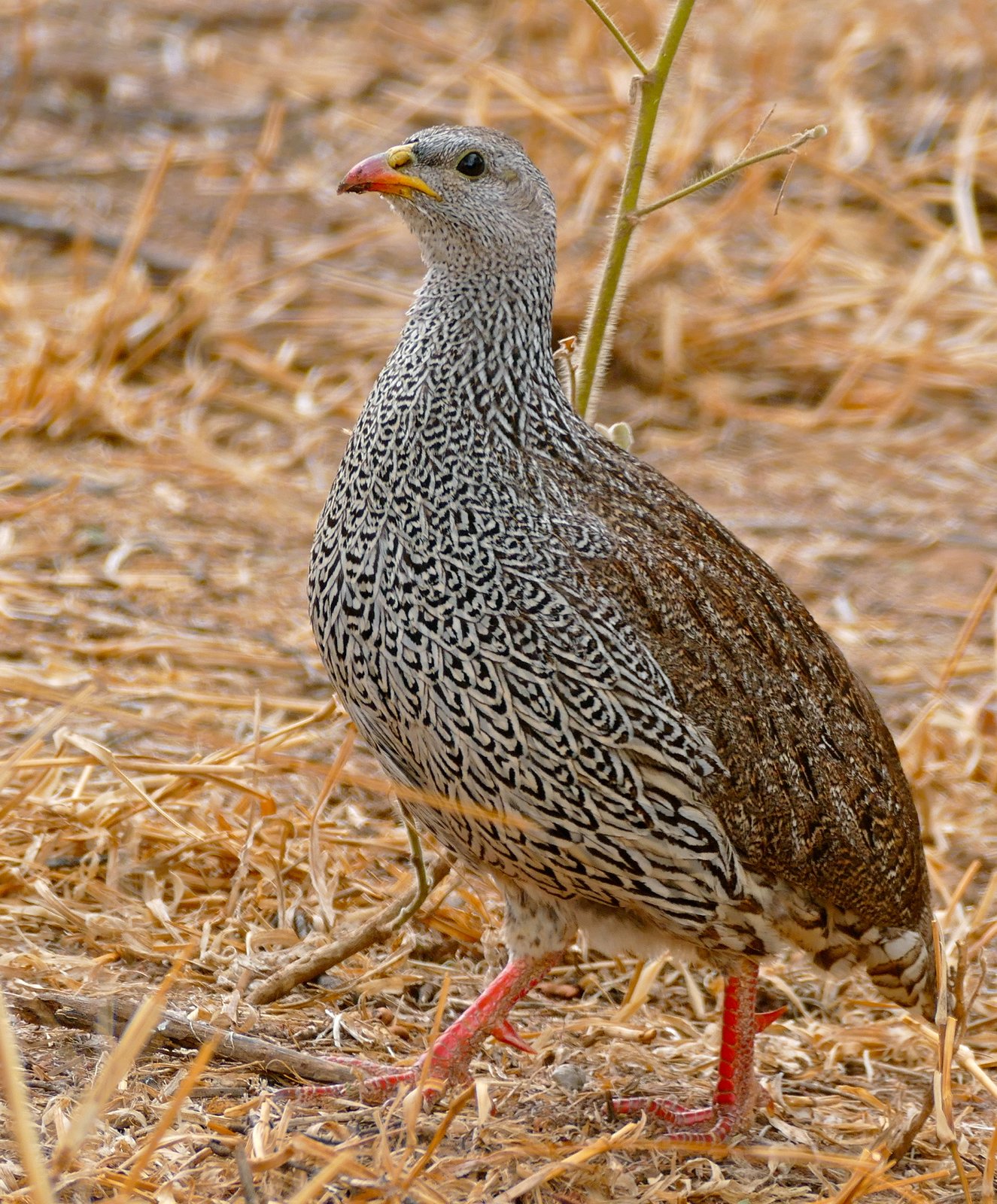
About 35 cm. The upperparts are brown with fine black vermiculation; the underparts are white with black feather edges, so the breast and belly look boldly scaled black and white. The head and neck are finely speckled black and white. The bill is orange-red with a yellow base and the legs are orange-red; there is no bare skin around the eye or on the throat. The sexes are alike, the male spurred. Juveniles are browner, with less distinct scaling.
Confusion species
The Red-Billed Spurfowl, in the west, has a bare yellow eye-ring and finely barred, not scaled, underparts. The Red-Necked Spurfowl and Swainson's Spurfowl have a bare red throat. Hildebrandt's Spurfowl, further north, looks very similar but the female has plain rufous underparts; the two barely overlap. The Crested Francolin has a white supercilium and walks with a cocked tail.
Habitat
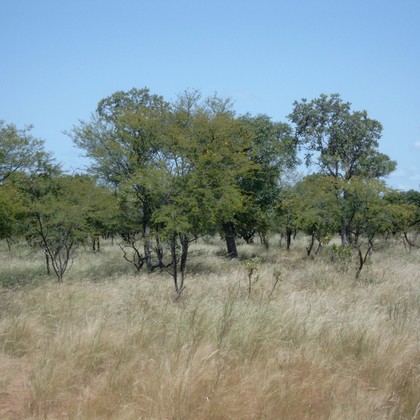
Dense thicket and riverine woodland along rivers and dry watercourses, bushveld with undergrowth, wooded rocky hills, forest edges and field margins with cover. It forages in pairs or small groups on the ground for seeds, berries, bulbs, tubers, figs and insects, and drinks daily.
Where the bird is most at home, classified by the vegetation units of southern Africa.


Range and movements
In the east of the region: KwaZulu-Natal, Mpumalanga, Limpopo, Gauteng and North West in South Africa, Eswatini, southern and central Mozambique, almost all of Zimbabwe, eastern Botswana and southern Zambia (the Zambezi and Luangwa valleys). Not found beyond the region.
- Resident
- Winter visitor (c. Apr–Sep)
- dark = core range, pale = thinly spread
How and when to look
Common in the Kruger National Park, especially around rest camps and picnic sites along rivers, where birds come onto the road at dawn. Also easy at Hluhluwe-iMfolozi, Mapungubwe and in the Matobo Hills. Listen for the chorus at first light and then scan the edges of the thicket.
Conservation status
Not threatened and common. The species tolerates some disturbance and also lives in mixed farmland with cover. It is hunted as a gamebird; locally, clearance of riverine vegetation causes habitat loss.
Scientific name
Pternistis natalensis | (Smith, 1833)
Smith described the species in 1833 as Francolinus Natalensis; because it was later moved to another genus, the author and year stand in brackets. The genus Pternistis was introduced in 1832 by Wagler. Pternistis comes from Greek pternistēs 'one who strikes with the heel', from pterna 'heel', after the spurs on the legs. natalensis means 'from Natal', the region (now KwaZulu-Natal) the type material came from. The specimen the first description was based on came from Durban, KwaZulu-Natal.