All species › Passerines › Waxbills › Jameson's Firefinch
Jameson's Firefinch | Lagonosticta rhodopareia
Roze amarant | Amaranta de Jameson
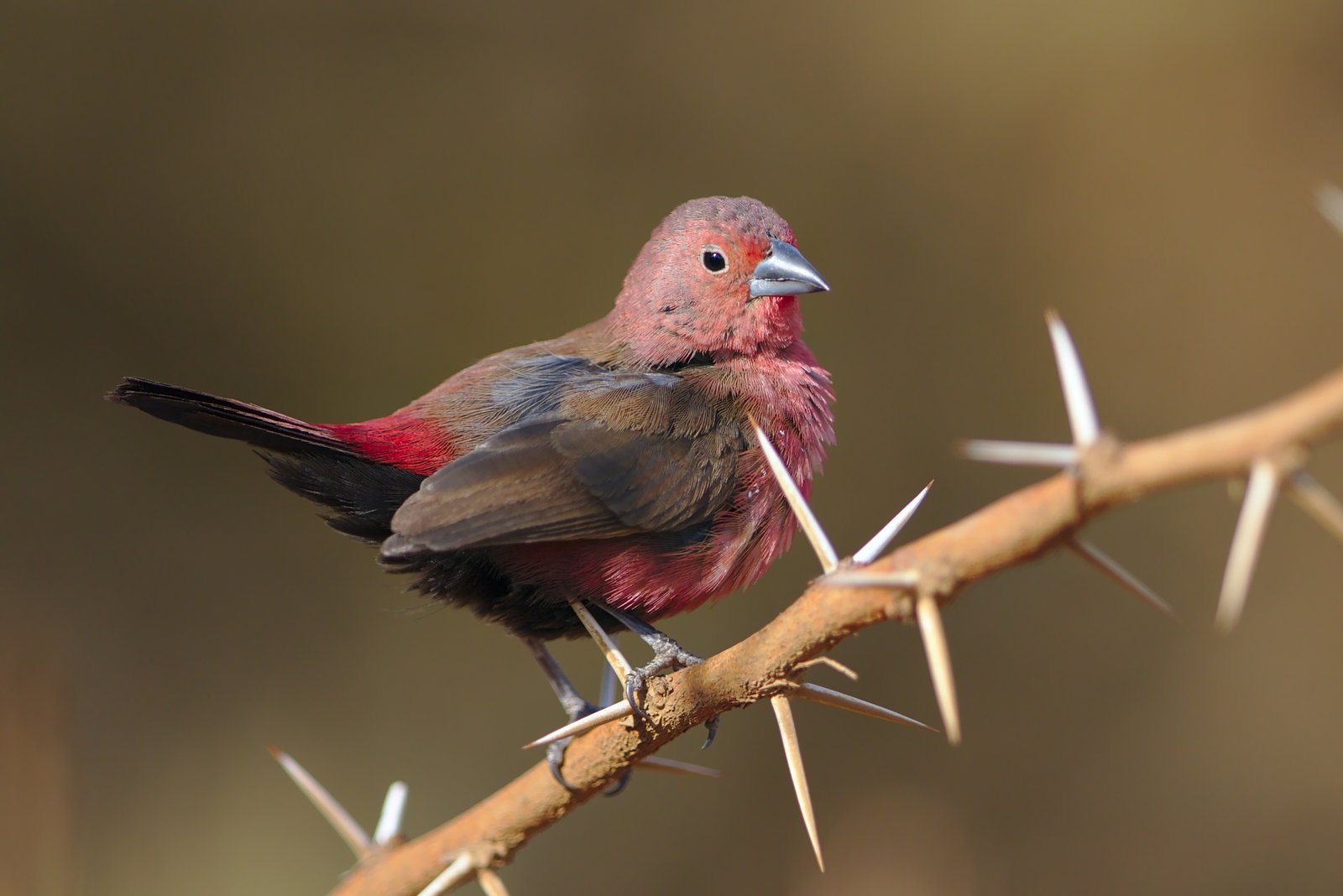
Jameson's Firefinch is the firefinch of dry, open thornveld: a pinkish-red bird that searches for grass seeds under bushes in pairs. It closely resembles African Firefinch but is paler and pinker and lives in a drier setting.
Click a thumbnail to switch the photo above.
Voice
A fast, tinkling trill, trrrrrrt, in alarm, and a repeated clear tcheet or vit-vit as contact call. The song is a soft twitter with whistled notes, usually from within a bush.
Recording: Ehren Eksteen — CC BY-NC-SA 4.0 · converted to mono · xeno-canto
Identification
10 to 11 cm. The male is rosy-red below with a few small white spots on the breast sides; the rear belly is blackish and the undertail coverts are black. Crown, nape and back are grey-brown with a distinct pink wash, so that the whole bird looks rosy; rump and uppertail coverts are red, the tail black. The bill is blue-grey with a dark tip, the eye-ring pale grey and inconspicuous. The female is paler, salmon-pink to orange-pink below, with red lores. Juveniles are brown with a red rump and no spots.
Confusion species
African Firefinch (Lagonosticta rubricata) is a deeper crimson with a pure brown back and lives in dense, moist tangles and forest edges. Red-Billed Firefinch (Lagonosticta senegala) has a pinkish-red bill, a yellow eye-ring and pale brown undertail coverts; the female is brown with only red lores. Brown Firefinch (Lagonosticta nitidula) is largely brown with a brown rump. Check back colour, bill colour and the colour of the undertail coverts.
Habitat
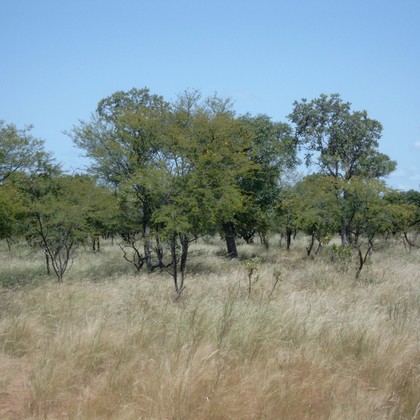
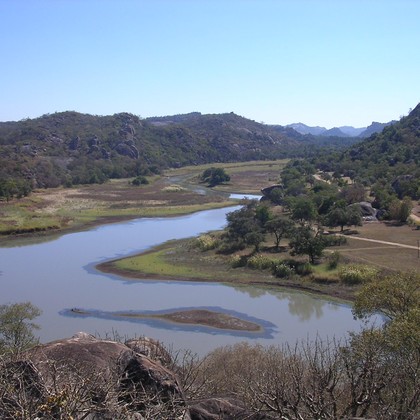
Dry, open savanna and thornveld with tall grass and bushes, the edges of mopane and mixed woodland, rocky hills with scrub and abandoned fields. It forages on the ground in pairs or small groups, often with other waxbills. It is the host of Purple Indigobird (Vidua purpurascens), which lays its eggs in its nest.
Where the bird is most at home, classified by the vegetation units of southern Africa.
Range and movements
Within the region in Angola, Zambia, Malawi, Mozambique, Zimbabwe, northern and eastern Botswana, northern Namibia, Eswatini and north-eastern South Africa (Limpopo, Mpumalanga and northern KwaZulu-Natal). Beyond the region patchily in East Africa, from Tanzania and Kenya to Ethiopia and South Sudan.
- Resident
- Summer visitor (c. Oct–Mar)
- Winter visitor (c. Apr–Sep)
- Passage (Mar–Apr, Oct–Nov)
- dark = core range, pale = thinly spread
How and when to look
In the Kruger National Park and the Zimbabwean Lowveld search roadsides with tall grass and thorn bushes early in the morning, when pairs forage on the ground. When confused with African Firefinch, habitat and the rosy back settle it. A singing Purple Indigobird nearby often betrays that Jameson's Firefinches are breeding.
Conservation status
Not threatened. Fairly common but often inconspicuous in dry savanna. There is no evidence of a significant decline; overgrazing of the grass layer may locally reduce food and cover.
Scientific name
Lagonosticta rhodopareia | (Heuglin, 1868)
Heuglin described the species in 1868 as E[strelda] rhodopareia; because it was later moved to another genus, the author and year stand in brackets. The genus Lagonosticta was introduced in 1851 by Cabanis. Lagonosticta comes from the Greek lagōn, 'flank', and stiktos, 'spotted' — for the white spots on the flanks of firefinches. rhodopareia comes from the Greek rhodon, 'rose', and pareia, 'cheek' — for the pink head and cheeks. The specimen the first description was based on came from Keren, Eritrea.