All species › Passerines › Larks › Karoo Lark
Karoo Lark | Calendulauda albescens
Karooleeuwerik | Alondra del Karoo
The Karoo Lark is a sturdy, heavily streaked lark of the Succulent Karoo and the strandveld of the west coast. It is endemic to South Africa and one of the species that draw birders to Namaqualand and the West Coast. The colour of the upperparts varies greatly and matches the soil: from dark rufous-brown to pale grey-brown.

Voice
A short, loud song, chip-chip-chrrrrr, in which a few separate notes run into a fast, rattling trill, delivered from a bush top or in a short song flight in which the male flutters up and descends again. Call: a dry cheep.
Recording: Walter Wallner — CC BY-NC-SA 4.0 · shortened to the first 60 s, mono · xeno-canto
Identification
17–18 cm. Upperparts rufous-brown to grey-brown with broad dark streaking on the crown and back. A long white supercilium, a dark eye-stripe, a white cheek with a dark border and a dark moustachial stripe give the head a strongly patterned look. White below with heavy dark streaks on the breast and flanks. The bill is fairly long and slightly decurved. It runs quickly between the shrublets and sings from a bush top.
Confusion species
Barlow's Lark Calendulauda barlowi, north of Port Nolloth and in southern Namibia, is paler, with fewer and finer streaks on the breast; hybrids occur in the contact zone. Red Lark Calendulauda burra of the red dunes of Bushmanland is larger, with a heavier bill and a plainer rufous back. Dune Lark Calendulauda erythrochlamys of the Namib is plain sandy above and barely streaked below. Cape Long-Billed Lark Certhilauda curvirostris is larger, with a much longer, decurved bill.
Habitat
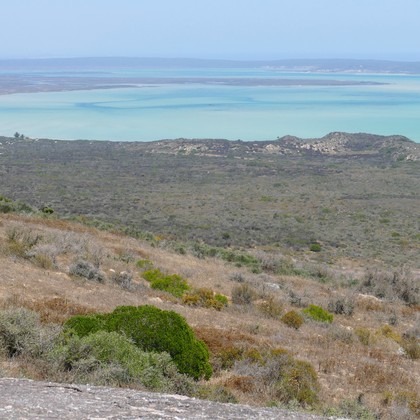
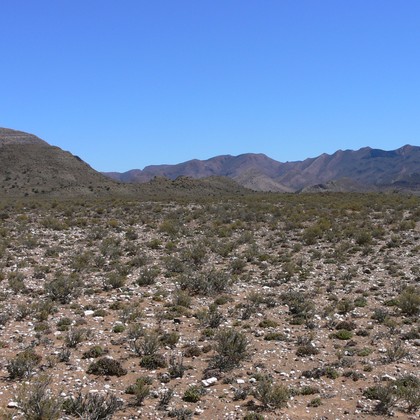
Open, low scrub of succulent dwarf shrubs in the Succulent Karoo, strandveld and coastal fynbos on sand along the west coast, and the western edge of the Nama Karoo. It avoids bare gravel plains without shrubs and forages on the ground among the shrublets for insects and seeds.
Where the bird is most at home, classified by the vegetation units of southern Africa.

Range and movements
Endemic to South Africa: the Western Cape along the west coast (from West Coast National Park northwards), Namaqualand, the Knersvlakte and the Tankwa Karoo, the Northern Cape to about Port Nolloth, and the western Karoo into the west of the Eastern Cape. North of Port Nolloth and in southern Namibia it is replaced by Barlow's Lark.
- Resident
- Summer visitor (c. Oct–Mar)
- Winter visitor (c. Apr–Sep)
- Passage (Mar–Apr, Oct–Nov)
- dark = core range, pale = thinly spread
How and when to look
Year-round; best after the winter rains (August–October), when males sing from bush tops. Good sites are West Coast National Park, the Lambert's Bay area and the Tankwa Karoo. The heavy breast streaking and the rattling song separate it from the other larks in the scrub.
Conservation status
Not threatened; fairly common in suitable habitat. Overgrazing, cultivation of strandveld and mining along the west coast degrade its habitat locally.
Scientific name
Calendulauda albescens | (de Lafresnaye, 1839)
De Lafresnaye described the species in 1839 as Alauda albescens; because it was later moved to another genus, the author and year stand in brackets. The genus Calendulauda was introduced in 1855 by Blyth. Calendulauda is a combination of two other lark names: Calendula and Alauda, the Latin word for 'lark'. albescens is Latin for 'whitish', from albus, 'white' — for the pale underparts and supercilium. The specimen the first description was based on came from Blauwberg, South Africa.